How to Ventilate a Room With One Window (No Cross Breeze)
To ventilate a room with one window, face a box fan out, crack the door for intake, and flush 10 to 20 minutes, or about 5 in winter. See the full routine.
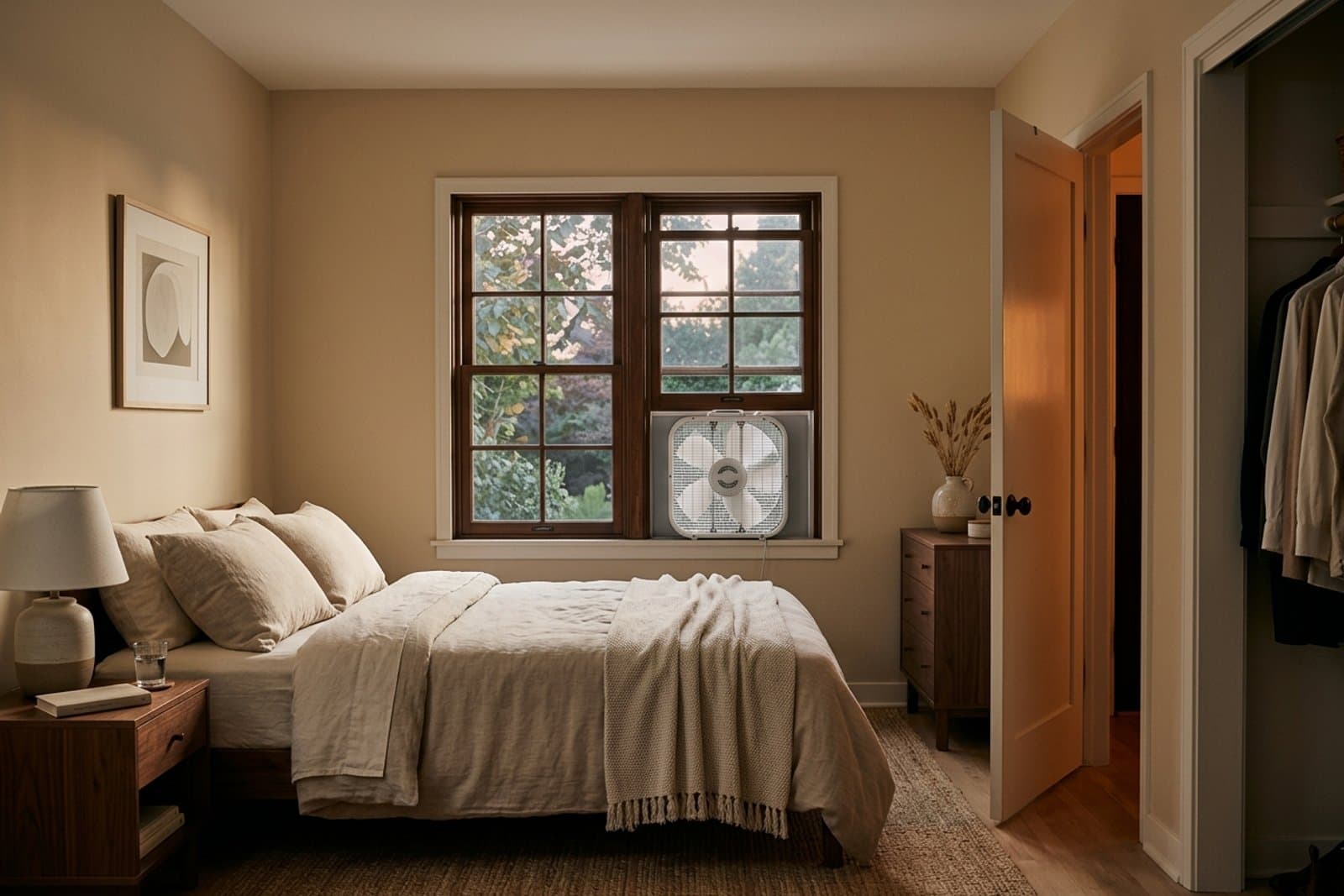
To ventilate a room with one window, make the window the exhaust and give fresh air another way in. Face a box fan outward in the window, crack the interior door, and use a window or exhaust fan elsewhere in the home as the intake. Flush 10 to 20 minutes in warm weather and about 5 minutes in winter, as Germany's Federal Environment Agency recommends.
With no second opening, the air still changes, only slowly. Clear the floor in front of the window and repeat short flushes instead of leaving the window open all day.
This guide is for renters and homeowners with a bedroom, office, studio corner, or guest room that has exactly one operable window. If the room has no operable window at all, use how to ventilate a room without windows instead, because the method there starts at the doorway rather than the sash. If heat is the bigger issue, start with cooling a room with one window or cooling a top floor apartment. Now that the heat is on, two winter problems show up in one window rooms: windows that are wet in the morning and air that feels stuffy.
Can you ventilate a room with only one window?
Yes, but a single window needs help. The same opening has to let air out and let air in, so the exchange stays weak near the glass while the far side of the room goes stale. Give the window one job, exhaust, and let the door, the hallway, or another room supply the incoming air.
Building designers have a rule of thumb for this. UK natural ventilation guidance, including the Essex Design Guide, says a room ventilated from one side should be no deeper than 2.5 times its ceiling height, while a room with openings on two sides can be up to 5 times as deep. Under an 8 foot ceiling, that is roughly 20 feet for one window and 40 feet for two. Most bedrooms fall inside the shorter limit, but only when nothing blocks the air on its way across.

Use this quick room check before setting up:
| Check | What you want | Why it matters |
|---|---|---|
| Window area | Floor and sill clear | Air needs space to reach the fan |
| Door | Open at least a few inches | Replacement air needs an entry route |
| Fan | Facing outward for a flush | Stale air should leave first |
| Timing | Cooler, cleaner outdoor air | Hot or smoky air outside makes the room worse |
Air does not take turns
In commercial projects, airflow is engineered. In homes, it is improvised. I have spent twenty five years on both sides of that line, and the single biggest mistake I see in one window rooms is treating the window as both the inlet and the outlet. Air needs a path with two ends, which is why the door gap matters more here than the fan you buy.
When I plan a small room, I decide where air enters and where it leaves before I place a single piece of furniture. A stack of boxes in front of a window kills a room's air the same way it kills its light.
Can I use a fan in the window to ventilate a room?
Yes. Put a box fan in the window facing outward when the goal is ventilation. That turns the single window into an exhaust point, so stale air, warm air, and odor leave the room instead of circling around your bed, desk, or sofa. A 20 inch box fan fills more of a standard window opening than a small desk fan.
The Lasko B20200 is a common example: a 20 inch, 3 speed box fan that Lasko sells with a weather resistant motor for use in a window, either to bring in fresh air or to exhaust stale air.
Do not point the fan inward for a ventilation flush unless outdoor air is clearly cooler and you have a separate exit elsewhere. Inward airflow can feel nice on skin, but it often pushes stale room air into corners. The U.S. Department of Energy reminds people that fans cool people, not rooms, so use inward airflow for comfort and outward airflow for exchange.
A simple placement sequence:
- Open the window.
- Set the fan in or near the opening, facing outward.
- Close the sash onto the fan if the frame allows it.
- Crack the room door or another safe intake route.
- Run the fan for the flush, then reassess smell, humidity, and temperature.
How do you improve ventilation in a room with one window and no cross breeze?
Borrow a cross breeze from the rest of the home. With one window, the second opening usually lives in another room. Open the bedroom door, then open a window in a nearby room or turn on a bathroom exhaust fan if it pulls air from the hallway side. Your window then works as the exit.
Air will take the easiest route. If the path from the door to the window is blocked by a tall dresser, a pile of laundry, a desk, or heavy curtains, the fan works harder and the far corner stays stale. Move the big blockers first. You do not need an empty room. You need one readable path.

Try this test:
- Close closet doors so air does not disappear into storage.
- Open the room door and one other opening elsewhere in the home.
- Face the fan outward in the room window.
- Hold a tissue near the door gap. It should pull slightly toward the room.
- If nothing moves, widen the intake route or clear furniture near the window.
How long does it take to air out a room with one window?
About 10 to 20 minutes in warm weather and about 5 minutes in cold weather, with the window opened wide, per Germany's Federal Environment Agency (Umweltbundesamt), which suggests two or three airings a day per room in the cold months. One window moves air more slowly than two, so judge the room after the first flush.
Winter is where short flushes pay off. Cold outdoor air carries little moisture, so a few minutes with the window wide open replaces damp, stale air without chilling the walls and furniture. The agency warns against the opposite habit: a window left tilted or cracked for hours raises heating costs sharply and cools the wall around the window, which is where mold tends to start.
| Season | How long per flush | How often |
|---|---|---|
| Cold months | About 5 minutes, window wide open | 2 to 3 times a day |
| Warm months | 10 to 20 minutes | When outdoor air is cooler and cleaner |
| Bedroom, any season | 5 to 10 minutes after getting up | Every morning |
If the glass fogs or drips on winter mornings, the room's humidity is too high. The EPA recommends keeping indoor relative humidity below 60 percent, ideally between 30 and 50 percent, and a digital hygrometer on the nightstand tells you where you stand.
Is it better to keep the one window open or closed?
Closed, most of the day, with timed flushes in between. Leaving one window open all day can bring in heat, humidity, pollen, smoke, traffic dust, and noise without giving stale air a strong exit. In summer, the room may feel fresher for a few minutes and then store more heat in bedding, rugs, books, and upholstery.
Open the room when outdoor air is useful, then close it when outdoor air starts working against you. In summer, that usually means early morning, late evening, or after a storm has passed and the humidity has dropped. In winter, it means short, wide openings rather than a sash left cracked all night.
For indoor air quality, the U.S. Environmental Protection Agency names source control as usually the most effective strategy, with ventilation as the second. That matters in a one window room. If the source is a drying towel, litter box, damp rug, scented candle, or hot laptop, remove or reduce the source first. Ventilation cannot fix a room that keeps making the same problem.
How do you air out a room with one window when it still smells stale?
If the room still smells stale with the window open, the fan is stirring the same air rather than replacing it. The most common causes are a closed door, a blocked window area, damp textiles, or an intake path that draws from another stale space. Fix those before buying a second fan.
Work through the room in this order:
- Remove damp towels, gym bags, wet shoes, and overwatered plants.
- Pull the bed, sofa, or desk a few inches away from the exterior wall.
- Keep the door open during the flush.
- Face the fan outward, not across the room.
- Run a nearby bath fan during the flush if it helps draw air through the home.
If the smell improves but returns quickly, look for hidden moisture. A room with one window can trap humidity behind headboards, storage bins, and curtain folds, and in winter the coldest of those spots are the first to turn musty. Air cannot refresh what it cannot reach.

When to keep the window closed: smoke, pollen, and humidity
Keep the window closed when the outdoor air is worse than the indoor air, even if the room feels stale. The EPA's AirNow.gov shows the local Air Quality Index (AQI); at 101 and above the air is rated unhealthy for sensitive groups. During wildfire smoke, the EPA advises keeping windows and doors closed. Heavy pollen, high humidity, and traffic exhaust are reasons to wait as well.
In those hours, use the fan for comfort inside the room instead of exchange. Aim it across your body, keep the window closed, and reduce indoor sources: candles, aerosol sprays, damp textiles, cooking spillover, and electronics that heat the room. If you own an air purifier, place it near where you sit or sleep rather than directly in the window.
For a simple decision rule:
| Outdoor condition | Good time to open? | Better move |
|---|---|---|
| Cooler and clean | Yes | Exhaust fan in the window |
| Cold winter day | Yes, briefly | Window wide open about 5 minutes, then shut |
| Hotter than indoors | Not usually | Fan on body, window shaded |
| Smoky or dusty | No | Close window, filter if possible |
| Very humid | Short test only | Remove moisture source first |
What is the best way to ventilate a room with one window at night?
Start half an hour before bed rather than right before you turn in. Open the interior door, clear the window area, and face the fan outward. If another room has a cooler window, open it a few inches so air can travel through the home toward your room. Then close up to a safe sleeping position.
Use this evening routine:
- Check outside air at the window with your hand or a small thermometer.
- If it is cooler and clean, open the sash.
- Put the fan outward in the window for 10 to 20 minutes, or open the window wide for about 5 minutes on a cold night.
- Crack the room door and keep the path open.
- Close the window to the safest sleep position, or fully in winter, then move the fan toward the bed if you need personal cooling.
The next morning, note what changed: smell, sleep, humidity, noise, and whether the room felt calmer. If the flush helped only near the window, the air path is blocked. If it helped everywhere but faded fast, the room probably has a source issue that needs cleaning, drying, or rearranging.
A one window room is less forgiving, but it works. Archie can help because it reads the room as a system: where air enters, where it leaves, what blocks the path, and which objects keep the room stale after the window closes.
Frequently Asked Questions
How long should you ventilate a room with one window?
Germany's Federal Environment Agency recommends airing with the window wide open for 10 to 20 minutes in warm weather, and for about 5 minutes two or three times a day in cold weather. A single window exchanges air more slowly than windows on two sides, so check the room after the first flush. Short, timed flushes work better than leaving one window open all day.
Is it better to have a fan blowing in or out of a one window room?
For ventilation, blowing out is usually better. An outward fan makes the window an exhaust point and pulls replacement air from the door or hallway. Blowing inward can cool your skin, but without a separate exit it may only stir stale air around the room.
Should you open the window in winter with the heat on?
Yes, briefly. Open it wide for about 5 minutes, two or three times a day, then close it fully. Germany's Federal Environment Agency warns that a window left tilted open for long periods raises heating costs sharply and chills the wall around the window, which encourages mold.
How do you air out a room with one window and no fan?
Open the window and the interior door at the same time, then remove blockers between them. The exchange will be slow, so choose a cooler, cleaner hour and keep the path clear. If the room has odor or dampness, remove the source first because passive airflow may not be strong enough.
Can a bathroom fan help ventilate a bedroom with one window?
Sometimes. If the bathroom fan pulls air from the hallway side and the bedroom door is open, it can help draw air through the home while the bedroom window supplies or exhausts air. Test with a tissue at the door gap. If there is no movement, the fan is not helping that room much. If the bathroom itself has no window, see how to ventilate a bathroom without a window.
Jihyun Lee is the founder of STUDIO DID IT and has spent more than 25 years designing residential and public interiors, from private homes to the National Library of Korea in Sejong.
The Noticer
For thoughtful people who notice spaces.
What did you notice?
Did something in this story make you see your own space differently?
Ask Archie to find the air path in your room
Upload a photo of the room and Archie will read the window, door swing, furniture blocks, fan locations, and heat sources so you can test a ventilation layout before buying more gear.
Plan my air path with ArchieAdvertisement. Archie is made by STUDIO DID IT, the studio that publishes Spatia.
Related Articles
How to Cool a Room With One Window Without AC (West or South)
Cool a room with one window without AC: shade the glass before the sun lands, aim a fan at your body, then flush stored heat out after sunset.
How to Cool a Humid Room Without AC (7 Steps)
Cool a humid room without AC by controlling moisture first, then airflow. A renter safe routine to exhaust damp air, dry textiles, and place fans right.
7 Best Curtains to Keep Heat Out of an Apartment (No Drilling)
Afternoon sun bakes a no-AC apartment through the window. Here are 7 curtains and blinds that actually keep heat out, all renter safe and no drilling.