How to Ventilate a Room Without Windows (7 Ways)
No operable window at all? Give the air an exhaust route plus a separate intake, then size the fan to the ASHRAE 62.2 minimum of 50 CFM. 7 ways, door to duct.
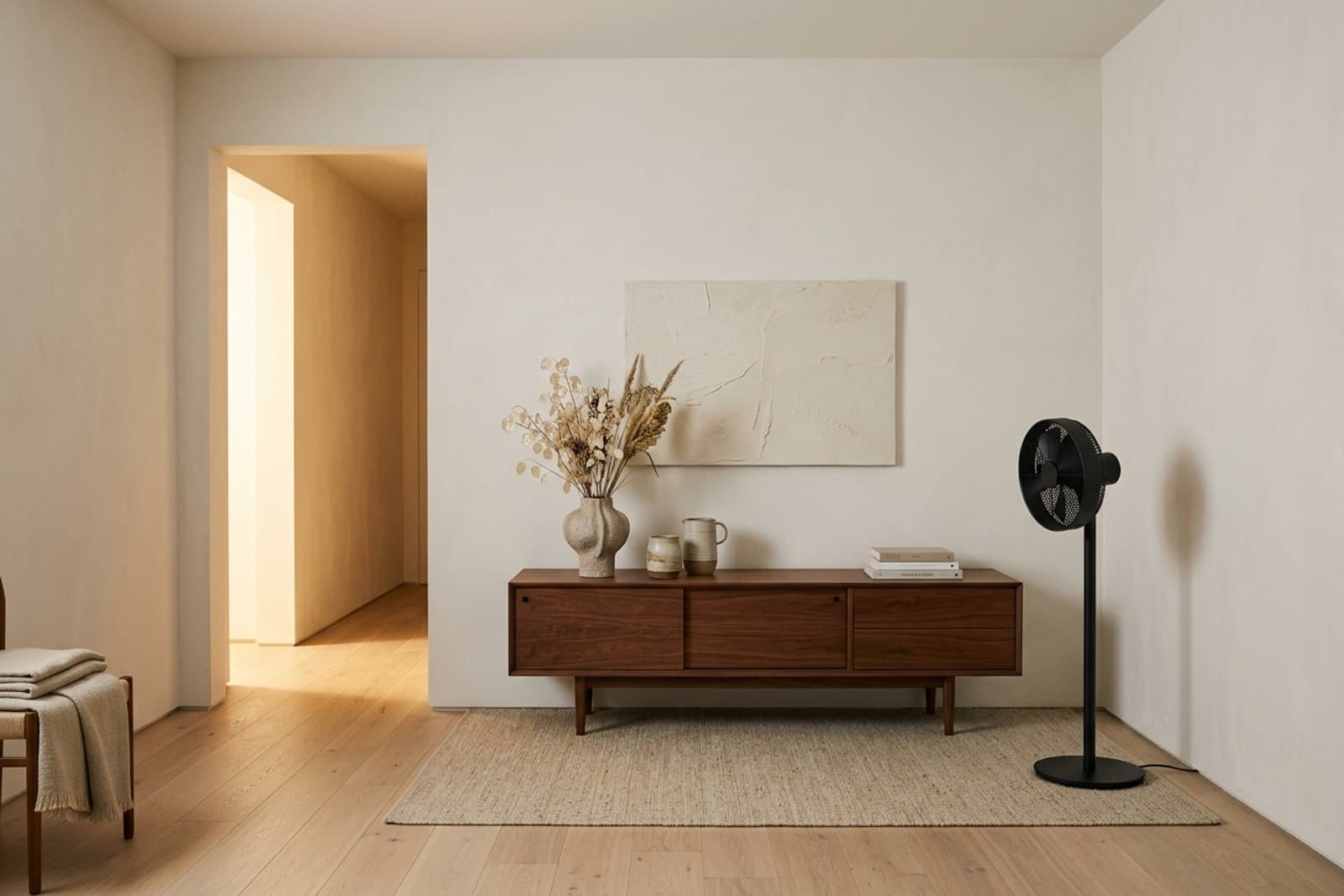
A room with no windows at all still ventilates, but only if you give the air two openings instead of one, and with no sash to open both of them have to be interior. Pick an exhaust route that leads out of the room: a bathroom or laundry exhaust fan, a ducted ceiling fan, or a fan aimed out through the doorway. Then open a separate intake, usually the door gap pulling air from a cleaner adjoining space.
One fan alone is not ventilation. If air leaves and returns through the same gap, the room feels breezier while humidity and odor stay put. For a wet room, ASHRAE 62.2 sets the minimum at 50 CFM.
This guide is for an interior bedroom, windowless bathroom, basement room, or converted closet office in a home you rent or own. If the room is a bathroom, use our dedicated guide to ventilating a bathroom without a window. If the room has even one operable window, this is not the guide for it; start with ventilating a room with one window, cooling a humid room without AC, or cooling a one window room.
Why does a windowless room feel stuffy so quickly?
Because nothing is leaving. A room with a window loses air through the gap whether you manage it or not. A sealed interior room only exchanges air as fast as its weakest leak, which is usually the half inch under the door, so everything the room produces stays in the room.
What accumulates is not mysterious. It is moisture from skin and breath, odor from textiles and bins, heat from a laptop or a television, and carbon dioxide from you. ANSI/ASHRAE Standard 62.1-2022 treats indoor carbon dioxide as acceptable when it stays within about 700 ppm of outdoor air, and outdoor air typically runs 300 to 500 ppm. That puts the familiar stuffy threshold near 1,000 to 1,200 ppm. Health Canada sets its residential guideline at 1,000 ppm as a 24 hour average.

There is a quick self-diagnosis in that. If the room smells like itself within an hour of closing the door, it has an exchange problem, not a cleaning problem.
7 ways to ventilate a room without windows
These run from the no install options to the ones that need a trade. Most windowless rooms are fixed by the first three.
- Make the doorway a two way path. Set one fan just inside the door facing out into the hallway, and leave the far side of the room clear so replacement air can travel to it. One fan pushing out beats two fans fighting each other.
- Borrow an exhaust fan you already have. A bathroom or laundry fan that ducts outside will pull air through the home. Open the windowless room's door, close the doors you do not want feeding it, and run that fan for 20 to 30 minutes.
- Add a transfer grille. A grille cut into the door or the wall above it gives the room a real intake instead of a door gap. Building Science Corporation's transfer grille research sizes these at roughly 1 square inch of free area per CFM of air moved, and notes that a door undercut generally needs to be 1.5 inches or more before it passes useful air on its own.
- Install a ducted exhaust fan. This is the only option that truly removes moisture. ASHRAE 62.2 sets the residential minimum at 50 CFM intermittent or 20 CFM continuous for a wet room. The Panasonic WhisperCeiling DC FV-0511VQ1 is a common choice because a single unit is selectable at 50, 80, or 110 CFM, so it can be dialed to the code minimum or above it.
- Use an inline duct fan when there is no exterior wall. Interior rooms often cannot vent straight out. A centrifugal inline fan mounted in the duct run produces more pressure than a wall mounted axial fan, which is what makes a longer duct to a soffit or roof workable.
- Set the HVAC fan to On instead of Auto. If the room has a supply register, running the system fan continuously moves and filters air between cycles. It circulates without exchanging, so treat it as support.
- Filter what you cannot exhaust. A HEPA purifier does nothing for humidity or carbon dioxide, but it handles particles well. Size it with the AHAM two thirds rule below.
| # | Method | Needs a trade? | What it actually fixes |
|---|---|---|---|
| 1 | Doorway fan facing out | No | Stale air, mild odor |
| 2 | Borrowed bath or laundry fan | No | Odor, light humidity |
| 3 | Transfer grille in door or wall | Light DIY | A sealed room with no intake |
| 4 | Ducted exhaust fan | Usually yes | Real moisture removal |
| 5 | Inline duct fan | Usually yes | Rooms with no exterior wall |
| 6 | HVAC fan set to On | No | Circulation and filtration |
| 7 | HEPA purifier | No | Particles only |

How do you make air circulate in a room?
Give it somewhere to go, then get out of its way. Air follows the easiest route, so a single fan in the middle of a closed room stirs a loop instead of moving the room over. You need one point where air leaves and one point where air enters, and a clear line between them.
Run this 30 minute test before you buy anything:
- Close the closet doors so air does not disappear into storage.
- Open the room door and set a fan just inside it, facing out.
- Open a second interior door somewhere the air can come from, ideally a room that is not damp.
- Hold a tissue at the door gap on the far side of the fan, or tape a strip to the door frame so it hangs free. It should pull steadily toward the exhaust.
- If the tissue is still, widen the intake or move whatever sits between the door and the far wall.

Furniture is the usual culprit. A tall wardrobe or a headboard pushed flat against the wall opposite the door will park stale air behind it no matter how good the fan is. Pull the largest piece three to four inches off the wall and retest.
Find the path before you buy the fan
The mistake we see most often in windowless rooms is buying equipment before finding the route. People arrive with a fan, a purifier, and a dehumidifier already in the room, and the room still smells closed, because all three are working inside a sealed box.
Decide where air leaves first. That single decision tells you whether the room needs a 50 CFM ducted fan or just a door left open and a bin emptied. More often than not, it is the second one.
How long can you stay in a room without ventilation?
For an ordinary closed bedroom, indefinitely. The air in a sealed domestic room does not run out of oxygen; carbon dioxide climbs and the room feels thick and hard to sleep in well before anything approaches a medical concern. That is a comfort and sleep quality problem, and it is the one most people are actually asking about.
The real hazard is combustion, not occupancy. Anything that burns fuel in an unvented room, including a portable generator, a charcoal or propane grill, a kerosene heater, or a car left running in an attached garage, produces carbon monoxide and can become dangerous quickly. The U.S. Environmental Protection Agency's guidance on indoor air pairs ventilation with source control for exactly this reason. Never run fuel burning equipment in a windowless space, and fit a carbon monoxide alarm if the room adjoins a garage or a furnace.
For everyday stuffiness, a carbon dioxide monitor is the simplest honest answer. Watch whether the room crosses 1,000 ppm overnight. If it does, no candle or spray will help; the room needs air moved through it.
How do you ventilate a windowless room at night?
Front load it. Run the exhaust for 20 to 30 minutes before you go to bed rather than while you are trying to sleep, so the room starts the night already flushed. Overnight, keep a quiet path open instead of a loud fan running.
Bath fan noise is rated in sones, and the figure varies widely between models and speed settings. Check the rating on the fan you are considering rather than assuming a ceiling unit is quiet enough to sleep through.
Hold the path open while you sleep:
- Leave the door open several inches, or fit a transfer grille if privacy matters.
- Keep a quiet circulation fan on low, aimed along the room rather than at the bed.
- Move damp towels, laundry baskets, and plants out before lights out.
- Charge laptops and phones outside the room if it is small.
An interior room that sleeps badly is often carrying a humidity load rather than a temperature one. If the walls feel cool and the bedding feels slightly damp by morning, a small dehumidifier will do more for sleep than another fan. Our guide to why a bedroom feels hard to sleep in covers the rest of the setup.
How do you ventilate a room without windows when painting?
Exhaust continuously and give the fumes a route out of the house, not into the hallway. The EPA's guidance on remodeling is to ventilate as much as possible, continuously, from the start of the work until two or three days after painting finishes.
That is a longer window than most people plan for, and it matters more in a room with no window because there is no passive backup.
Set it up like this:
- Run the nearest ducted exhaust fan for the whole job and for 48 to 72 hours after.
- Put a box fan in the doorway facing out, with the path running toward an open exterior door or window elsewhere in the home.
- Close doors to bedrooms along that path so fumes do not settle in them.
- Choose a low VOC or zero VOC product, which shortens the off gassing window substantially.
- Keep children, pregnant people, and anyone with a respiratory condition out of the area through that same two to three day window.
The scale is worth knowing. The EPA notes that while painting or stripping paint, VOC levels indoors can reach 500 to 1,000 times outdoor levels. A windowless room holds that concentration far longer than a room you can throw a sash open in.

Can a bedroom legally have no window?
Generally no, and this is worth checking before you spend money ventilating it. Under IRC Section R310, every sleeping room requires at least one operable emergency escape and rescue opening, and it must open without keys, tools, or special knowledge.
The code sets that opening at:
- 5.7 square feet minimum net clear area
- 24 inches minimum clear height
- 20 inches minimum clear width
- 44 inches maximum sill height above the finished floor
A room marketed as a bedroom with no window usually fails that test. It is often a den, a bonus room, or an unpermitted conversion. Local codes and their adoption dates vary, so confirm with your building department rather than a listing.
That does not mean you cannot use it. It does mean two things:
- Treat the exit route as a safety question, not a paperwork one, and keep the doorway clear.
- If you own the home and are planning a conversion, budget for the egress opening alongside the ventilation, because an appraiser will not count the room as a bedroom without it.
How do you ventilate a windowless room in winter without losing heat?
Shorten the flush and lengthen the gap between flushes. In heating season the cost of ventilation is the heat that leaves with the stale air, so a 20 minute exhaust run twice a day beats a fan you leave on all afternoon. The air changes; the walls, floor, and furniture hold their warmth and reheat the room quickly.
Two adjustments make the difference in an interior room:
- Pull intake air from inside the heated envelope, not from an unheated basement, garage, or attic hatch.
- Run the exhaust while the heating system is already cycling, so the recovery is immediate rather than delayed.

If humidity rather than odor is the driver, a dehumidifier is more efficient than exhaust in winter, because it removes moisture without removing heat.
How do you size an air purifier for a room with no windows?
Use the AHAM two thirds rule: the smoke CADR should be at least the room's square footage multiplied by 0.67, which delivers roughly 4 air changes per hour. A 120 square foot interior bedroom needs a smoke CADR of about 80. A 200 square foot room needs about 132.
Two adjustments matter:
- CADR ratings assume an 8 foot ceiling. Multiply the requirement by 1.13 for a 9 foot ceiling and 1.25 for a 10 foot ceiling.
- For wildfire smoke, AHAM recommends a smoke CADR equal to the full room square footage rather than two thirds of it.
Place the unit near where you actually breathe, so beside the bed or the desk rather than in a far corner behind a chair. A purifier in a windowless room is doing real work on particles, but be clear about what it is not doing: it does not lower humidity and it does not lower carbon dioxide. Only exchange does that.

Frequently Asked Questions
Can you ventilate a room without windows using just a fan?
Only partly. A fan on its own moves air within the room rather than replacing it, so odor and humidity stay. It becomes real ventilation when the fan sits in the doorway facing out and a separate opening, such as a cracked door on the other side of the room or a transfer grille, lets replacement air in.
What size exhaust fan does a windowless bathroom need?
ASHRAE 62.2 sets the residential minimum at 50 CFM for a fan that runs on demand, or 20 CFM for one that runs continuously. For a windowless bathroom, run the fan for 20 to 30 minutes after a shower rather than switching it off with the light, since the moisture has nowhere else to go. Our guide to ventilating a bathroom without a window covers fixture based sizing and the duct length limits in full.
How do you get fresh air into a basement room with no windows?
Pull it from the heated part of the house rather than from the basement's own damp corners. Open the room's door, add a transfer grille if the door stays shut, and run an exhaust that ducts outside. Basements usually carry a humidity load as well, so pair the exchange with a dehumidifier. The EPA advises keeping indoor relative humidity below 60 percent and ideally between 30 and 50 percent, since anything above 60 percent tends to produce condensation and then mold.
Does leaving the bedroom door open actually help?
Yes, more than most people expect. The door is usually the largest opening a windowless room has, and opening it several inches turns a half inch undercut into a working intake. It helps most when something elsewhere is pulling air, such as a bath fan or the HVAC system running.
How can I tell if my windowless room is actually exchanging air?
Hold a tissue at the door gap while the exhaust runs. Steady movement toward the exhaust means air is being replaced; a still tissue means it is being stirred. A carbon dioxide monitor is the more precise version of the same test. If the room stays under about 1,000 ppm overnight, the exchange is working.
The Spatia Editorial Team reports on interior rooms, basements, and converted closets, where airflow has to be designed rather than assumed.
The Noticer
For thoughtful people who notice spaces.
What did you notice?
Did something in this story make you see your own space differently?
Ask Archie to map the air path in your windowless room
Describe the room or upload a photo. Archie reads the door swing, furniture blocks, moisture sources, and the nearest exhaust point so you can test a layout before you buy a fan or call anyone.
Plan my air path with ArchieAdvertisement. Archie is made by STUDIO DID IT, the studio that publishes Spatia.
Related Articles

Why Does My Room Feel Stuffy? (5 Real Causes)
Stuffy air comes down to stale air, trapped moisture, and no exchange path, and temperature barely enters into it. See the 5 causes and the 5 minute winter fix.
How to Ventilate a Room With One Window (No Cross Breeze)
To ventilate a room with one window, face a box fan out, crack the door for intake, and flush 10 to 20 minutes, or about 5 in winter. See the full routine.

How to Cool a Room With One Window Without AC (West or South)
Cool a room with one window without AC: shade the glass before the sun lands, aim a fan at your body, then flush stored heat out after sunset.