How to Ventilate a Bathroom Without a Window (6 Ways)
See how to ventilate a bathroom without a window: size the fan at 1 CFM per square foot, duct it outdoors, and run it 20 minutes after every shower.
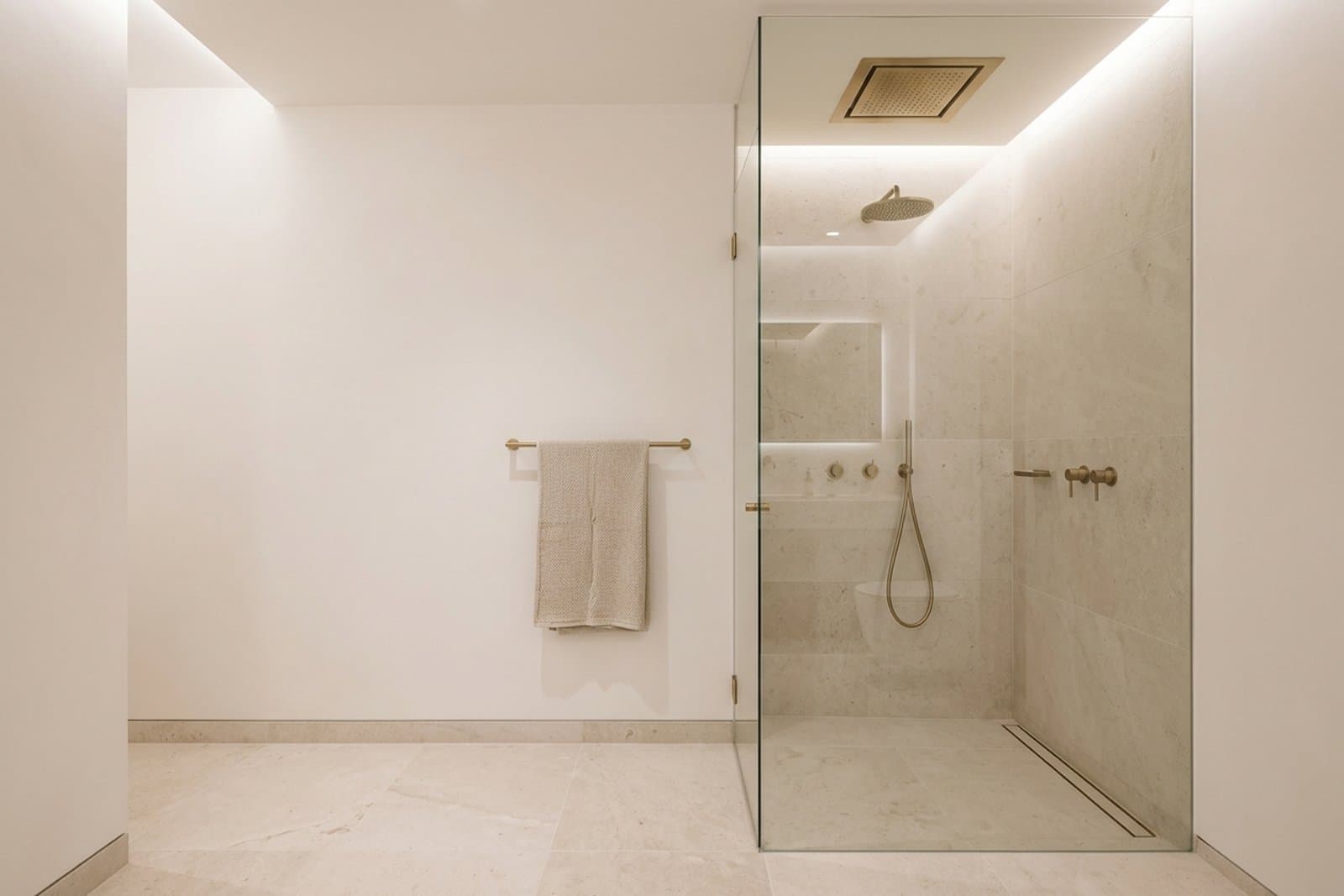
A bathroom with no window ventilates one of two ways: with a fan ducted to the outdoors, or through a deliberate air path from the door to whatever exhaust the home already has. Under the International Residential Code, that exhaust has to discharge outdoors, never into an attic, soffit, or crawl space.
Size the fan at 1 CFM per square foot for a bathroom up to 100 square feet, then run it 20 minutes after every shower instead of switching it off with the light. With no fan, the door gap becomes the intake and a dehumidifier does the drying.
This guide is for an interior bathroom, hall bath, or basement powder room in a home you own or rent. If the room is not a bathroom, start with ventilating a room without windows. If it does have a window, use the one window guide or our notes on cooling a humid room.
Why does a windowless bathroom stay damp so long?
Because the moisture has no route out, and the surfaces it lands on are the coolest in the house. A hot shower puts more water into the air than that air can hold, which is why the mirror fogs, and in a sealed room that vapor moves onto the tile, the grout, and the back of the door.
Timing is what turns dampness into damage. The U.S. Environmental Protection Agency notes that if wet materials are dried within 24 to 48 hours, mold will usually not grow. A windowless bathroom used twice a day rarely gets a dry 24 hours, so the clock never resets.
The EPA also recommends keeping indoor relative humidity between 30 and 50 percent, and warns that above 60 percent tends to produce condensation and then mold. A hygrometer on the vanity tells you which side of that line the room sits on.
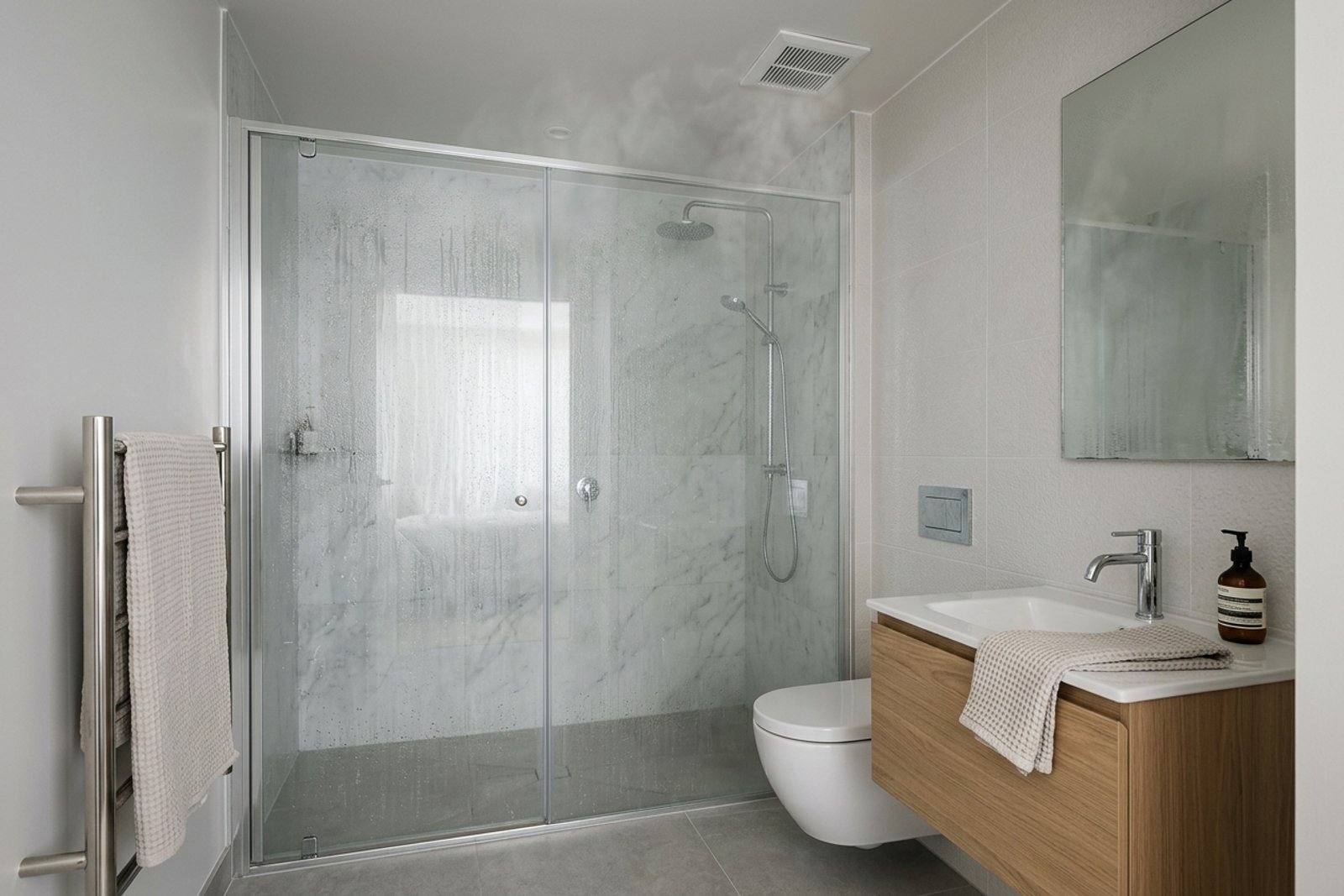
The practical read: if the mirror is still fogged 20 minutes after the shower, the room is not exchanging air. It is holding it.
What are the best ways to ventilate a small bathroom?
Six options cover almost every windowless bathroom, running from a habit change to a job for a trade. Most rooms are fixed by the first three, and the table below sorts which ones remove moisture from the building rather than just move it around.
- Run the existing fan properly. The Home Ventilating Institute recommends leaving the fan on for 20 minutes after the bathroom is used. Switching it off with the light vents the easy half of the moisture and leaves the rest on the walls.
- Open the door and give the fan an intake. An exhaust fan can only remove what it can replace. Leaving the door open several inches turns a stalled fan into a working one.
- Add a timer or humidity sensing switch. This removes the discipline problem entirely. The Panasonic WhisperSense DC uses built in motion and humidity sensors to start and stop itself, and is selectable at 50, 80, or 110 CFM.
- Borrow a doorway fan. A box or blade fan set just inside the doorway facing out pushes damp air into the hall, where the home's other openings dilute it. This is the renter's option, and it is reversible.
- Install or upsize a ducted exhaust fan. The Panasonic WhisperCeiling DC FV-0511VQ1 is a common pick because one unit is selectable at 50, 80, or 110 CFM, so it can be set to the code minimum or above it.
- Add a dehumidifier for what the fan cannot reach. In a basement bath or a room with a long duct run, a compact dehumidifier removes moisture without removing heat, which matters from October onward.
| # | Method | Needs a trade? | Removes moisture from the building? |
|---|---|---|---|
| 1 | Run the fan 20 minutes longer | No | Yes, if the fan is ducted outside |
| 2 | Open the door for intake air | No | Improves whatever fan exists |
| 3 | Timer or humidity sensing switch | Light DIY | Yes, and without relying on memory |
| 4 | Doorway fan facing out | No | No, it dilutes into the hallway |
| 5 | Ducted exhaust fan | Usually yes | Yes |
| 6 | Compact dehumidifier | No | Yes, as collected water |
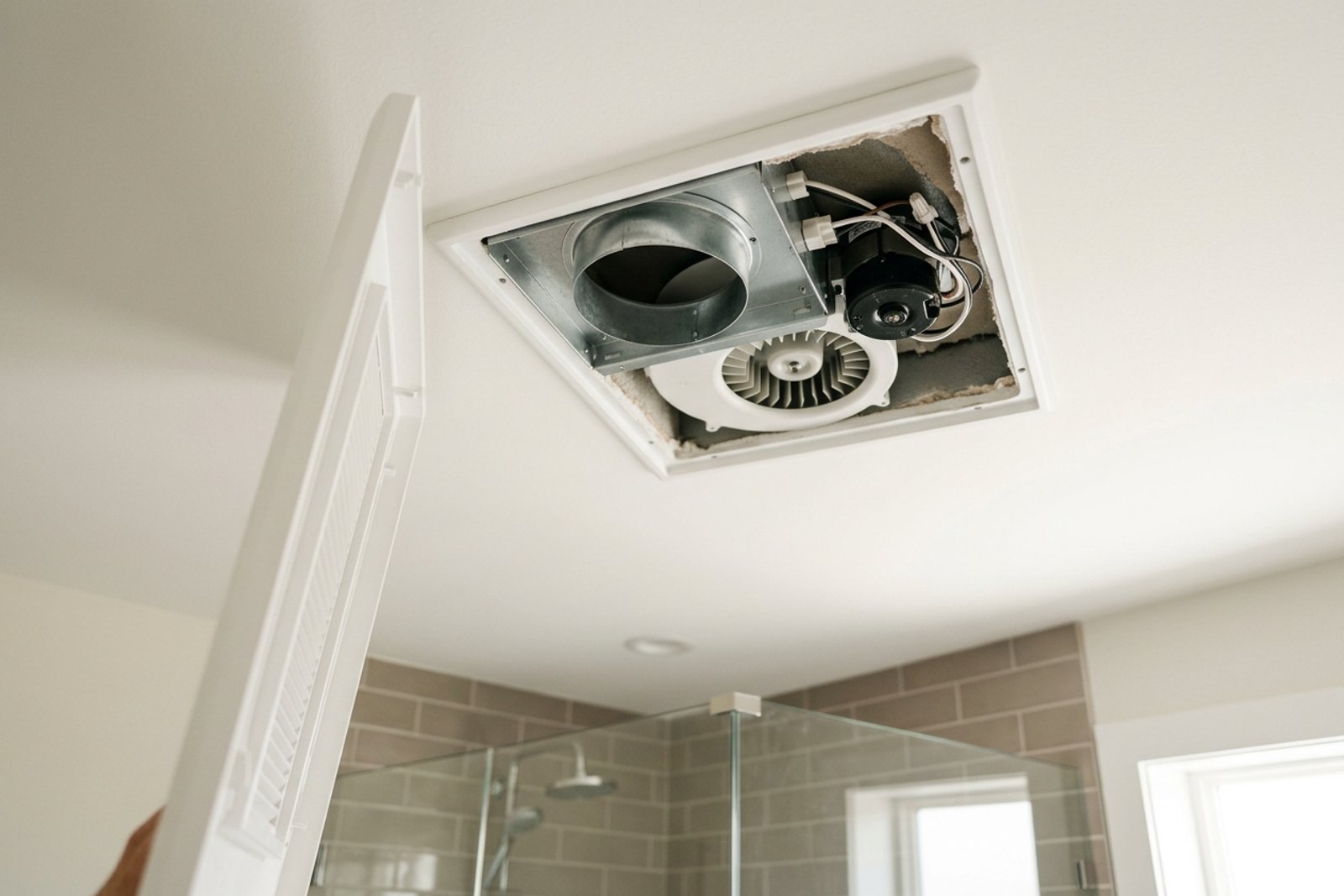
What size exhaust fan does a windowless bathroom need?
For a bathroom of 100 square feet or less, the Home Ventilating Institute recommends 1 CFM per square foot, which works out to roughly eight air changes per hour. A 7 by 10 foot bathroom therefore wants about 70 CFM, and ASHRAE 62.2 sets the floor at 50 CFM for a fan on a demand switch.
That minimum is 20 CFM for a fan running continuously, and it applies regardless of room size, which makes it a floor rather than a target.
Above 100 square feet, HVI switches to counting fixtures rather than floor area:
- Toilet: 50 CFM
- Shower: 50 CFM
- Bath tub: 50 CFM
- Jetted tub: 100 CFM
The number on the box is only the starting point, because the duct behind the fan decides how much of that rating survives. IRC Table M1504.2 caps duct length by fan rating, duct diameter, and duct type, and the difference between flexible and smooth wall duct is not subtle.
| Fan rating | Duct diameter | Flexible duct max | Smooth wall max |
|---|---|---|---|
| 50 CFM | 3 inch | Not permitted | 5 feet |
| 50 CFM | 4 inch | 56 feet | 114 feet |
| 50 CFM | 5 inch | No limit | No limit |
| 100 CFM | 4 inch | Not permitted | 10 feet |
| 100 CFM | 6 inch | 158 feet | No limit |
Two footnotes on that table matter more than the numbers themselves. It assumes no elbows, and 15 feet of allowable length is deducted for every elbow in the run. A 100 CFM fan on 4 inch duct is already limited to 10 feet of smooth wall duct, so a single elbow puts the installation outside the table. That is why an upgraded fan sometimes moves less air than the one it replaced.
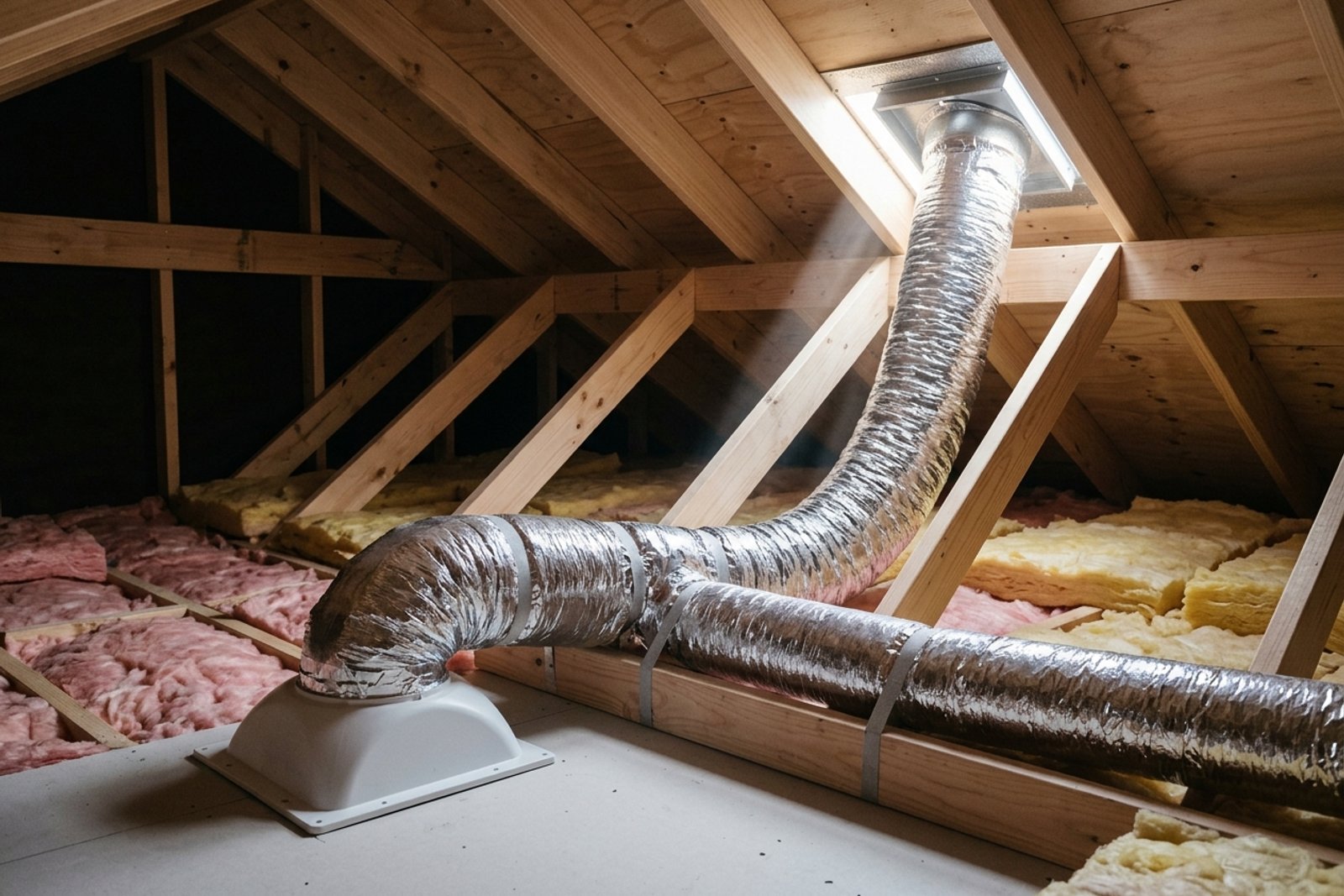
Two more things worth checking while someone is up in the ceiling:
- Where the duct terminates. Exhaust openings have to sit at least 3 feet from property lines and from operable windows and doors, and at least 10 feet from mechanical air intakes.
- Whether the duct is insulated where it crosses an unheated attic. Warm wet air meeting cold metal condenses inside the duct and runs back down to the fan.
How can I ventilate my bathroom if I don't have a fan?
Make the doorway the exhaust and borrow the exchange from the rest of the house. A fan set just inside the door facing out, plus a second opening somewhere beyond it, moves the humid air into a much larger volume of drier air where it stops being a condensation problem.
This is the arrangement for a rental, a period home with no ducting, or the stretch between deciding to install a fan and having it done. It dilutes rather than removes, so pair it with something that actually dries.
The arrangement, in order:
- Open the bathroom door fully as soon as the water stops, before the mirror has cleared.
- Set a fan just inside the door facing out into the hall, not pointed at the shower.
- Open a window or exterior door elsewhere in the home, so the moisture leaves the building rather than settling in the bedrooms along the way.
- Run a compact dehumidifier for an hour if the room is still holding above 60 percent.
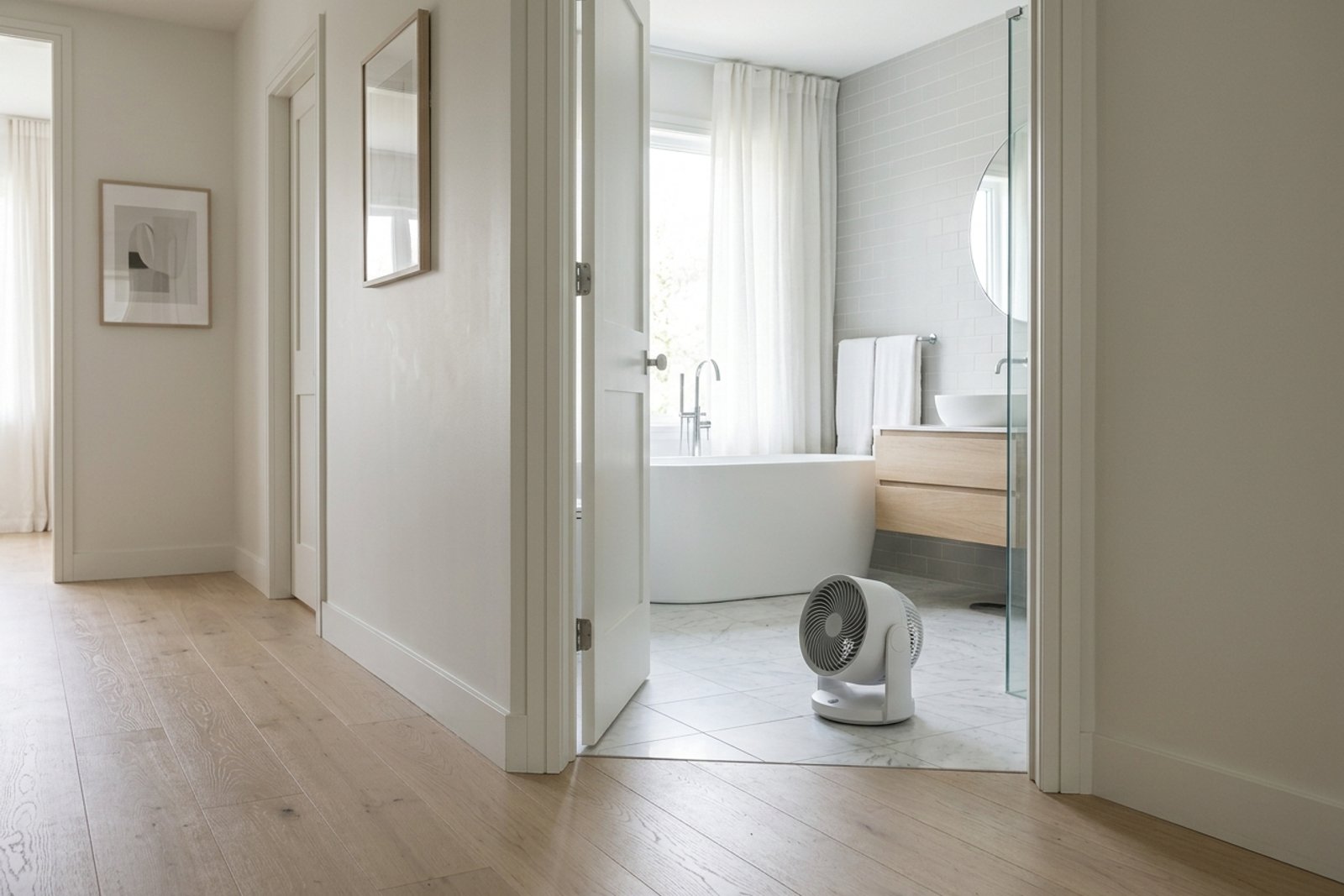
Closing the bedroom doors along that path matters more than it sounds. Damp air pushed out of a bathroom will happily condense on the coolest surface it reaches next, and an unheated back bedroom is often exactly that surface.
What can I put in my bathroom if I don't have a vent?
A hygrometer first, then a dehumidifier, then a ductless fan only for odor. That order matters more than the spend, because two of the three usual purchases for a windowless bathroom do almost nothing about moisture and are very often bought to solve exactly that problem.
Ductless recirculating fans are the honest disappointment. A unit like the Broan 682 pulls air through a replaceable charcoal filter and returns it to the same room, which handles odor and very little else. There is a code dimension too: IRC Section M1505.2 states that exhaust air from bathrooms and toilet rooms shall not be recirculated within a residence and shall be exhausted directly to the outdoors. The ductless exception in the code covers range hoods, not bathrooms.
What each item is actually for:
- Hygrometer. Tells you whether the room clears to under 50 percent or plateaus at 65.
- Compact dehumidifier. The one device that removes water when no duct exists. Empty it, or it becomes a standing water source.
- Ductless charcoal fan. Odor control only. Not a moisture solution, and not a substitute for required exhaust.
- Heated towel rail. Dries textiles so they stop releasing moisture back into the room.
- Silicone squeegee. The least interesting item on the list and the one that removes the most water.

If you are choosing a ducted fan, ENERGY STAR certification is a useful shortcut on both noise and running cost. Fans rated 10 to 89 CFM must deliver at least 2.8 CFM per watt at no more than 2.0 sones. A fan loud enough to be annoying is a fan that gets switched off early.
How do you reduce moisture in a bathroom without a window?
Treat it as a routine rather than a purchase. The room's humidity is the sum of how much water you release, how long it stays airborne, and how much you physically remove, and the last of those is the part most people skip.
A workable rhythm:
- Before the shower: switch the fan on, or open the door and start the doorway fan.
- During: keep the shower a few degrees cooler if you can. Less steam is less to clear.
- Immediately after: squeegee the walls and glass, wipe the vanity, and open the door fully.
- For 20 minutes after: leave the fan running. This is the single step the Home Ventilating Institute calls out, and the one most often missed.
- Same day: hang towels and bath mats where air moves, and leave the shower curtain spread rather than bunched.
- Weekly: pull the fan grille and vacuum it. Lint on the grille and blades quietly cuts airflow over years.
- Seasonally: check the hygrometer trend as heating season starts. Closed up homes run damper from October through February.
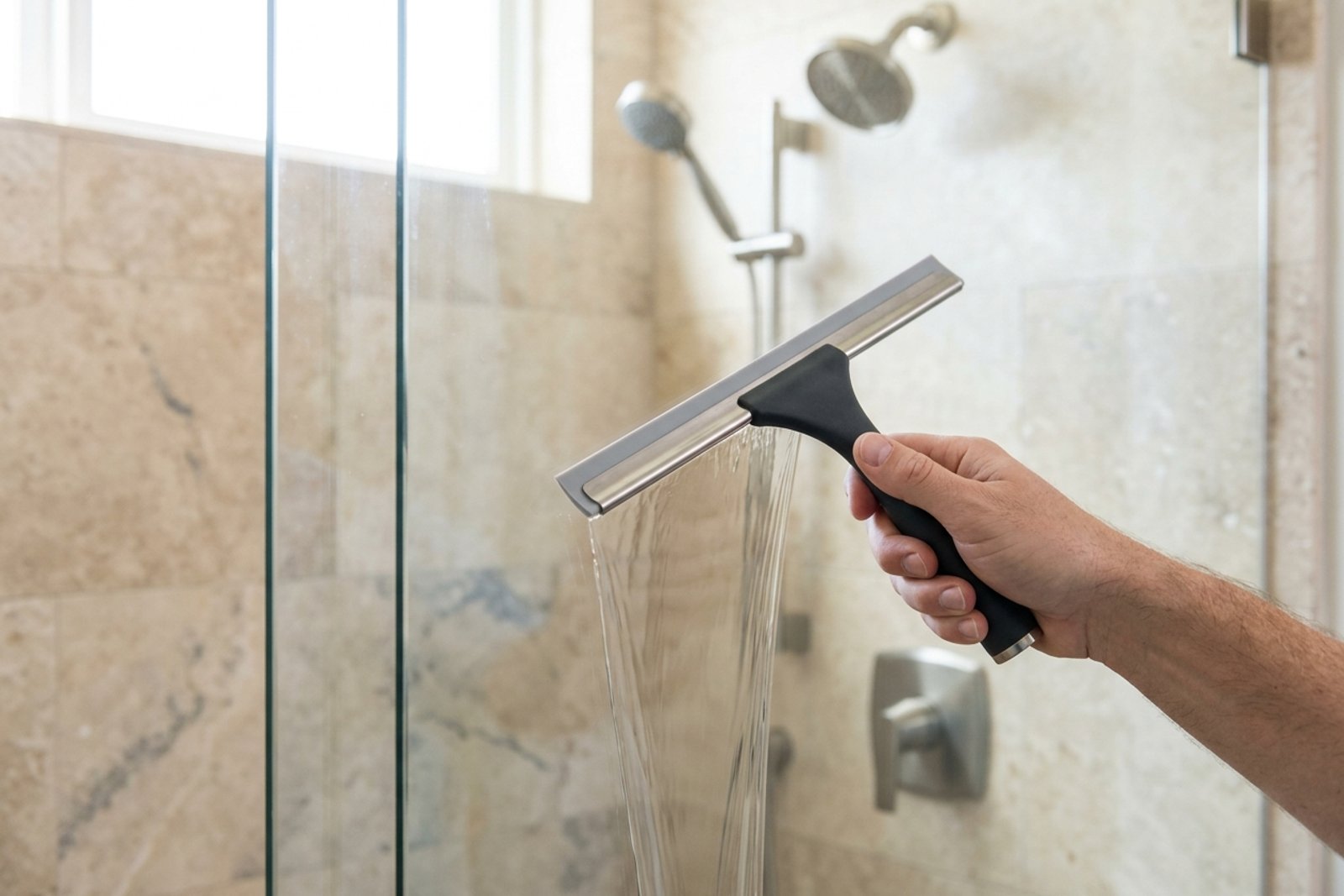
The weekly grille cleaning is the item nobody schedules. A fan sized correctly at installation can end up well under its rating after years of dust, and the symptom reads as slow decline rather than fault.
How do you ventilate a toilet without windows?
A separate water closet is an odor problem with a small moisture load, which makes it the one case where the cheaper options are genuinely adequate. HVI counts a toilet at 50 CFM, and ASHRAE 62.2's 50 CFM intermittent minimum applies to toilet rooms the same way it applies to bathrooms.
Because there is no shower feeding it, the fixes are simpler:
- A 50 CFM ducted fan on a timer switch covers it comfortably.
- The door undercut usually supplies enough intake air on its own.
- A ductless charcoal fan is more defensible here than in a full bathroom, since odor really is the problem being solved.
- The termination rule does not change: outdoors, not into a soffit or an attic.
The mistake in a small water closet is oversizing. A 110 CFM fan in a room of 15 square feet is loud, pulls conditioned air out of the house faster than needed, and gets switched off for exactly that reason.
Spatia Design Note
The most common error we see in windowless bathrooms is upgrading the fan without touching the duct. Someone replaces a tired 50 CFM unit with a 110 CFM model, and the room clears no faster, because the original 4 inch flexible duct with two elbows was already the bottleneck. Under the IRC table, that run supports a 50 CFM fan and not a 100 CFM one.
Find out where the duct goes and how many turns it takes before you shop. In a surprising number of homes the honest answer is that it ends in the attic, in which case no fan on the market will fix the room, and the duct is the whole project.
Frequently Asked Questions
Is a bathroom without a window legal?
Generally yes, provided it has mechanical ventilation. Codes treat a window as one acceptable way to ventilate a bathroom and an exhaust fan as the other, so windowless bathrooms are normal in interior and basement layouts. What is not permitted is a bathroom with neither, or a fan discharging into an attic, soffit, or crawl space instead of outdoors. Local codes vary, so confirm with your building department.
What size fan does a 5 by 8 bathroom need?
A 5 by 8 bathroom is 40 square feet, so the Home Ventilating Institute's 1 CFM per square foot rule gives 40 CFM. Round up to 50 CFM, which is also the ASHRAE 62.2 minimum for a fan on a demand switch. Fans below 50 CFM are rarely worth installing in a windowless room, and a 50 CFM unit on 4 inch smooth wall duct has plenty of length to work with.
Can I use a dehumidifier instead of an exhaust fan?
As a supplement, yes. As a replacement, not really. A dehumidifier removes water but does nothing for odor or for the air exchange the code requires, so it works best alongside an exhaust route rather than in place of one. It earns its keep in basement bathrooms and during heating season, when it removes moisture without removing the heat you are paying for.
How long should a bathroom fan run after a shower?
At least 20 minutes after the bathroom is used, which is the Home Ventilating Institute's recommendation. Switching the fan off with the light clears the visible steam and leaves the water that has already landed on the tile, grout, and mirror. A timer switch or a humidity sensing fan handles this without anyone having to remember.
Does leaving the bathroom door open actually help?
Yes, and it is usually the difference between a fan that works and one that only hums. An exhaust fan can remove only what it can replace, and in a sealed bathroom the door gap is the sole intake. Opening the door several inches during and after a shower gives the fan something to pull on.
Will a windowless bathroom always get mold?
No. Mold needs time as much as moisture. The EPA notes that drying wet materials within 24 to 48 hours usually prevents growth, so a windowless bathroom that clears to under 50 percent relative humidity between uses stays clean indefinitely. The rooms that develop problems are the ones that never fully dry, which is a ventilation and wipe down question rather than an inevitability of the layout.
Spatia Editorial Team writes about small homes from the room outward: light, airflow, walking paths, storage, and the decisions that make a space easier to live in before it photographs well.
Ask Archie where the air leaves your bathroom
Describe the bathroom or upload a photo. Archie reads the fan location, door gap, fixture layout, and the nearest exterior wall so you can test a ventilation plan before you buy a fan or book a trade.
Plan my bathroom airflow with ArchieRelated Articles

How to Cool a Humid Room Without AC (7 Steps)
Cool a humid room without AC by controlling moisture first, then airflow. A renter safe routine to exhaust damp air, dry textiles, and place fans right.

How to Ventilate a Room Without Windows (7 Ways)
See how to ventilate a room without windows: give the air an exhaust route plus a separate intake, then size the fan to the ASHRAE 62.2 minimum of 50 CFM.

Dorm Room Essentials Checklist: What to Buy Before Move-In Day
A realistic dorm room essentials checklist organized by what actually matters first, plus the items worth skipping until you see the room in person.