Why Are My Bedroom Windows Wet in the Morning? (6 Fixes)
Bedroom windows wet every morning? It is your room's humidity meeting cold glass. See the humidity numbers to aim for and 6 fixes a renter can make tonight.

Bedroom windows are wet in the morning because the glass is the coldest surface in the room, and overnight your breathing behind a closed door pushes the humidity up until the air touching that glass reaches its dew point. At 70°F and 50 percent humidity, any surface colder than about 50°F fogs.
So the fix is the room's humidity, not the window. Bring it to 30 to 40 percent, open the door, take the drying rack out, run the bathroom fan 20 minutes after showers, and wipe the sill every morning.
This guide is for a bedroom whose window drips once the heat comes on, in a home where you cannot replace the glass. If the whole room also feels cold, start with why one room in your house is so cold. If the air feels heavy rather than wet, see why a room feels stuffy.
Why are my bedroom windows wet in the morning?
Because a bedroom is the one room that sits closed, occupied, and slowly cooling for eight hours straight. You add moisture with every breath, the glass cools as the night gets colder outside, and by dawn the two meet. That is why the window is dry at bedtime and dripping at 7 a.m.
NC State Extension puts a typical person's breathing at about 3 pints of water a day, which works out to roughly a pint across an eight hour night. Two people in a closed room add about two pints of water to the air before the alarm goes off, and almost all of it has nowhere to go but the coldest surface.
The six things that turn a damp window into a dripping one:
- The door stays shut all night. The moisture builds up in one room instead of spreading through the home.
- Laundry dries in the bedroom. A study by the Mackintosh Environmental Architecture Research Unit at The Glasgow School of Art found an average load releases about 2 litres of moisture as it dries indoors.
- The heat under the window is blocked. A bed, dresser, or desk parked on the radiator or register stops warm air from washing up the glass, so the glass runs colder.
- Heavy curtains are closed tight. They trap a pocket of cold air against the glass while damp room air still seeps behind them.
- Shower steam drifts in. An en suite or a bathroom across the hall with no fan running feeds the bedroom every morning.
- Houseplants are grouped by the window. The Minnesota Extension Service counts 5 to 7 houseplants at about a pint of water a day.
| What you see | Most likely cause | First fix |
|---|---|---|
| Wet only after nights with the door shut | Moisture from breathing | Door open or ajar overnight |
| Wettest on laundry days | Drying rack in the room | Dry clothes elsewhere |
| One window drips, the next one is dry | Heat blocked under the wet one | Pull furniture off the heater |
| Water pooled behind the curtain | Curtains trapping cold air | Open them the moment you wake |
| Worst on shower mornings | Bathroom steam | Fan on 20 minutes, bathroom door shut |
| Fog between the two panes | Failed glass seal | Report it to the landlord |

Does condensation mean my house is too cold?
Not usually. It means the air is too humid for the coldest surface in the room, and that surface is almost always the glass. A warm room with damp air will fog a cold window long before a cool room with dry air does, so turning the heat up rarely fixes it on its own.
Condensation forms at the dew point, the temperature at which air can no longer hold its water. The more humid the room, the higher that line sits, and the warmer the glass has to stay to keep dry. These are dew points for a room at 70°F, worked from the standard Magnus approximation:
| Bedroom humidity at 70°F | Glass fogs below about |
|---|---|
| 30 percent | 37°F |
| 40 percent | 45°F |
| 50 percent | 50°F |
| 60 percent | 56°F |
| 70 percent | 60°F |
At 60 percent, the glass has to stay above 56°F to keep dry, a high bar for old glass on a cold night. At 40 percent, the same glass only needs to stay above 45°F. Dropping the humidity moves the line far more than any thermostat setting can.
Where cold does matter is the glass itself. Single pane glass, an old double pane, and the bottom corners of any window run colder than the rest, which is why the water collects there first. The fix for those surfaces is the same as the fix for a cold room: keep the heat under the window clear, and the guidance in why one room in your house is so cold applies here too.
How much condensation on windows is normal?
A thin fog along the bottom inch or two of the glass on the coldest mornings is normal and clears within an hour or two of sunrise. Water that runs down the glass, pools on the sill, or shows up every single morning is not normal. It is a humidity problem you can measure.
The clearest guide is the outdoor temperature. Window makers publish a maximum indoor humidity for each band, based on engineering studies at the University of Minnesota. This is Simonton's version, for a home kept at 70°F:
| Outdoor temperature | Indoor humidity not over |
|---|---|
| 20°F to 40°F | 40 percent |
| 10°F to 20°F | 35 percent |
| 0°F to 10°F | 30 percent |
| −10°F to 0°F | 25 percent |
| −20°F to −10°F | 20 percent |
| −20°F or below | 15 percent |
October and early November nights in most of the US sit in the top row, so 40 percent is the ceiling to aim under right now. As winter deepens, the safe number drops, which is why a window that was fine in October can start dripping in January with nothing else changed.
To know where you stand, put a digital hygrometer on the nightstand and read it when you wake up, before you open the door. A reading over 50 percent in heating season explains the window by itself.
How do I stop condensation on my bedroom window?
Lower the moisture in the room and warm the glass, in that order. Every fix below is free or close to it, works in a rental, and can start tonight. Give it three nights before you judge it, because the walls, bedding, and carpet hold moisture and release it slowly.
Do these in order:
- Open the door. Leave the bedroom door open or ajar overnight. A closed door is the most common reason a bedroom window is wetter than the living room's.
- Take the drying rack out. Dry clothes in a vented dryer, or in the bathroom with the fan running and the door shut. Never on a bedroom radiator.
- Clear the heat under the window. Pull the bed, dresser, or desk off the radiator or register so warm air can rise across the glass.
- Run the bathroom fan 20 minutes after showers. That is the Home Ventilating Institute's guidance, and it keeps steam from reaching the bedroom at all. If the bathroom has no fan, see how to ventilate a bathroom without a window.
- Air the room for 10 minutes in the morning. Open the window wide while you make coffee, then close it. A short, full flush trades the wet air for dry winter air without chilling the walls, and how to ventilate a room with one window covers the timing.
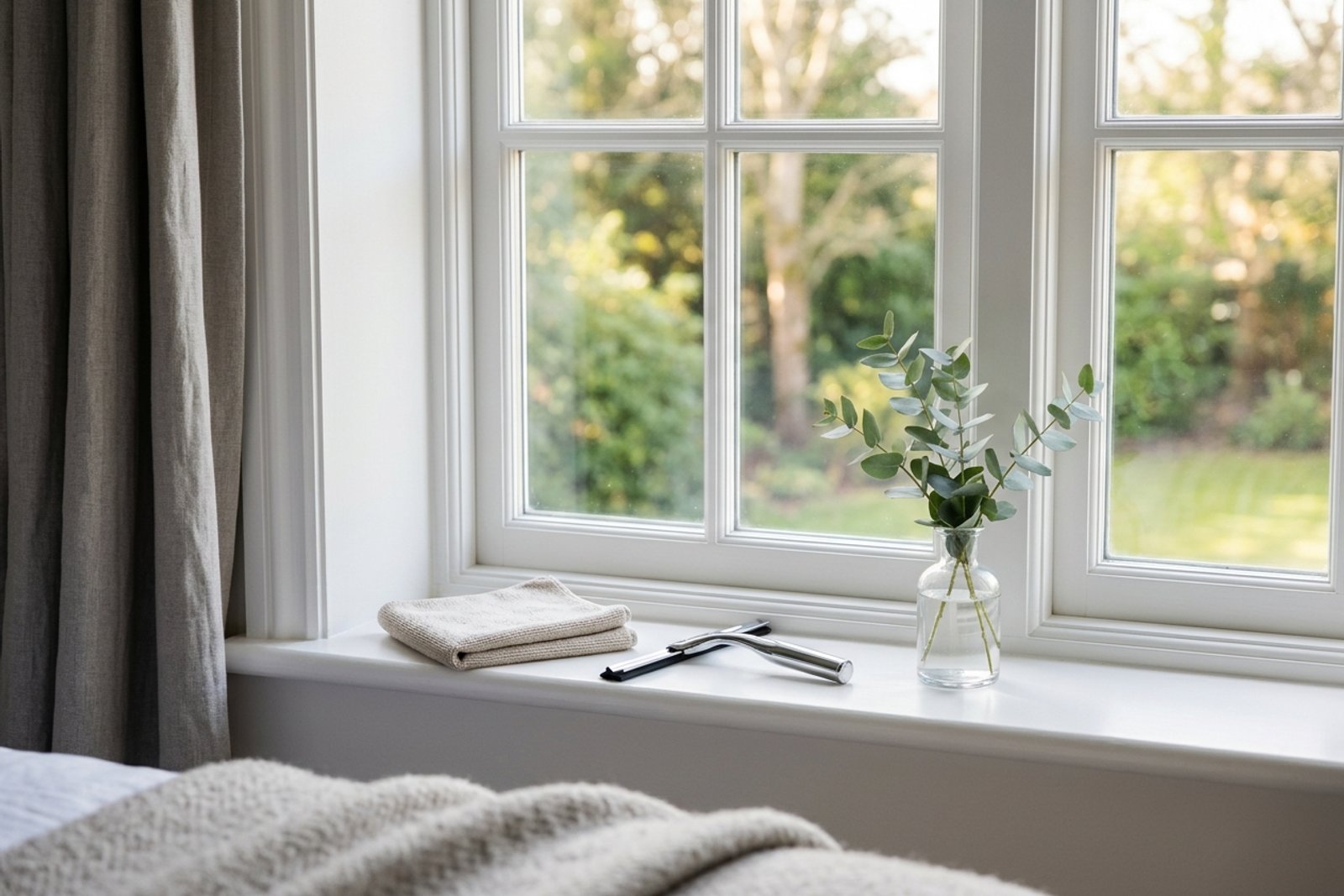
- Wipe the glass and the sill every morning. A small squeegee and a microfiber cloth, done within the hour.
| Fix | What it changes | Cost | Renter friendly |
|---|---|---|---|
| Door open overnight | Spreads breath moisture through the home | Free | Yes |
| Laundry out of the bedroom | Removes about 2 litres per load | Free | Yes |
| Furniture off the heater | Warms the glass | Free | Yes |
| Bathroom fan, 20 minutes | Stops steam before it travels | Free | Yes |
| 10 minute morning airing | Swaps wet air for dry air | Free | Yes |
| Plants moved for winter | Removes a steady source | Free | Yes |
| Small dehumidifier | Pulls humidity down directly | Moderate | Yes |
| Window shrink film (3M Indoor Window Insulator Kit) | Adds an air layer, warms the inner surface | Low | Yes, peels off |
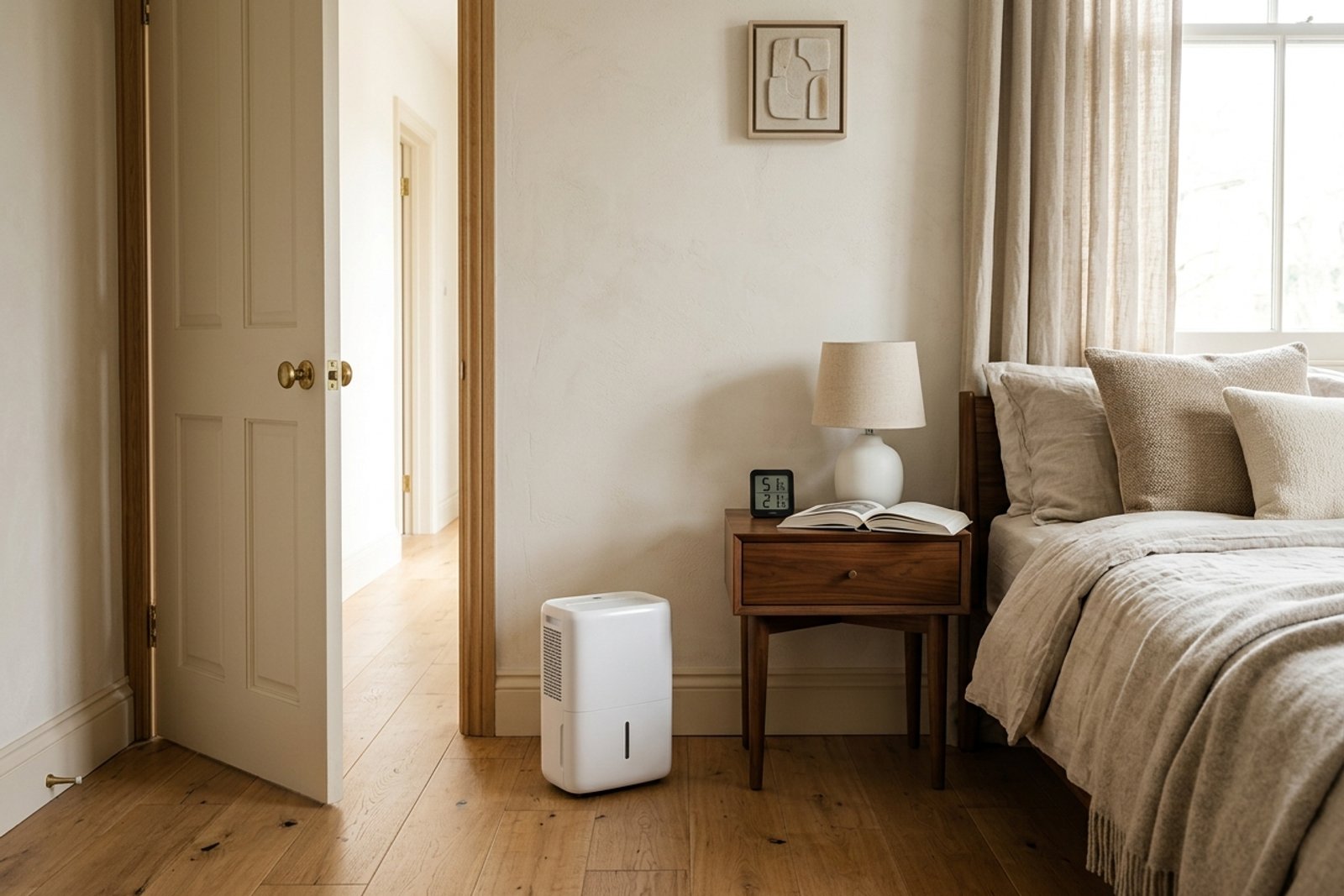
A dehumidifier is the step for a bedroom that still reads over 50 percent after a week of the free fixes. Set it to 40 percent, empty it daily, and keep it clear of the wall and the curtains so air can reach the intake.
One trade off to know about: curtains. Closing them at dusk keeps a cold room warmer, but on a window that drips, they also make the glass colder and give the wet air a hidden place to settle. Until the humidity is under 40 percent, open them the moment you wake, and keep them off the sill. Once the window stays dry, closing them at night is fine again.
Is condensation between window panes bad?
Yes, for the window, though not for your health. Fog trapped between the two panes means the edge seal has failed and humid air has leaked into the gap. Pella and other window makers describe it the same way: the insulating gas escapes, moisture gets in, and the unit stops insulating as designed.
You cannot wipe it or dry it out from inside the room. The fix is replacing the sealed glass unit, not always the whole window, and in a rental that is the landlord's repair. Take a photo on a cold morning, when the fog is easiest to see, and send it in writing.
How to tell where the water is:
- On the room side, a finger wipes a clear line. This is humidity, and the fixes above solve it.
- Between the panes, a finger leaves no mark from either side. This is a failed seal.
- On the outside, it is dew on the outer glass on a clear, still morning. Window makers note this happens on efficient glass and means the window is insulating well.
Should I be worried about condensation on my windows?
Only if it is happening every morning and nobody is drying it. Water left on the sill day after day soaks into the paint and caulk first, then the wood or drywall around the frame. That is where the black spots start, and they mean the moisture has been there for a while.
The US Environmental Protection Agency's guidance on condensation is to act quickly: dry the wet surface and reduce the source of the moisture. Its mold guide adds that damp materials dried within 24 to 48 hours usually will not grow mold, and that a moldy patch smaller than about 10 square feet (roughly 3 feet by 3 feet) is something most people can clean up themselves.
For black spots on a sill or the bottom of a frame:
- Scrub hard surfaces with detergent and water, then dry them completely.
- Wear gloves, and keep the window open while you work.
- Replace mildewed caulk rather than scrubbing it.
- Tell the landlord in writing if the spots keep coming back after the humidity is down, or if they spread onto the wall.
Bedding and the mattress matter too. A bed pushed against the window wall sits in the damp, cold air that slides off the glass, which is one more reason to move the headboard to an interior wall. Our guide to why a bedroom feels hard to sleep in covers the other reasons that wall is the wrong one.
Frequently Asked Questions
Why is there condensation on the inside of my window in the morning?
Because the night is when the glass is coldest and the room is most humid. Outdoor temperatures bottom out just before dawn, and a closed bedroom has been collecting moisture from your breathing for hours. When the air next to the glass cools past its dew point, the water comes out on the window.
Why are my bedroom windows wetter in winter?
Because the glass gets colder as the outside does, so the humidity it can handle drops. Window makers' guidance, based on University of Minnesota studies, allows up to 40 percent indoor humidity when it is 20°F to 40°F outside, but only 30 percent at 0°F to 10°F. A level that was fine in October can fog the glass in January.
Does vinegar stop condensation on windows?
No. A vinegar wipe cleans the glass and can help on a moldy sill, but it does nothing to the humidity in the room or the temperature of the glass, so the water comes back the next morning. Lowering the humidity is the only fix that lasts.
Will a dehumidifier stop condensation on my bedroom windows?
Usually, if the room reads over 50 percent after the free fixes. Set it to 40 percent, close the bedroom door while it runs, and empty the tank every day. It treats the symptom, so keep the laundry out and the door open overnight as well.
Should I keep my curtains open or closed at night?
On a window that drips every morning, open them as soon as you wake and keep them off the sill. Closed curtains keep a cold room warmer but make the glass colder behind them. Once the humidity is under 40 percent and the window stays dry, closing them at dusk is fine again.
Is condensation on windows a sign of mold?
Not by itself, but it is the condition mold needs. The EPA notes that damp materials dried within 24 to 48 hours usually will not grow mold, so a sill wiped dry every morning stays clean. Black spots on the sill or frame mean the water has been sitting there for days.
Written by the Spatia Editorial Team. Spatia is published by STUDIO DID IT, the practice founded by interior designer Jihyun Lee. Bedroom guides here stick to fixes a renter can make without a drill, a contractor, or the landlord's sign off.
The Noticer
For thoughtful people who notice spaces.
What did you notice?
Did something in this story make you see your own space differently?
Ask Archie why your bedroom window is dripping
Send Archie a photo of the bedroom with the window in frame. Archie reads where the bed, the heater, the curtains, and the door sit, and tells you which one to move first so the glass stays dry.
Diagnose my wet window with ArchieAdvertisement. Archie is made by STUDIO DID IT, the studio that publishes Spatia.
Related Articles

Why Is One Room in My House So Cold? (6 Causes You Can See)
Why is one room in my house so cold? Usually a surface problem, not a furnace problem. See the 6 causes you can spot by eye and the free fix to try first.

Why Does My Bedroom Feel Hard to Sleep In? (5 Room Fixes)
A bedroom feels hard to sleep in when layout, light, heat, and visual noise keep you alert. Run this room check before you buy a new mattress.

How to Cool a Bedroom Without AC for Sleep: 12 Moves for Summer 2026
Cool a bedroom without AC for sleep: 12 layered moves that stack curtains, airflow, and bedding so the room stays cooler all night, from under $250.