Cold Floors in an Apartment: What a Rug Actually Fixes
Cold floors in an apartment are a surface problem, not a thermostat problem. See the tested R values, and why the pad under the rug does most of the work.
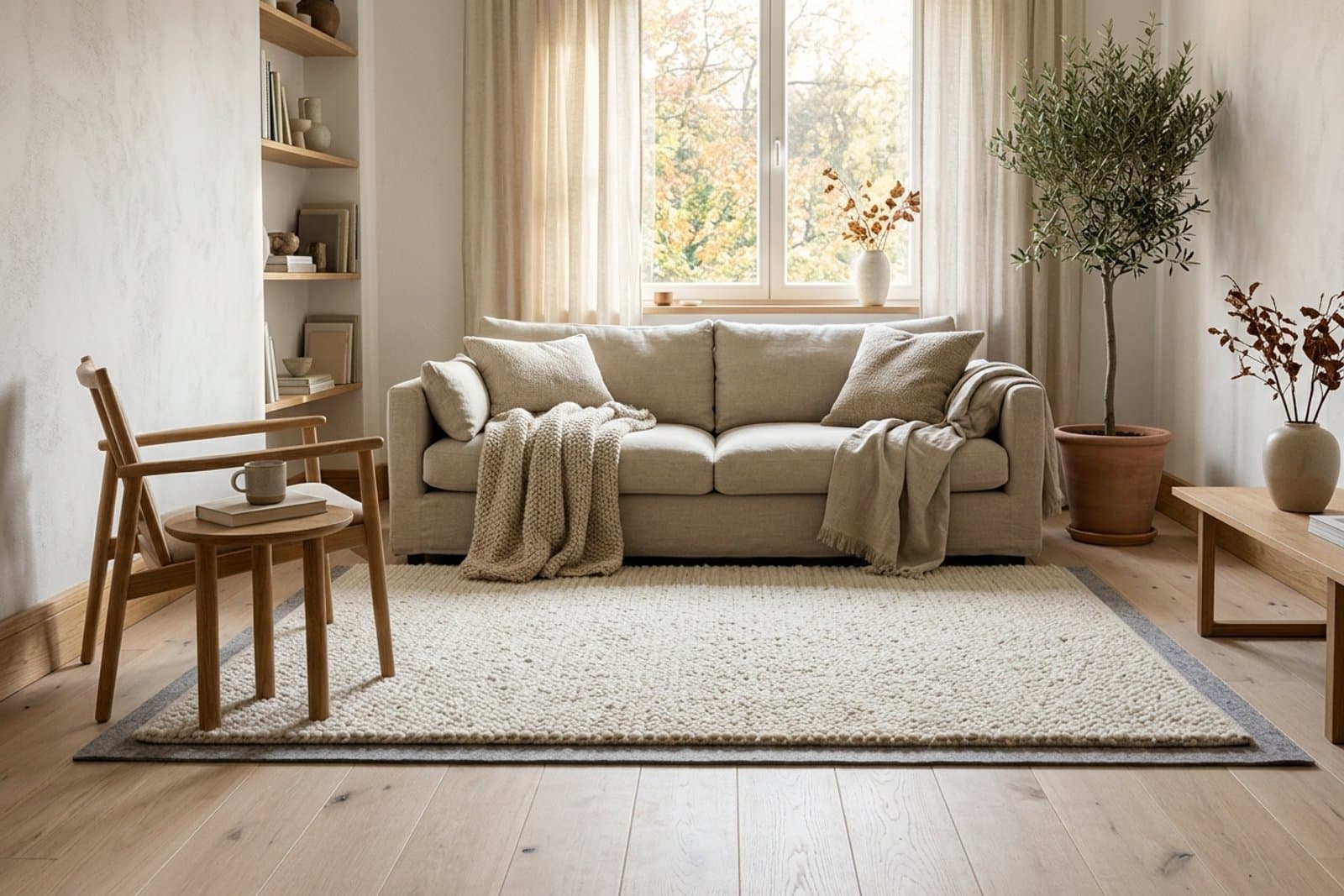
Cold floors in an apartment are a surface temperature problem, not an air temperature one. ANSI/ASHRAE Standard 55-2023 asks for floor surfaces between 66.2°F and 84.2°F where people sit with their feet on the floor, and a thermostat set to 70°F will not pull an uninsulated subfloor into that band.
The fix is thermal resistance laid on top of the floor. In the Carpet and Rug Institute's tested numbers, the pad often carries more of that resistance than the rug does.
This is for a room where the air reads fine and the floor does not, in a unit you probably cannot renovate. It is not a radiant heating guide. If the room feels heavy rather than cold, start with why your room feels stuffy. If the chill is arriving at the glass instead of the floor, the layering order is in our guide to curtains that work at the window. If one room is colder than the rest of the home, start with why one room in your house is so cold.
Why are my apartment floors so cold?
Because the floor is the largest single surface you are in contact with, and in most apartments it sits directly above something nobody heats. A ground floor unit sits over a slab, a crawl space, or a parking garage. A second floor unit can sit over a lobby, a breezeway, or a mail room that runs 20 degrees colder than the apartment above it.
ANSI/ASHRAE Standard 55-2023, the standard that defines thermal comfort conditions for occupied buildings, is unusually direct about why a warm thermostat does not settle this. It lists the causes of local thermal discomfort separately from whole body comfort, and the list includes draft, the temperature difference between your head and your ankles, radiant temperature asymmetry, and floors that are too warm or too cool. A room can satisfy every whole body condition and still fail on the floor.
The standard also puts a number on the cold surface effect. Table 5-10 allows a wall no more than 10°C, or 18.0°F, cooler than the air before radiant asymmetry alone is expected to make people uncomfortable, a limit built on the point where 5 percent of occupants are dissatisfied. A single pane window wall in January clears that margin easily, and so does a floor over an unheated garage.
| What you notice | Most likely cause | What to check | First move |
|---|---|---|---|
| Floor is cold everywhere, evenly | Unheated space directly below | What is under the unit | Pad plus rug on the standing zones |
| Only the outside wall side of the room | Cold perimeter and rim joist | Floor temperature at the baseboard | Seal the baseboard gap first |
| Cold air moving across your ankles | Draft, not floor temperature | Entry door, balcony door, window sill | Door sweep and weatherstrip |
| Tile and stone read cold, wood nearby does not | Conduction through the material | Whether you are barefoot | Runner or pad in that zone |
| Floor feels fine in shoes, bad barefoot | Material conductivity | Same spot, both ways | A soft layer, not more heat |
That last row is the one the standard itself flags. Its own commentary says that for people in lightweight indoor shoes, "the temperature of the floor, rather than the material of the floor covering, is the most important factor for foot thermal comfort while wearing shoes," and then states plainly that the standard "does not address the floor temperature required for people not wearing shoes." Nearly every apartment complaint about cold floors happens barefoot, in the gap the standard declines to cover. That is not a loophole. It is the reason the material you put down matters more than the thermostat reading suggests.
Do rugs actually make a room warmer?
A rug makes the floor warmer to touch, which is most of what you feel, but its own insulating value is smaller than the marketing implies. The Carpet and Rug Institute publishes measured R values from a study by the Georgia Institute of Technology School of Textile Engineering, and the tested samples land between R 0.55 and R 2.46. That is a narrow range, and the top of it is roughly four times the bottom, so the choice matters even though no rug is going to perform like insulation.
The study's headline finding is the useful one, because it contradicts almost everything written about warm rugs: it "concluded that the total R-value is more dependent on the total thickness of the carpet than on the type fiber content." Thickness is the lever. Fiber is a distant second.
Here is what that looks like in the tested samples:
| Sample | Pile height | R value |
|---|---|---|
| Nylon level loop | 0.125 in | 0.68 |
| Nylon level loop, denser | 0.125 in | 0.55 |
| Acrylic level loop | 0.210 in | 0.78 |
| Acrylic level loop, attached foam back | 0.210 in | 1.03 |
| Polyester plush | 0.280 in | 0.95 |
| Wool plush | 0.487 in | 2.19 |
| Nylon saxony | 0.552 in | 1.96 |
| Nylon shag | 1.25 in | 2.46 |
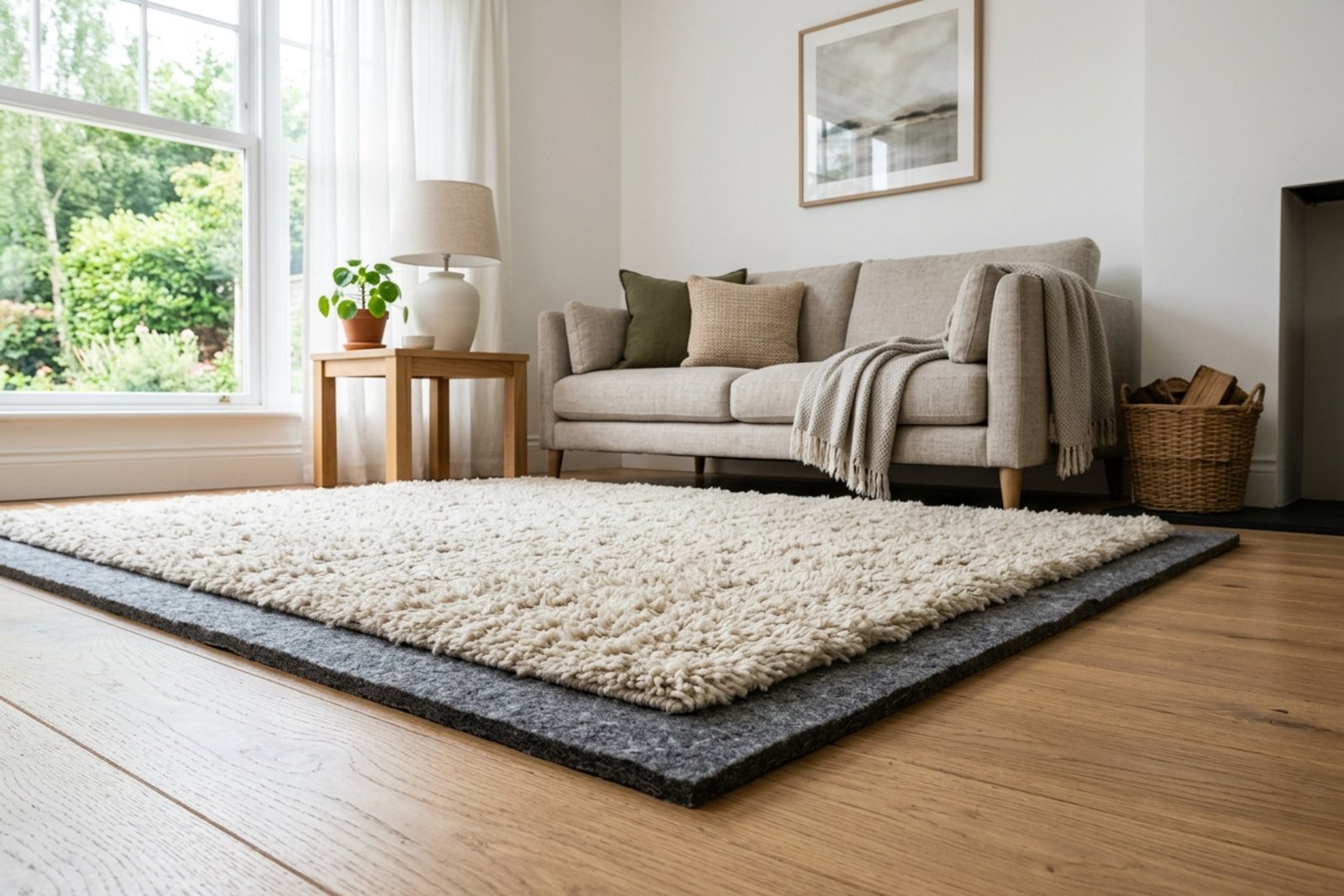
Read the third and fourth rows together, because they are the same face construction at the same pile height. Adding an attached foam back moved an acrylic level loop from R 0.78 to R 1.03, a 32 percent gain with no change to the part you can see. That is the whole argument for the pad, made inside a single pair of samples.
When you have no published figure to work from, the Institute offers a proxy: "multiplying the total carpet thickness measured in inches by a factor of 2.6 to approximate the carpet's R-value." A half inch rug lands near R 1.3 by that rule, which matches the tested wool and nylon samples in that thickness range closely enough to plan with.
What R value do I need under a rug?
Aim for a combined rug and pad total near R 2.5 to 3, and build it from the bottom up. R values stack, which the Carpet and Rug Institute states explicitly: "R-values are additive for any combination of materials. For example, a combination of carpet with an R-value of 1.3 and a prime polyurethane cushion with an R-value of 1.6 will yield an overall R-value of 2.9."
The cushion table is where most people lose the argument without realizing it, because the thin mesh pad sold for grip is the worst performing material on the list.
| Cushion material | Thickness | R value |
|---|---|---|
| Slab rubber | 0.23 in | 0.62 |
| Waffled sponge rubber | 0.43 in | 0.78 |
| Prime polyurethane | 0.40 in | 1.61 |
| Hair and jute, coated | 0.44 in | 1.71 |
| Bonded polyurethane | 0.50 in | 2.09 |
A half inch bonded polyurethane pad at R 2.09 carries more thermal resistance than every rug in the carpet table except the 1.25 inch shag. The quarter inch slab rubber pad at R 0.62 carries about as much as the thinnest nylon loop. Both are sold in the same aisle, at prices that do not signal the difference.
One honest limit. No rug pad manufacturer publishes an R value. RugPadUSA sells 100 percent felt pads in quarter inch, three eighths inch, and half inch, and describes them by density, cushion, and floor protection, with no thermal rating anywhere in the product line. Mohawk and the major retail listings do the same. So match by material and thickness against the Institute's table, or use the 2.6 per inch rule, and treat any pad advertising an R value with suspicion until it names a test method.
What is the warmest rug material for cold floors?
Thickness first, fiber second, and the tested data is blunt about the order. The highest R value in the Georgia Institute of Technology samples was a nylon shag at 1.25 inches of pile, R 2.46, ahead of a wool plush at R 2.19 and well ahead of a wool or nylon rug in a low profile weave. A high pile synthetic beats a flatweave wool on thermal resistance, every time, because there is more trapped air in it.
Wool still earns its place, just not on this axis. It holds resilience under furniture, it manages moisture without feeling clammy, and it ages better over the ten or fifteen years a good rug stays in a room, which is the argument for treating it as an investment rather than a seasonal purchase. If you want warmth and wool together, buy wool in a plush or high pile construction rather than a flatweave, and put the thickness in the pad.
Three constructions to avoid on a cold floor, regardless of fiber: flatweaves and kilims, which have almost no loft; indoor and outdoor polypropylene rugs, which are built to shed water rather than trap air; and anything described as low profile, which is a shipping and door clearance feature, not a comfort one.
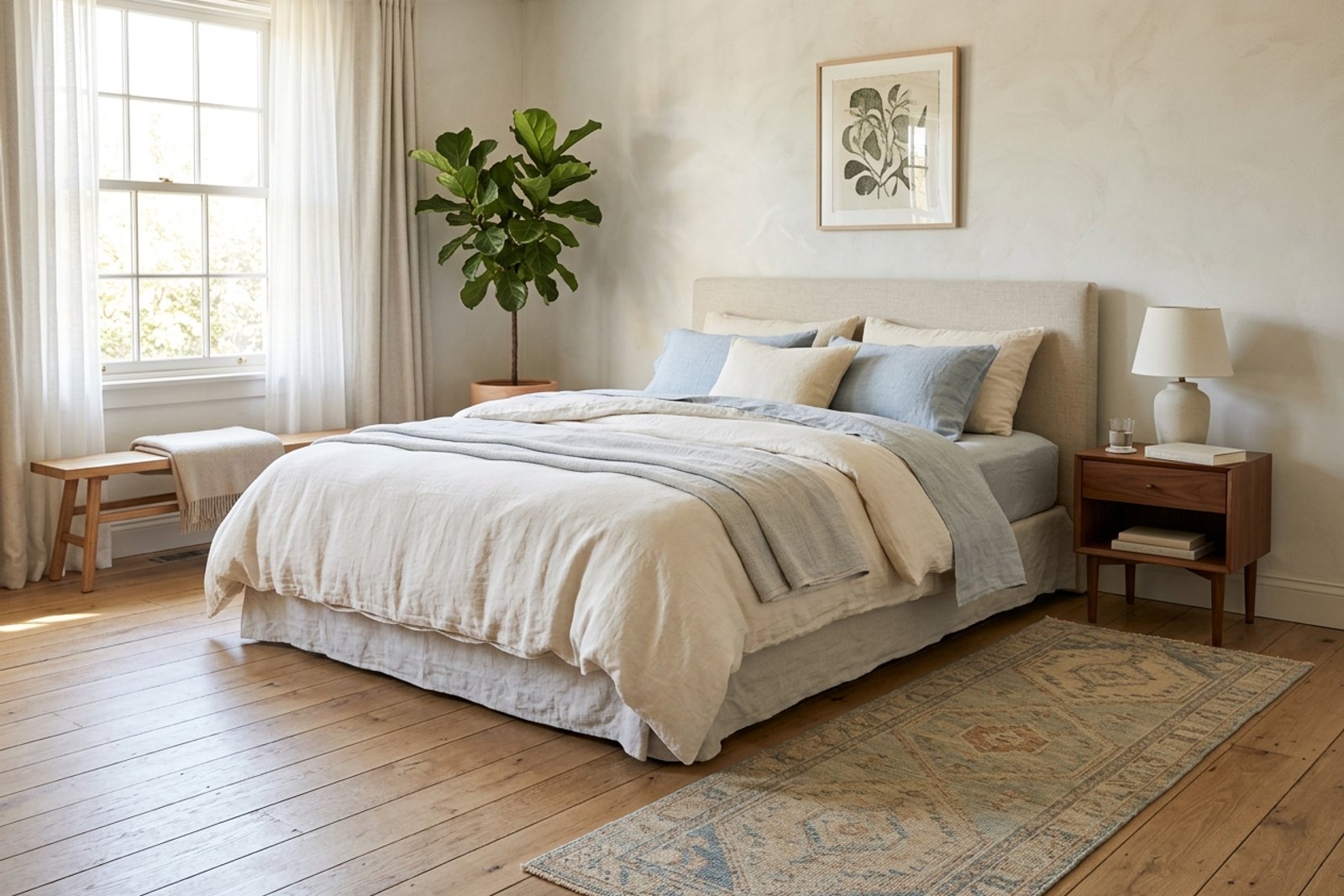
Size matters as much as specification. The floor temperature you feel is only the floor temperature where your feet are, so cover the standing zones rather than centering a rug in the room: the side of the bed you get out of, the strip in front of the sofa, the two feet at the kitchen counter. A rug that stops short of where you stand is decoration. Our guide to rooms that feel cramped covers how to scale a rug to the furniture rather than to the walls.
One safety note, because thick pads and loose edges work against each other. A high loft rug has a taller edge, and a taller edge is a trip point, especially at a doorway or the top of a stair. Keep thick rugs inside the room rather than crossing thresholds, and choose a pad cut slightly smaller than the rug so the edge lies flat. Our guide to designing a home you can stay in for the long term covers the level change rule this belongs to.
How do I warm up cold floors without carpet?
Layer thermal resistance where your feet land, then close the perimeter of the room, then handle the glass. In that order, because the first step is the only one you will feel the same day.
- Measure the floor, not the air. Point an infrared thermometer at the coldest patch and compare it to the 66.2°F to 84.2°F band in ANSI/ASHRAE Standard 55-2023. If the air reads 70°F and the floor reads 58°F, no thermostat setting is going to solve this.
- Map the standing zones. Mark the four or five spots where you are actually barefoot. Those are the only square feet that need covering, which usually means two or three well sized rugs rather than wall to wall anything.
- Choose the pad before the rug. Start at half an inch of felt or bonded polyurethane. The Carpet and Rug Institute's cushion table puts a half inch bonded polyurethane pad at R 2.09, against R 0.62 for the thin slab rubber mesh most people default to.
- Add total thickness on top. Use the Institute's 2.6 per inch rule to estimate what you are buying, and aim for a combined total near R 2.5 to 3.
- Seal the perimeter. Close the gap where the floor meets the baseboard on exterior walls, and fit a sweep on the entry and balcony doors. The ENERGY STAR air sealing fact sheet puts air leakage at 25 to 40 percent of the energy used for heating and cooling in a typical residence, and cold air arriving at ankle height reads as a cold floor even when the floor is fine.
- Handle the glass and the humidity. The U.S. Department of Energy puts heat gain and loss through windows at 25 to 30 percent of residential heating and cooling energy use, so an insulating layer at the window protects the comfort you just bought. Keep relative humidity inside the 30 to 50 percent range the EPA recommends in its guide to mold and moisture, since very dry heated air makes the same room read colder.
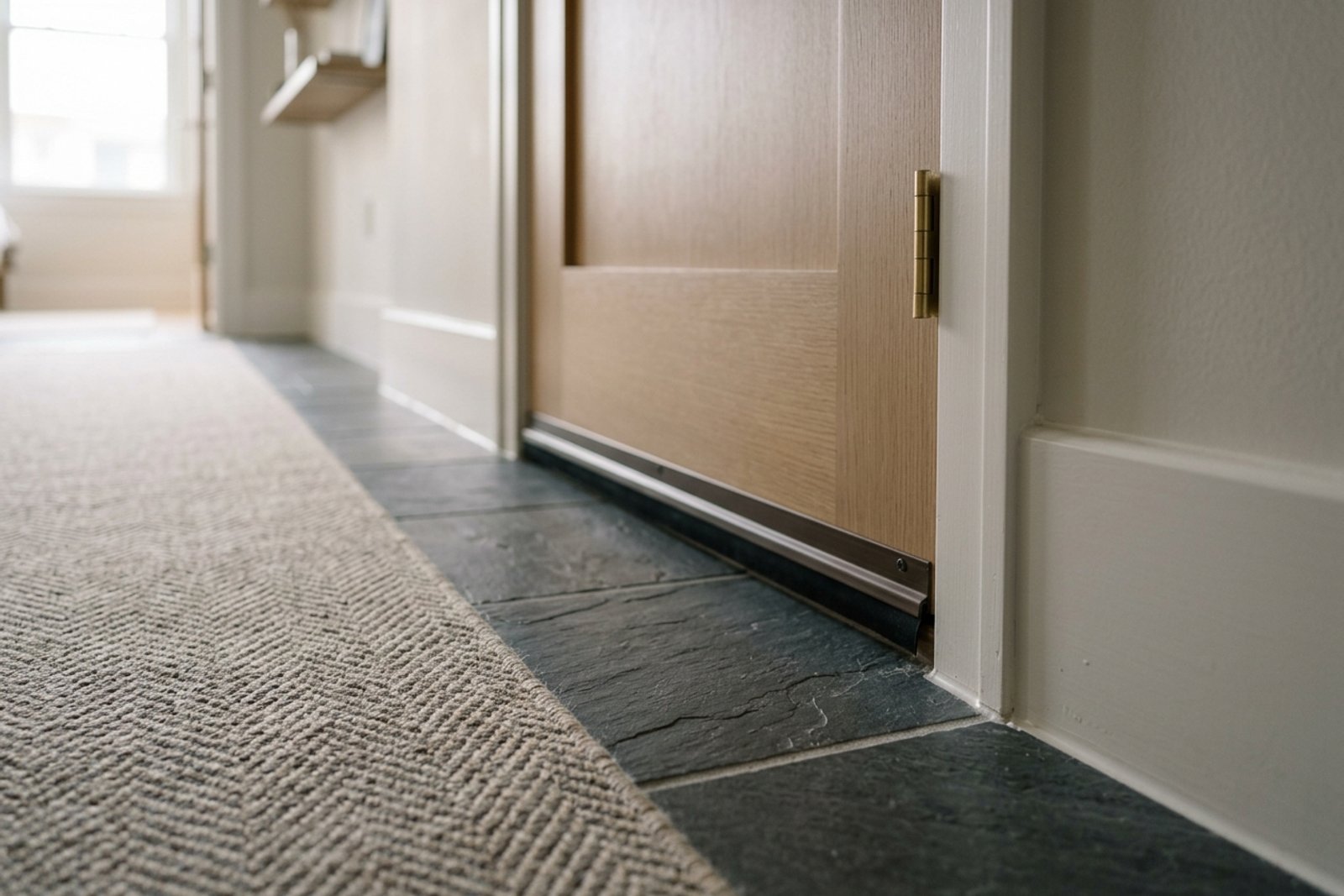
Two cautions. Sealing a room tightens it, and a tighter room needs a deliberate air exchange rather than an accidental one, which is the exchange covered in why your room feels stuffy. And skip anything that puts a heat source under a rug. Foil backed foam underlayment, heated mats intended for bathrooms, and plug in floor warmers were not tested with a high pile rug on top of them, and R 2.5 of trapped insulation above a heater is how you find that out.
Will fixing the floor lower my heating bill?
The rug buys comfort. The sealing buys the bill. Keeping those separate is the honest answer, because no manufacturer or standards body publishes a figure for what an area rug does to a heating bill, and any page that gives you one made it up.
What is measured is the envelope. The EPA states that "homeowners can save an average of 15% on heating and cooling costs (or an average of 11% on total energy costs) by air sealing their homes and adding insulation in attics, floors over crawl spaces and basements." That sentence names floors over crawl spaces specifically, which is the cold floor case, and it is also the one item on the list a renter cannot do. If you own the unit, insulating the floor assembly is the move with the number attached to it. If you rent, the perimeter sealing in step five is the version available to you.
The indirect saving is real but not quantified anywhere we can cite. A floor that reads inside the ASHRAE band is a floor you stop compensating for by pushing the thermostat up, and the thermostat is where your bill actually lives. Treat that as a reason to fix the floor, not as a number to put in a spreadsheet.
Frequently Asked Questions
What R value do I need for a rug on a cold floor?
Aim for a combined rug and pad total near R 2.5 to 3. The Carpet and Rug Institute states that R values are additive and gives a worked example of a carpet at R 1.3 over a prime polyurethane cushion at R 1.6 for an overall R 2.9. Build most of it in the pad, since a half inch bonded polyurethane cushion tested at R 2.09 against R 0.62 for quarter inch slab rubber.
Does a rug pad really make a difference for warmth?
Yes, and it is usually the larger half of the total. In the Georgia Institute of Technology samples reported by the Carpet and Rug Institute, adding an attached foam back to an acrylic level loop at the same 0.210 inch pile height raised it from R 0.78 to R 1.03. A separate half inch pad does considerably more than that. The thin rubber mesh pad sold for grip contributes almost nothing thermally.
What is the warmest type of rug for a cold apartment floor?
A high pile construction, whatever the fiber. The highest R value among the samples the Carpet and Rug Institute publishes was a nylon shag at 1.25 inches of pile, R 2.46, ahead of a wool plush at R 2.19. The Institute's own conclusion was that total R value depends more on total thickness than on fiber type, so pile height is the specification to shop on. Avoid flatweaves and low profile rugs on a cold floor.
How cold is too cold for a floor?
ANSI/ASHRAE Standard 55-2023 sets floor surface temperatures of 19°C to 29°C, or 66.2°F to 84.2°F, for occupants seated with their feet on the floor, a range built around no more than 10 percent of people being dissatisfied. The standard notes it does not set a figure for barefoot occupants, so treat that band as a floor rather than a target if the room is used without shoes.
Why is my floor cold when the thermostat says 70?
Because a thermostat measures air at one point and your body also exchanges heat with every surface around it. ANSI/ASHRAE Standard 55-2023 treats cold floors, drafts, radiant asymmetry, and head to ankle temperature differences as local discomfort causes separate from whole body comfort. An apartment floor over a garage, slab, or unheated lobby can sit well below the room air with the heating working correctly.
Can I fix cold floors in a rental without landlord permission?
Yes, for everything except the floor assembly itself. Pads and rugs, removable door sweeps, adhesive weatherstripping at the entry door, and an insulating layer at the window all come off at move out. The measured insulation work the EPA credits with 15 percent heating and cooling savings involves floors over crawl spaces and basements, which is owner territory, so a renter should put the effort into the standing zones and the perimeter instead.
The Noticer
For thoughtful people who notice spaces.
What did you notice?
Did something in this story make you see your own space differently?
Ask Archie where the rug actually needs to go
Send Archie a photo of the room with the cold floor. Archie reads the standing zones, the traffic path, the furniture footprint, and the window wall, then tells you what size rug covers the floor you actually use instead of the floor you can see.
Plan my rug with ArchieAdvertisement. Archie is made by STUDIO DID IT, the studio that publishes Spatia.
Related Articles
Why Does My Room Feel Stuffy? (5 Real Causes)
Stuffy air comes down to stale air, trapped moisture, and no exchange path, and temperature barely enters into it. See the 5 causes and the 5 minute winter fix.
How to Ventilate a Bathroom Without a Window (6 Ways)
See how to ventilate a bathroom without a window: size the fan at 1 CFM per square foot, duct it outdoors, and run it 20 minutes after every shower.
How to Ventilate a Room Without Windows (7 Ways)
No operable window at all? Give the air an exhaust route plus a separate intake, then size the fan to the ASHRAE 62.2 minimum of 50 CFM. 7 ways, door to duct.