Small Living Room Work Zone Ideas (5 Setups That Disappear)
Small living room work zone ideas that keep the desk off the walking path and off duty by evening. See 5 setups, real depths, and a two minute reset plan.
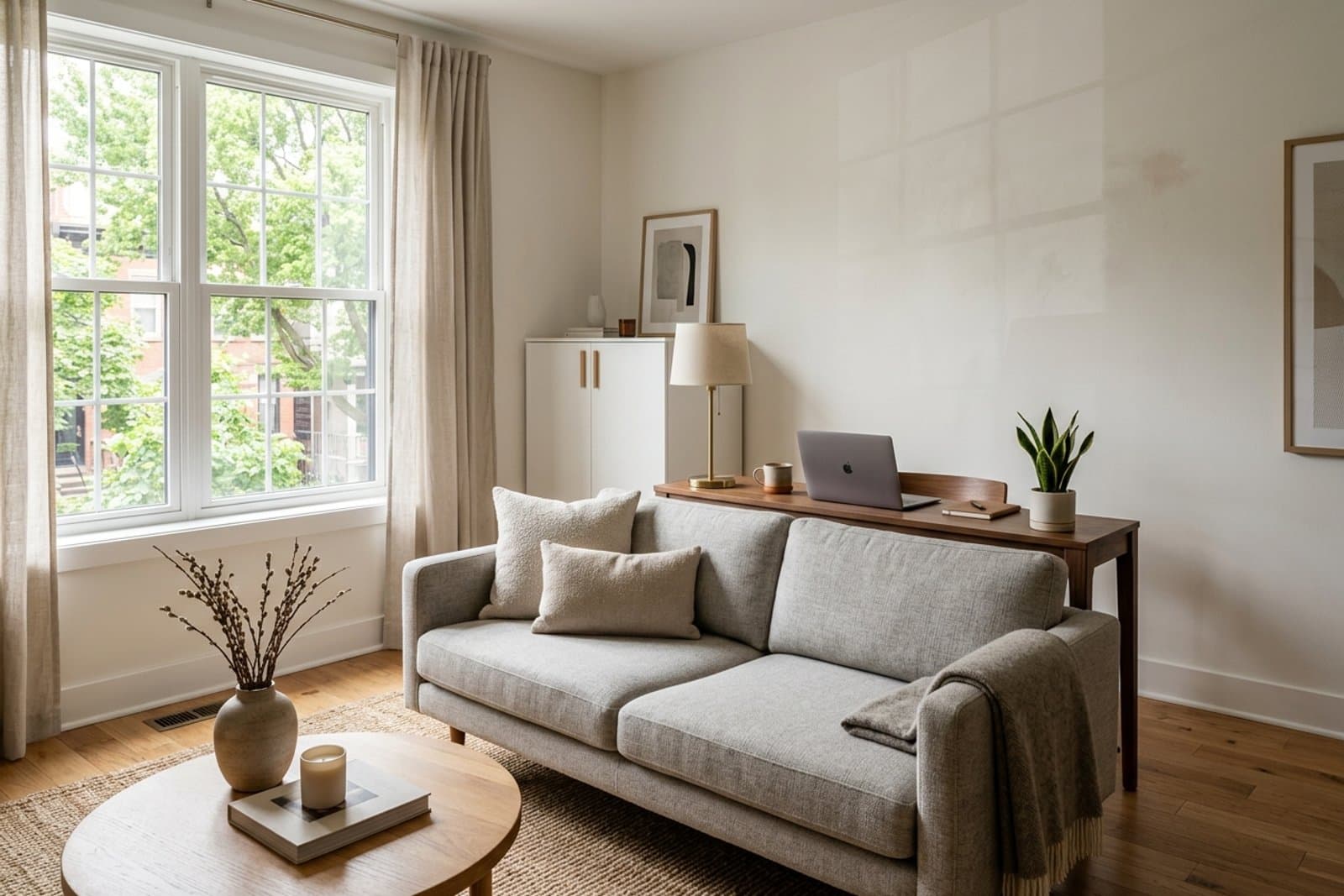
Small living room work zone ideas work best when the office function is treated as a zone, not a new room squeezed into the corner. Put the desk where it borrows light, keeps at least 30 inches of walking path clear, and can disappear visually when the laptop closes. A slim desk 16 to 20 inches deep, a console, a wall shelf, or the dining table can all work if the zone has a clear boundary and storage for daily clutter.
The goal is not to hide that work happens at home. It is to stop work from owning the living room after 5 pm, when the sofa is also where you recover. This guide is for renters and homeowners fitting real work into a room they still want to relax in, not for anyone lucky enough to close a door on a spare room. If the room mainly feels tight, start with why your room feels cramped; if it is a studio, read how to divide a studio into zones; and if work clutter is making the room feel loud, the clean but cluttered room guide will help too.
Where should a work zone go in a small living room?
Put the work zone on the quietest wall that does not interrupt the path from the doorway to the sofa. In most small living rooms, that means beside the sofa, behind the sofa, or on a short wall near a window. Avoid placing the chair where someone has to step around it every time they cross the room.
The living room 2/3 rule is a useful sizing check here. When the sofa takes up about two thirds of its wall, the leftover third is usually the natural slot for a slim desk or console.
The best test is physical, not visual:
- Pull out the desk chair as if you are working.
- Walk from the room entrance to the sofa and window.
- If you have less than 30 inches of path, move the work zone.
A work zone that blocks the room will feel wrong even if the desk is beautiful.
What is the best work surface for a living room office combo?
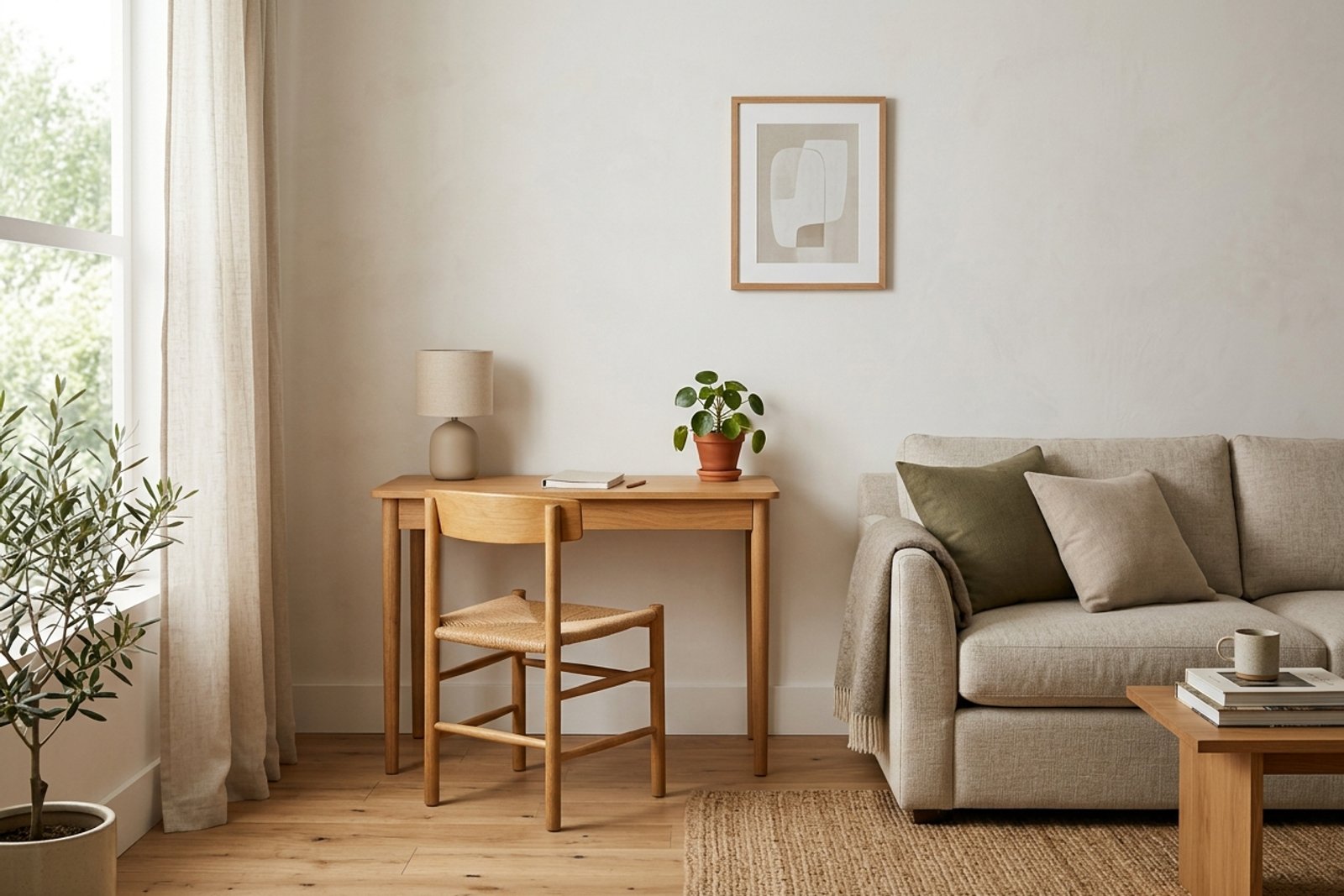
The best work surface for a living room office combo is the one that resets fastest, not the biggest desk that fits. In a very small living room, a dining table, console, or wall mounted shelf can beat a separate desk because it does not add another chair, another cable nest, and another visual stop.
Choose the surface by the kind of work you do:
- Laptop only: use a narrow console, wall shelf, or table end.
- Paper heavy work: use a real desk with one closed drawer.
- Video calls: choose the wall with the calmest background, not the brightest corner.
- Evening work: make sure a lamp can sit beside the screen without glare.
The furniture matters less than the reset. If the surface cannot return to living room mode in two minutes, it is too demanding for the space.
How do you make a living room office disappear after work?
Give the work zone a shutdown ritual that is as visible as the desk itself. A laptop left open, a cable crossing the floor, and papers stacked beside the sofa keep the room in office mode. The body reads those objects as unfinished tasks, even when you are trying to rest.
Cal Newport popularized the shutdown ritual in his book Deep Work: a fixed end of day routine that tells the brain work is over. When the office sits six feet from the sofa, the ritual has to be one you can see.
Set up one landing place for every work object:
- Laptop and notebook into a tray, drawer, or closed basket.
- Charger clipped to the desk leg or hidden in a cable box.
- Headphones on one hook, not on the sofa arm.
- Work chair tucked fully under the surface.
The room does not need to look unused. It needs to look off duty.
What furniture works best for a small living room work zone?
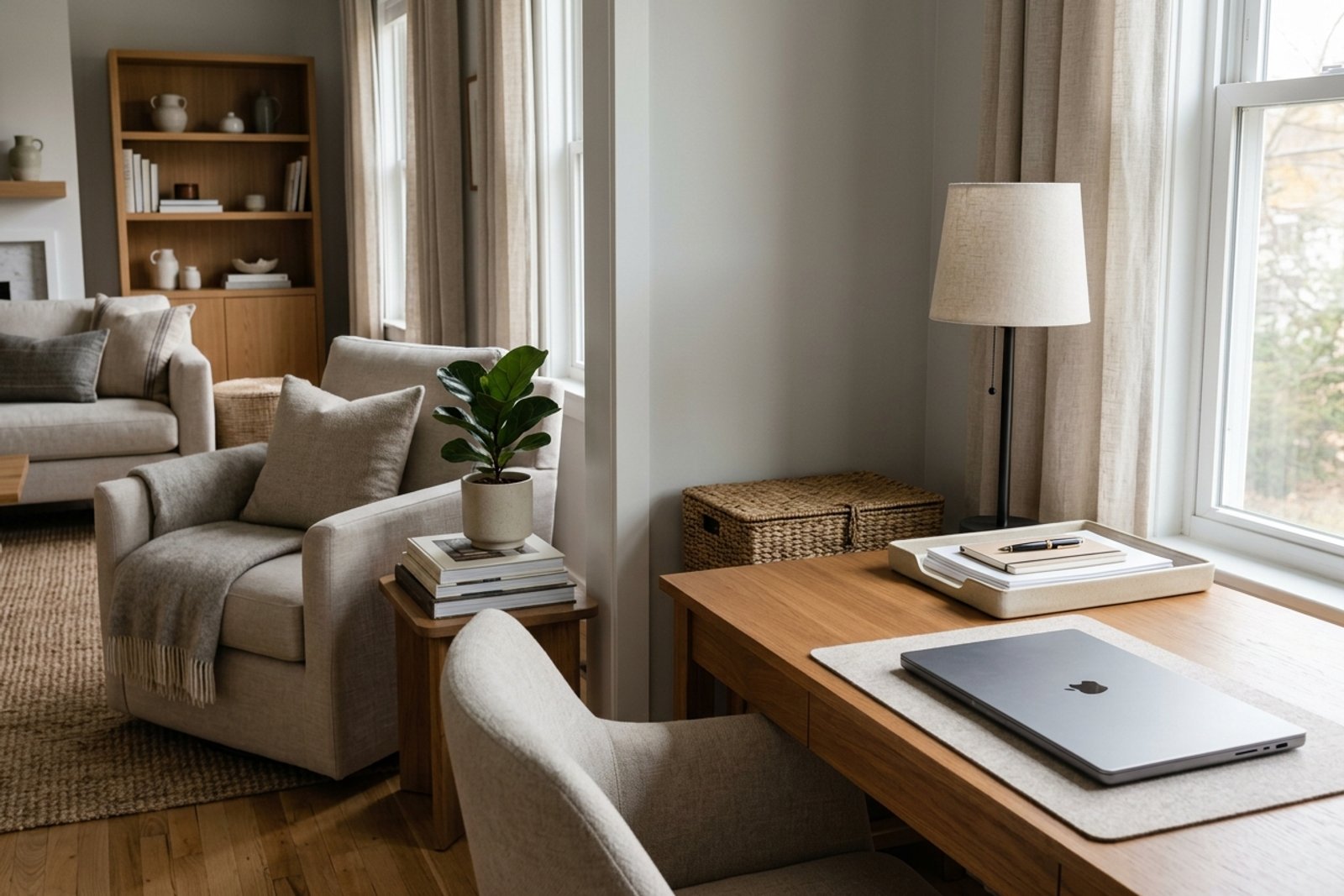
The best furniture is shallow, closed, and easy to clear. Start with depth before style. A work surface that is 16 to 20 inches deep can handle a laptop and notebook without stealing as much floor as a standard office desk. If you use a monitor, choose a 24 inch screen before you choose a deeper desk.
Good options are simple:
- A slim writing desk with one drawer. The IKEA MICKE, about 29 inches wide and just under 20 inches deep, is the classic example.
- A wall mounted shelf with a chair that tucks in.
- A console behind the sofa for laptop work.
- A cabinet desk that closes when work ends.
- A small round dining table if it already serves two jobs.
| Work surface | Best for | Watch out for |
|---|---|---|
| Slim desk with one drawer | Paper heavy work | Becomes a dumping surface if the drawer fills |
| Wall mounted shelf | Laptop only work | Needs a chair that tucks fully under |
| Console behind the sofa | Laptop work in tight layouts | Cables dropping behind the sofa |
| Cabinet desk that closes | Rooms where work must vanish | Deeper footprint than a shelf |
| Dining table | Rooms already short on floor space | Every meal requires a full reset |
Skip open shelves above the desk unless you are unusually disciplined. In a living room, visible office supplies read as clutter faster than decor does.
The chair gives the zone away faster than the desk
In office design, the task chair is the strongest signal in the room: wheels, levers, and mesh say work even when every paper is put away. At home I often keep the desk and change the seat. A wooden or upholstered dining chair with decent back support handles two or three laptop hours comfortably, and when it tucks under the surface the zone reads as furniture rather than as an office waiting for Monday. If your work runs long and ergonomic support is not negotiable, roll the task chair to a closet or corner at shutdown. Clearing the desk while the office chair stays visible is only half a reset.
How should lighting work when the living room is also an office?
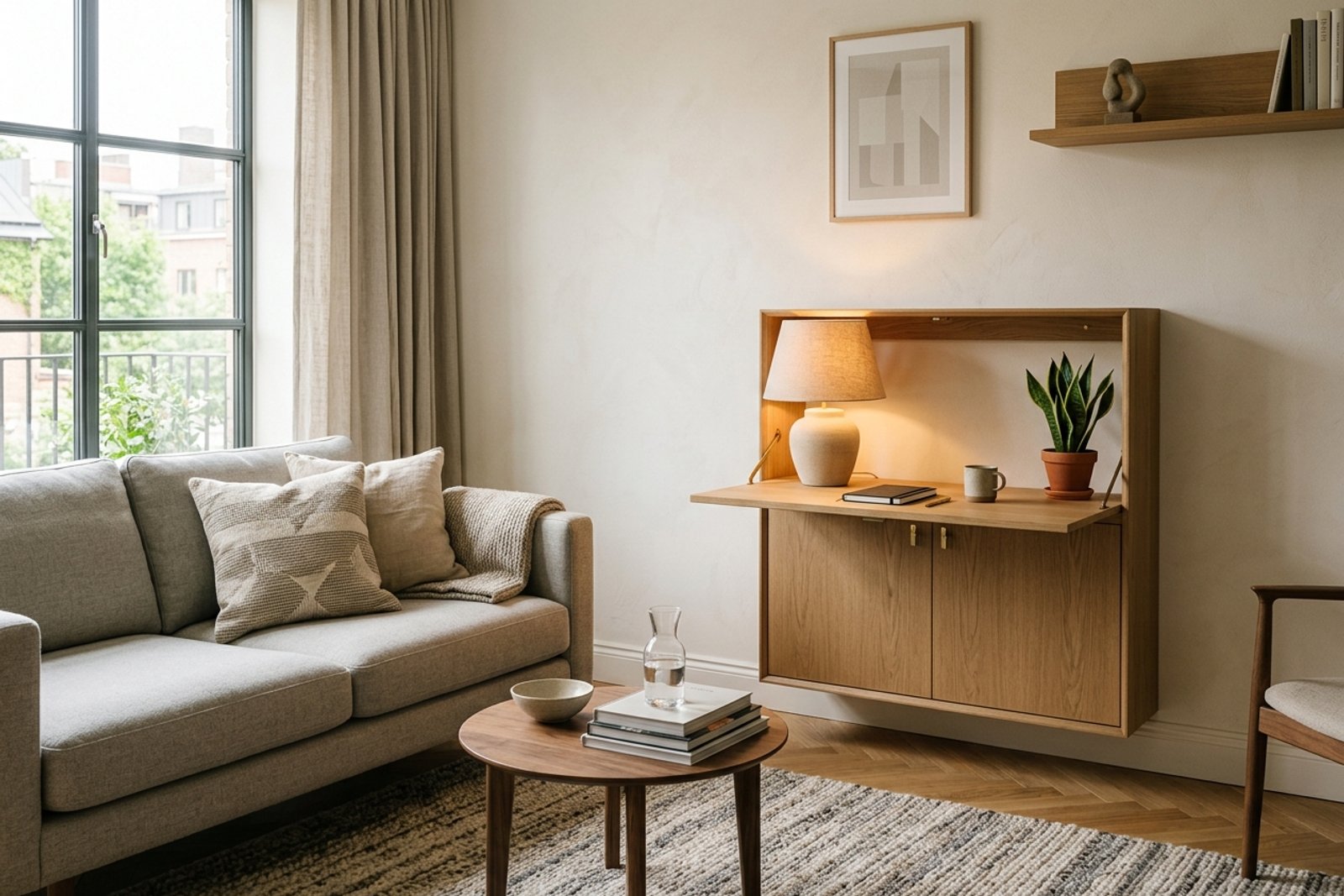
Use one task light for work and keep the room's relaxation lighting separate. A desk lamp should light the keyboard and notebook without throwing glare onto the television or into the sofa area. After work, that lamp should turn off and the living room lamps should take over.
A simple lighting plan is enough:
- Task lamp at the desk, 2700K to 3000K. A basic Philips Hue White (2700K, E26) works, and so does any dimmable warm LED.
- Sofa lamp at sitting height for evening use.
- Window light during the day, controlled with curtains if the screen reflects.
If the room runs dark even by day, where to put lamps in a dark room covers placement in more depth.
Do not solve work lighting by making the whole room brighter. That is how a living room starts feeling like a waiting room. Light the task, then let the rest of the room stay softer.
What is the fastest way to test a work zone before buying furniture?
Mock it up for one workday. Put a folding table, dining chair, or cardboard box where the desk would go. Sit there for 20 minutes, take one video call if that is part of your work, and then reset the room at the end of the day. The test tells you more than a floor plan.
Run the mock up on a normal workday, not a quiet Sunday, so the traffic and light match reality.
Check four things before you buy:
- Can you reach an outlet without a cord crossing the walkway?
- Can the chair tuck in all the way?
- Is the background calm enough for a call?
- Can you put everything away in two minutes?
If the answer is no, look at the location, the storage, or the shutdown plan before you blame the desk.
A small living room can hold a work zone without losing its living room job. The trick is deciding what the room should feel like when work is finished, then arranging the desk around that feeling. Archie can help with that decision because it reads the whole room at once: path, light, sofa view, storage, and the point where work starts taking over.
Frequently asked questions
How can I create an office space in my living room?
Pick the quietest wall that leaves at least 30 inches of walking path, use a work surface 16 to 20 inches deep, and give every work object a closed landing place: a tray for the laptop, a cable box for the charger, a hook for headphones. The office exists during work hours and goes off duty when the room does.
What is the 2/3 rule for living rooms?
The 2/3 rule is a proportion guideline. The sofa should take up about two thirds of the wall it sits on, and the coffee table should run about two thirds the length of the sofa. For a work zone, the useful part is the leftover third of wall, which is often exactly the width a slim desk or console needs.
Can a dining table replace a desk in a small living room?
Yes, if your work is laptop based and you reset the table at the end of each day. A dining table avoids adding a second chair and a second cable nest to a small room. Paper heavy work is the exception; it needs a real desk with one closed drawer so the pile has somewhere to go.
How deep should a desk be for a small living room?
16 to 20 inches. That depth holds a laptop and a notebook without stealing the floor a full office desk takes; the IKEA MICKE, at just under 20 inches deep, is a common example. If you want a monitor, pick a 24 inch screen before you pick a deeper desk.
The Noticer
For thoughtful people who notice spaces.
What did you notice?
Did something in this story make you see your own space differently?
Ask Archie where your work zone should go
Send Archie a photo of the living room you are trying to work in. Archie reads the traffic path, light, storage, and shutdown problem, then names the spot that gives you a work zone without turning the whole room into an office.
Plan my work zone with ArchieAdvertisement. Archie is made by STUDIO DID IT, the studio that publishes Spatia.
Related Articles

12 Small Bedroom Storage Hacks (That Actually Look Good)
Small bedroom storage that still looks good: a platform bed with drawers, a second closet rod, and ten more ideas. See how to hide clutter, no plastic bins.
Cold Floors in an Apartment: What a Rug Actually Fixes
Cold floors in an apartment are a surface problem, not a thermostat problem. See the tested R values, and why the pad under the rug does most of the work.
Why Does My Room Feel Stuffy? (5 Real Causes)
Stuffy air comes down to stale air, trapped moisture, and no exchange path, and temperature barely enters into it. See the 5 causes and the 5 minute winter fix.