How to Divide a Studio Apartment Into Zones (No Walls)
Divide a studio apartment into zones with no walls: place the bed first, hang a ceiling curtain on Command hooks, lay one rug per zone. See the 350 sq ft plan.
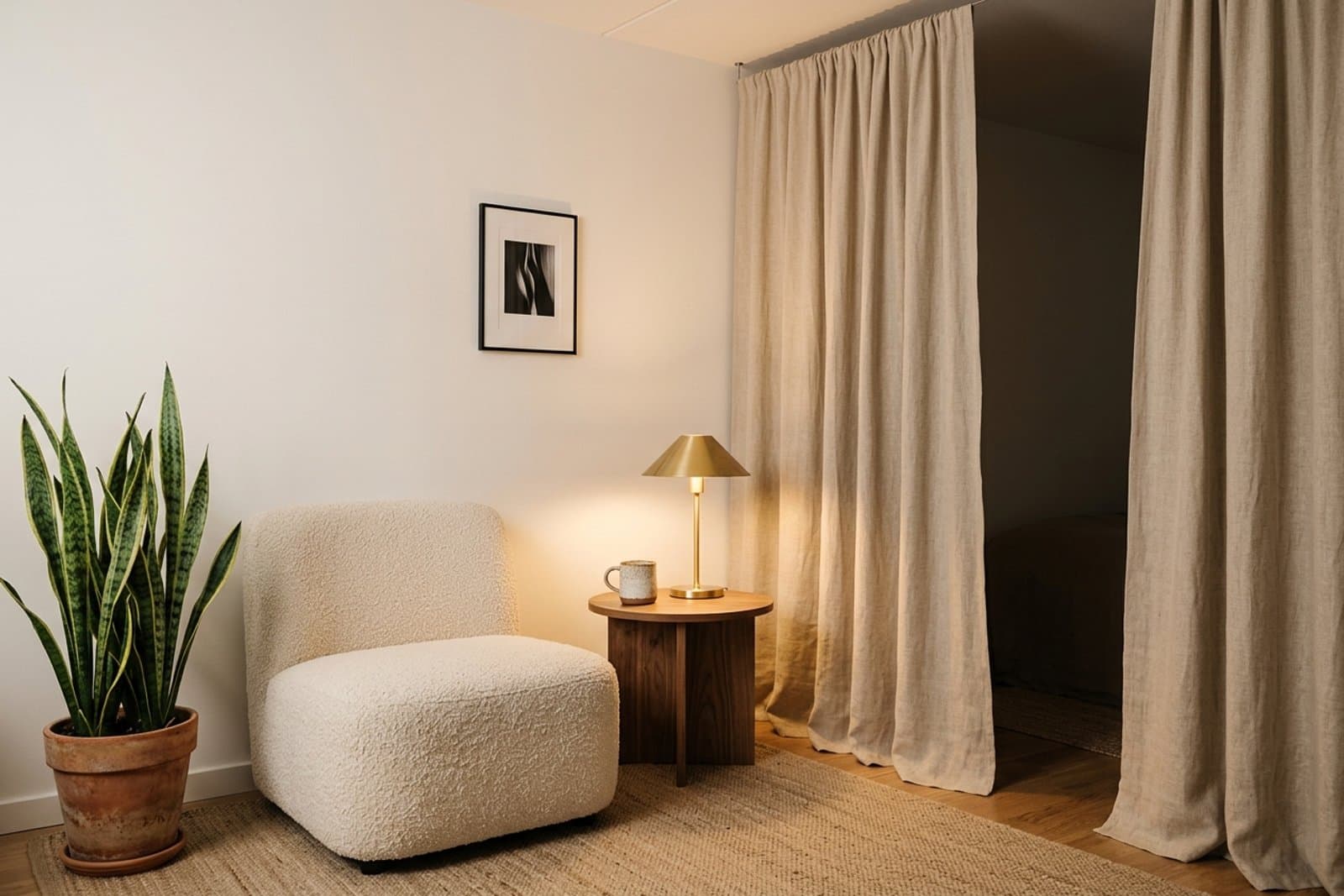
Divide a studio apartment into zones with four lightweight boundaries, applied in order: place the bed first to anchor the sleep zone, hang a ceiling curtain on 3M Command hooks, lay one rug per zone, and shift lamp color temperature between zones (2700K in the lounge, 3500K to 4000K at the desk). The four layers turn a 350 sq ft studio into four rooms without one hole in the wall.
Everything installs in a weekend and comes down clean at move out.
This is for renters in studios between 300 and 500 sq ft who sleep, work, cook, and host in the same square footage. If your apartment is over 800 sq ft or you can build into the walls, the boundaries here still apply, they just need fewer layers to do the same job.
Why a studio feels smaller than its square footage
A 350 sq ft studio has roughly the floor area of a small one bedroom plus its living room combined. What makes it read as one cramped room is the missing visual boundaries, the same force at work when a room feels cramped at any square footage. When the bed, sofa, desk, and dining surface all sit in the same uninterrupted floor plane, your eye reads the room as a single function (sleeping), and every other function feels like it is borrowing the space. Walls are not the answer, and you cannot build them anyway. What works is boundaries the eye can trust: a low partition, a rug edge, a lighting shift, a curtain pulled across at night. Once those boundaries hold, the same 350 sq ft starts reading as four rooms.
How do you divide a studio apartment without putting up walls?
Renters divide a studio without walls by stacking four lightweight boundaries: place the bed first so it anchors the sleep zone, hang a ceiling curtain on 3M Command hooks, lay a different rug under each functional area, and shift the bulb temperature in each zone so the eye reads a color change at the boundary.
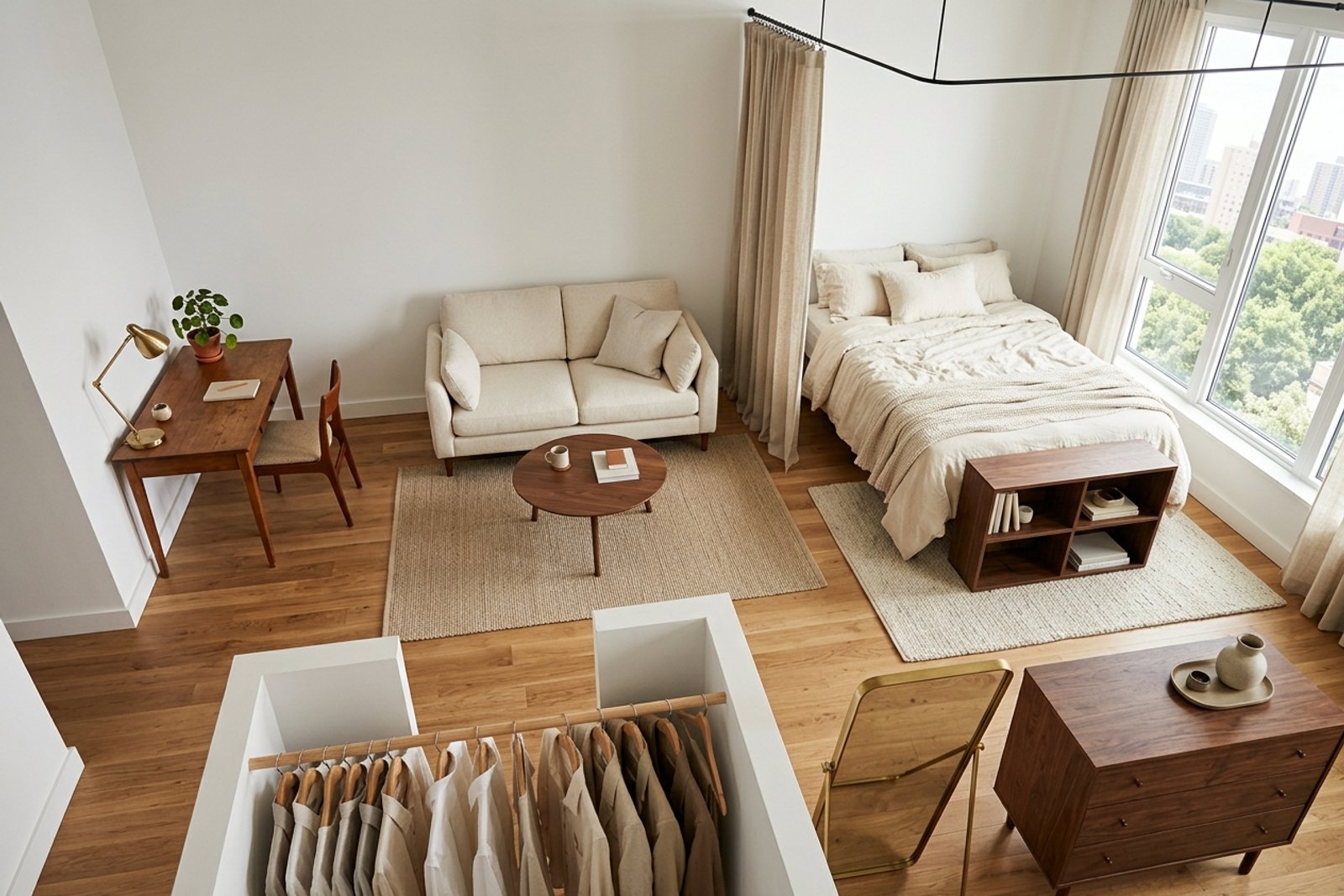
None of this needs a drill or a landlord's permission. The four layers do the same work a wall would do: telling your brain "this is a different room." A 350 sq ft studio comfortably holds four zones using this approach: sleeping (bed plus side table), lounge (small sofa or chair plus coffee table), work or dining (desk or a small table), and dressing or storage (open closet, dresser, mirror).
What is the ideal layout for a studio apartment?
The ideal studio apartment layout holds four zones planned in a set order: sleeping, lounging, working or dining, and dressing or storage. Plan them in that sequence because each one depends on the previous decision. The bed is the largest piece and the hardest to move, so its placement decides where every other zone goes. The lounge needs the second best wall, usually opposite or perpendicular to the bed, with the sofa or chair facing inward rather than toward the bed. The desk or dining surface fills the next available wall, ideally near a window or close to the kitchenette so you are not eating off your nightstand. The dressing zone gets sized last because it can fit into the smallest leftover slot: an open clothing rack, a low dresser, a wall mounted hook bar, or a curtain pulled across the closet opening.
Before you commit to that sequence, let the daylight vote. An open studio has one advantage a walled apartment loses: light crosses the entire floor uninterrupted, so the pattern of that crossing can decide which zone goes where. Mark where the sun actually lands with painter's tape at 8 a.m., noon, and 5 p.m. Put work and dining where the morning light falls, and push the sleep zone toward the corner that dims earliest. Zoning by wall geometry alone, bed wherever the alcove is, is how a studio ends up fighting your day.
One sizing note for the work and dining zone, because it is the zone most often undersized. A round table 36 to 42 inches across doubles as desk by day and dinner table at night, and the round shape shares floor space with a sofa more gracefully than a rectangle, which wastes its corners. Give it two chairs, not four; four chairs make a studio read as a dining room. If you need a dedicated workstation instead, size it at 40 to 48 inches wide and skip the folding wall desk. A foldaway desk reads as temporary, and a studio that is your whole home and your workplace deserves a surface you want to sit at.
This sequence matters more in a studio than in a one bedroom because mistakes compound. A bed placed in the wrong corner forces the sofa into the kitchen path, which pushes the desk into the bedroom zone, which leaves no room for clothes. Move the bed last and you are working around a 60 inch piece of furniture in a 350 sq ft footprint. The broader logic of designing a one person apartment lives in Spatia's solo living interior design guide, but the zone sequence above is the layout specific version.
Place the bed first, parallel to the window
The bed is the anchor. In a studio, place it parallel to the window rather than against the same wall, for two reasons. First, parallel orientation means the long side of the bed faces the window, which gives you morning light across the whole body rather than just at the head. Second, it leaves the wall directly under the window free for a low credenza, a desk, or a plant shelf, which is where the studio's best natural light is sitting unused if the bed is blocking it.
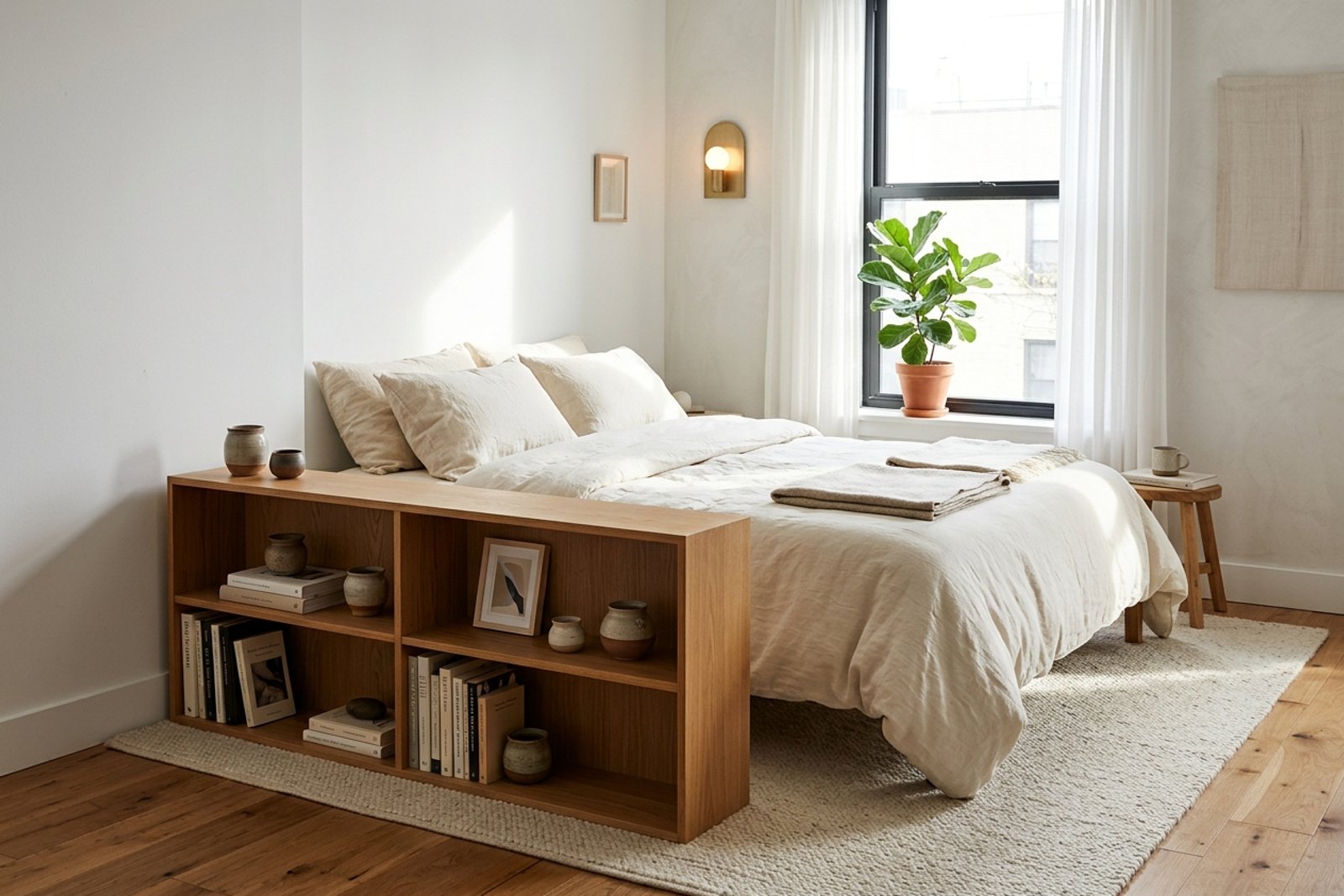
Pull the bed at least 18 inches off the nearest wall when possible. Beds shoved into corners feel like they are hiding. A bed pulled 18 to 24 inches off the wall reads as the bedroom zone rather than overflow furniture. If your bed is a full or queen, position the headboard against a long wall and use a low bookshelf or open shelving unit at the foot to mark the boundary between sleep and the rest of the room. The bookshelf does not need to be tall: a 30 to 42 inch open unit reads as a soft wall without blocking light.
If what sits on those shelves is laundry baskets and cables rather than books, use a closed low credenza instead, under 32 inches tall. It holds as much as a tall shelf, hides what a shelf would display, and still lets light and sight line pass over the top, so the studio reads as one volume with a seam in it. A 6 ft bookcase used as a divider does the opposite: it blocks light, blocks the sight line, and announces "wall" in a room that should still feel open. And skip the Murphy bed. At 350 sq ft the room has space for a real bed, and folding the bed away every morning buys back floor you were not using at 9 a.m. anyway.
The bedroom zone has its own deeper variant in our reading nook ideas for a small apartment, useful if you want a sitting corner inside the sleep zone.
A desk perpendicular to the window catches side light during the day and leaves the bed cooler at night. The 90 degree relationship between bed and desk also separates the two pieces visually, so the desk does not feel like the bed's twin.
What is the best divider for a studio apartment?
The best divider for a rented studio is a floor length curtain hung from the ceiling between the sleeping zone and the rest of the room. The renter version needs no drill: 3M Command Ceiling Hooks, a thin rod or wire, and a panel that pulls shut at night.
This is the single move that turns a studio into a "one bedroom" visually. The peel and stick hooks leave no holes and remove cleanly at move out. Run the rod or wire across the ceiling at the boundary line you defined with the bed and bookshelf, then keep the curtain pulled open during the day so the room stays one open space.
Three details make this work. First, the curtain should match the dominant wall color, not contrast with it. A linen curtain in oat, sand, or pale clay reads as a room divider; a bright graphic curtain reads as a statement piece that closes off half the apartment. Second, the curtain should reach the floor or just kiss it. A short curtain hovers and reads as temporary. A floor length curtain reads as architecture. Third, the curtain should be heavier than a sheer voile so it separates the zones, but lighter than blackout fabric so it does not block daylight when open.
The whole setup, including ceiling hooks, rod or wire, and curtain, runs $40 to $120 depending on the curtain length and fabric. Check the weight rating on the pack before buying: Command Ceiling Hooks are rated for 0.5 pounds each, so they carry a light panel on a wire with a hook every couple of feet. A heavier linen panel needs the Command Jumbo Utility Hook, rated for 7.5 pounds, mounted where the boundary line meets a wall or a beam.
Some ceilings refuse the hooks. Textured or popcorn ceilings, fresh paint, and sloped ceilings all defeat adhesive mounts. The fallback is a line of plants, which is the most overlooked divider in a studio. Three or four medium tall plants (parlor palm, kentia, monstera, fiddle leaf) set in a line along the boundary read as a soft wall while light still passes straight through, and the air moves better than it would past a panel. Stagger the heights between 3 and 5 ft and keep the planters in one material family, oak, ceramic, or woven, so the line reads as one object rather than four pots.
Mark each zone with its own rug
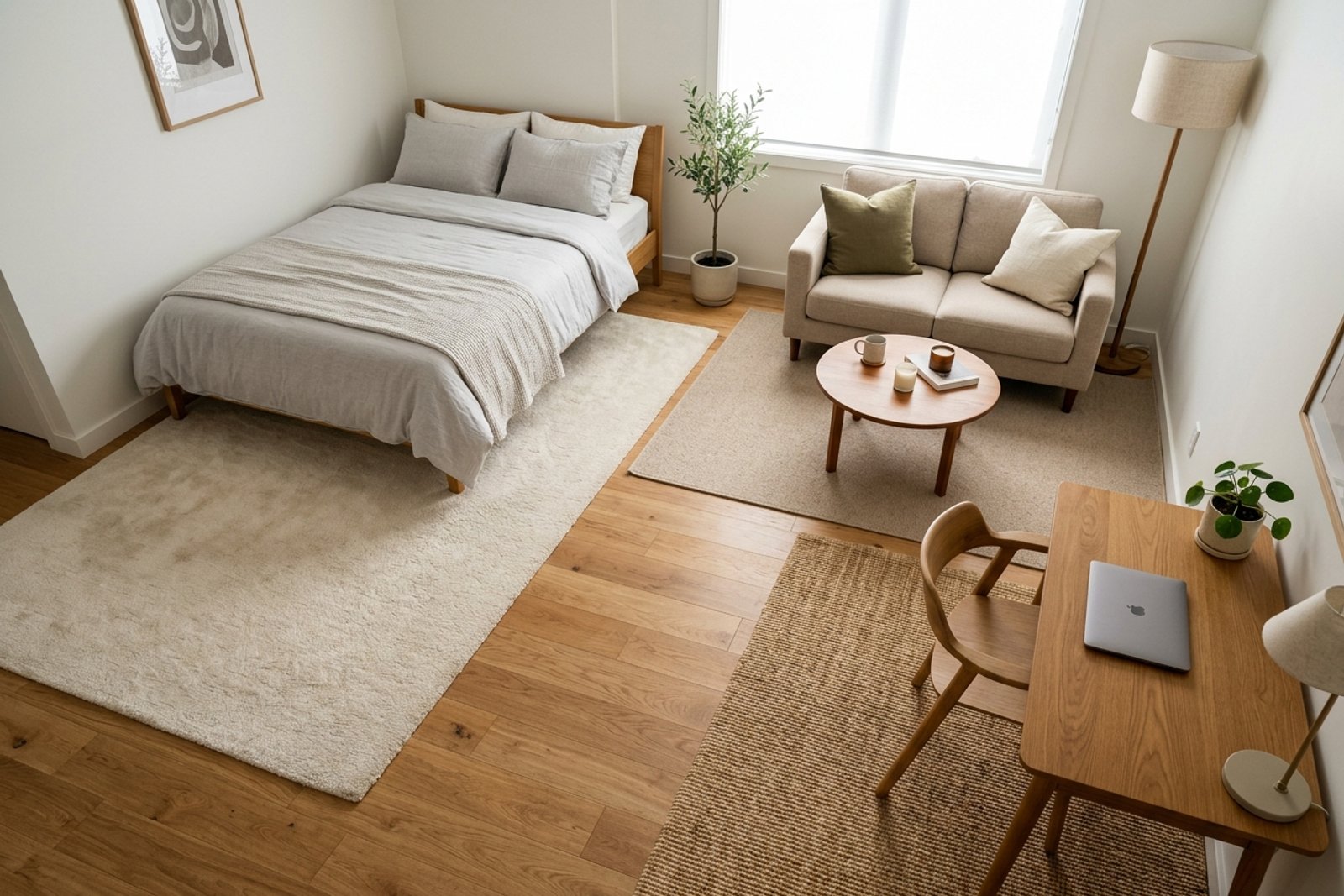
Rugs are the second boundary, doing horizontal work that the curtain does vertically. In a studio, use one rug per zone, sized to the furniture sitting on it rather than to the room. A 5 by 7 ft rug under the bed (sticking out 18 to 24 inches on each side and at the foot), a 4 by 6 ft rug in the lounge zone with the front legs of the sofa or chairs sitting on it, and a small 2 by 3 ft mat under the desk or at the dressing area is the rug stack for a typical 350 sq ft studio.
The rugs should differ in tone but stay in the same family. A pale wool under the bed, a slightly darker flatweave in the lounge, a small natural fiber mat under the desk: the eye reads the tonal shift as a zone change without the room feeling chopped up. Avoid matching all rugs to the same color and pattern (the boundaries disappear) or using a high contrast statement rug under the bed (the bedroom zone overwhelms the room).
Skip rug overlap. In larger apartments, layered rugs can look styled; in a 350 sq ft studio, overlap blurs the zone edges you are trying to define.
Leave one zone on bare floor. If every square foot is carpeted, the studio reads as too much rug and the boundaries stop registering, because a boundary needs something to be a boundary against. The entry path is usually the right zone to leave uncovered, or the strip in front of the kitchenette. The contrast between rug and bare board is a layer of depth in itself, and it keeps the room from reading like a hotel suite where every surface has been dressed.
Use light temperature to separate zones at night
The third boundary is invisible during the day and decisive at night: bulb color temperature. The eye reads warm light (2700K) and neutral light (3500 to 4000K) as belonging to different rooms even when they are 6 ft apart. Use this to your advantage in a studio. Every bulb box prints the number in Kelvin, and the US government's ENERGY STAR program rates bulbs on that same scale, where 2700K sits at the warm candlelight end and 4000K and above reads as office light.
Set the lounge to warm (2700K) with one floor lamp or table lamp. Set the desk or dining zone to neutral (3500K to 4000K) with a focused task lamp. Set the bed to dim, low ambient warm (2700K) with a small bedside lamp or a string of warm fairy lights along the headboard. The kitchenette will likely have its own overhead, which is fine.
| Zone | Bulb temperature | Fixture |
|---|---|---|
| Bed | 2700K, dimmed low | Small bedside lamp |
| Lounge | 2700K | Floor lamp or table lamp |
| Desk or dining | 3500K to 4000K | Focused task lamp |
There is a sleep argument for the warm bulbs too. Harvard Health Publishing reports that a Harvard study found blue light suppressed melatonin for about twice as long as green light of comparable brightness. Warm 2700K bulbs emit less of that blue wavelength, which is why the bed zone lamp should never be the cool one.
The overhead light in a studio is a switch you should rarely flip after sunset. Overheads at 4000K and above wash the whole room with one flat tone, which collapses the zoning you have built with rugs, curtains, and furniture placement. A studio that uses three or four lamps instead of one overhead reads as a furnished apartment, not a dorm.
Smart bulbs with color temperature control (Philips Hue, IKEA Tradfri) cost $15 to $30 per bulb and let you save a "lounge," "desk," and "sleep" scene that shifts the room mood without rearranging anything. For renters who do not want a smart system, a $7 warm 2700K bulb in every lamp is a simpler move with most of the same effect.
What wall color makes the zones read in a dark studio?
Paint does not draw a boundary. It sets the backdrop that decides whether the other three register. In a studio with one small window or a shaded outlook, the instinct is to go lighter, but a cool light color reads gray and flat in poor light because it has nothing warm to reflect. A warm earth tone with a yellow or red base does the opposite: it stays luminous under lamp light because it bounces back the same wavelengths your 2700K bulbs are putting out.
One wall is enough, and one wall is the renter safe amount to repaint at move out. Put it behind the bed or behind the sofa, whichever the eye lands on when you walk in, so the color anchors a zone rather than floating:
- Caramel: Benjamin Moore Stone Hearth.
- Soft terracotta: Farrow & Ball Red Earth.
- Warm chocolate brown: Sherwin-Williams Urbane Bronze.
Leave the other three walls in a warm off-white, Benjamin Moore Swiss Coffee, White Dove, or Soft Chamois, so the earth tone reads as a backdrop instead of an accent feature. A studio painted this way looks warmer at 8 p.m. with two lamps on than a white one does at noon.
Window curtains are part of the same wall plane, and hanging them wrong costs you ceiling height. Mount the rod 4 to 6 inches above the window frame and extend it 8 to 10 inches past each side, then hang panels long enough to reach the floor or break an inch on it. A short curtain hovering above the sill reads as temporary and shrinks the window it is meant to frame. Use a heavy linen or cotton in warm off-white, oat, or soft caramel rather than a sheer panel alone; the wall needs weight on it, not only a light filter.
The dressing zone: closet curtain, mirror, dark wood dresser
The fourth zone is usually the leftover slot. In a studio with an actual closet, replace the door with a curtain on a tension rod and the closet becomes a small dressing room: the curtain hides the clothes, the wall inside holds a clip on light, and a small mirror leans against one side. In a studio without a closet, an open clothing rack, a low dresser, and a full length mirror against the wall do the same work in a 36 to 48 inch wide footprint.
The dresser is where the studio can borrow from a current furniture mood: a compact dark wood piece (walnut, warm oak, or chocolate) anchors the dressing zone in a way a pale particleboard dresser does not. The dark tone reads as a deliberate furniture moment in a room that is otherwise lighter, which keeps the eye returning to that corner as styled rather than functional. Look for a dresser between 30 and 40 inches wide and 32 to 36 inches tall; anything wider competes with the bed for the room's primary furniture role.
A full length mirror placed at a 30 to 45 degree angle to the window bounces window light back into the deeper part of the studio, making the dressing zone feel bigger without taking floor space.
How do you add storage to a studio without wrecking the zones?
Build storage into the pieces the zones already need instead of adding cabinets. Every freestanding cabinet you add costs you open floor, and open floor is what makes the boundaries visible in the first place. The working rule is one visible job plus one hidden job per piece:
- The low credenza dividing the sleep and lounge zones carries what a tall shelf would, behind doors.
- A bed frame with drawers, or roughly 12 inches of clearance underneath for flat bins, swallows off season clothes inside the footprint the bed already occupies.
- A lidded bench at the entry hides shoes and works as the seat you need there anyway.
- One narrow shelf run high near the ceiling, painted the wall color so it disappears, takes books and baskets without touching the floor.
A 350 sq ft studio rarely needs more than three storage pieces when each one works twice. Keep what you touch weekly at hand height, and push seasonal and rarely used things to the under bed bins and the high shelf. The piece to skip is the third storage ottoman: two of them end up in a corner holding nothing, and they break the walking paths between zones while they do it.
The 350 sq ft math
A 350 sq ft studio comfortably holds all four zones: sleeping, lounge, work or dining, and dressing. The math works because each zone is sized to the furniture sitting in it, not to a generous standalone room. A sleeping zone with a queen bed and side table takes roughly 50 sq ft including walk around space. A lounge zone with a small sofa (or two armchairs) and a coffee table takes 40 to 60 sq ft. A desk or small dining table with one chair takes 20 to 30 sq ft. A dressing zone with a dresser, hanging rack, and mirror takes 20 to 30 sq ft. Total zone footprint runs 130 to 170 sq ft, which leaves 180 to 220 sq ft for circulation, the kitchenette, and the bathroom path. That is enough to walk between zones without the studio feeling stuffed.
The constraint that breaks the plan: a studio under 300 sq ft, or a layout where the kitchenette splits the floor plate awkwardly. In those cases, fold the dressing zone into the bedroom zone (the closet becomes the dressing area, sharing the same boundary as the bed) and run only three primary zones. For ideas on the cooking and eating side, our home cafe corner in a small apartment covers that zone on its own.
A weekend plan for zoning a studio
- Day 1, morning. Measure the floor plan, mark the bed location parallel to the window, and pull the bed 18 to 24 inches off the wall.
- Day 1, afternoon. Install 3M Command ceiling hooks at the boundary between the bed and the lounge. Run the curtain rod or wire.
- Day 2, morning. Lay the rugs (bed zone, lounge zone, desk or dressing zone). Adjust furniture so each zone's main piece sits on its rug.
- Day 2, afternoon. Swap the bulbs. Warm 2700K in the lounge and at the bed, neutral 3500K to 4000K at the desk. Stop using the overhead after dark.
- Day 2, evening. Test the layout. Close the curtain. Sit in the lounge. Sleep one night and adjust in the morning.
The whole project, including rugs, curtain, hooks, bulbs, and a dresser if needed, runs $300 to $900 depending on what is already in the apartment.
Final thought
A studio apartment holds the same square footage as a small one bedroom, rearranged into one room. What makes it feel cramped is rarely the size; it is the missing boundaries that let your eye and brain switch contexts. Four lightweight layers (a curtain, three rugs, two bulb temperatures, and a deliberate bed placement) do the work walls would do in a larger apartment. The studio still has one floor, but it stops feeling like one room.
The same boundary logic applies to a one bedroom with a small living room, just at a different scale. If the room still reads tight after the boundaries are in, the problem has usually moved to sight lines and visual weight, which is where a room that feels cramped at any size picks the diagnosis back up.
Frequently asked questions
How do you divide a studio apartment into two sections?
The simplest two section split is one curtain line: sleeping on one side, everything else on the other. Place the bed against the wall farthest from the door, hang a floor length curtain on ceiling hooks at the foot of the bed, and give each side its own rug and lamp. The room then reads as a bedroom and a living room with a single boundary.
How do you zone a studio apartment on a budget?
Under about $150 if the furniture stays. The curtain setup runs $40 to $120 including hooks and a wire, a warm 2700K bulb for each lamp costs around $7, and the bed placement and rug rearrangement cost nothing. Skip the smart bulbs; a fixed warm bulb in every lamp does most of the same work.
Is a temporary wall better than a curtain in a studio apartment?
A pressurized temporary wall gives real sound and sight privacy, but it needs landlord approval and many buildings prohibit them outright. A ceiling hung curtain does most of the same visual work, comes down clean at move out, and costs a fraction of a wall install. Start with the curtain; consider the wall only if sound privacy is the actual problem.
Do IKEA shelving units work as studio dividers?
Yes. Open shelving reads as a low wall while letting light through, which is exactly what a zone boundary needs. The IKEA Kallax in the 2 by 4 size stands about 30 inches tall on its long side, inside the 30 to 42 inch boundary height that marks the bed zone without blocking the window.
If the zone you need most is a desk, a work zone in a small living room covers five setups that disappear after hours.
Written by the Spatia Editorial Team, who test studio layouts against lease terms as much as floor plans: if it needs a drill or a deposit, it does not make the guide.
The Noticer
For thoughtful people who notice spaces.
What did you notice?
Did something in this story make you see your own space differently?
Plan your studio zones with Archie
Send Archie a photo of your studio. Archie returns a four zone layout, the bed placement, the curtain divider line, and the rug sizes that fit your floor plan, with no drilling required.
Plan my studio with ArchieAdvertisement. Archie is made by STUDIO DID IT, the studio that publishes Spatia.
Related Articles
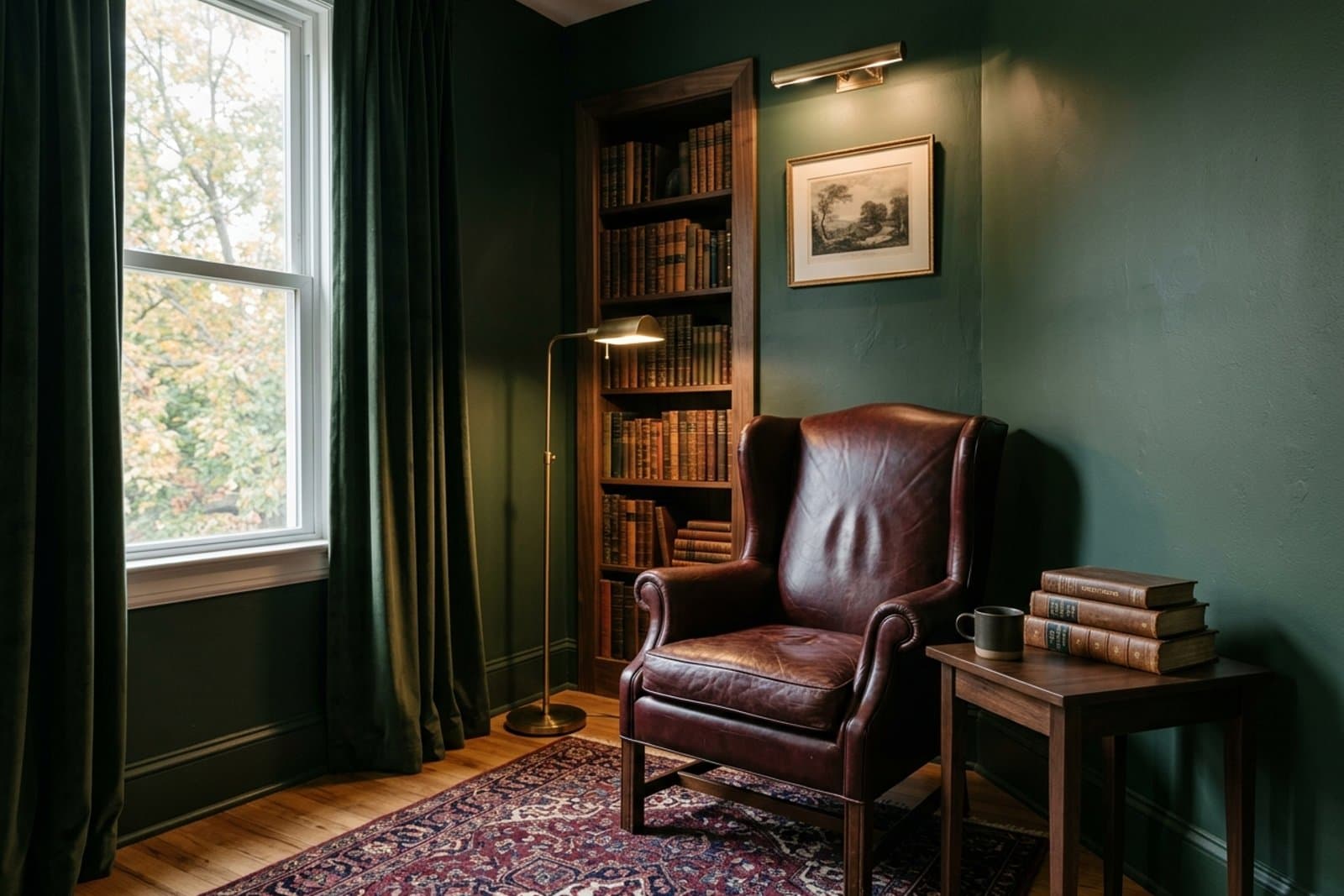
9 Reading Nook Ideas for a Small Apartment in 2026
A reading nook in a small apartment is one chair, one 2700K lamp, and a 30 inch corner. See 9 renter safe moves, from the closet nook to a no drill window seat.
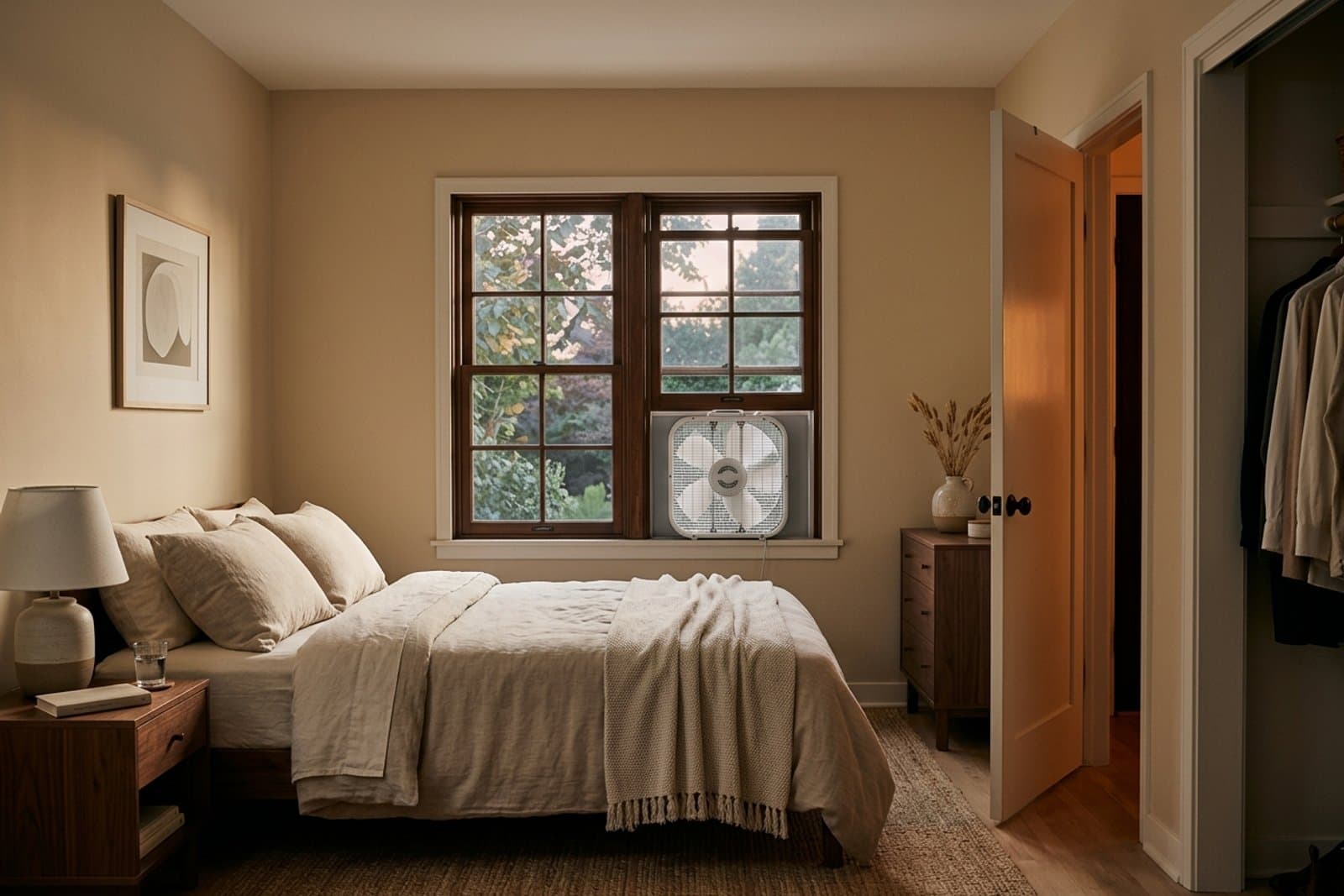
How to Ventilate a Room With One Window (No Cross Breeze)
To ventilate a room with one window, face a box fan out, crack the door for intake, and flush 10 to 20 minutes, or about 5 in winter. See the full routine.
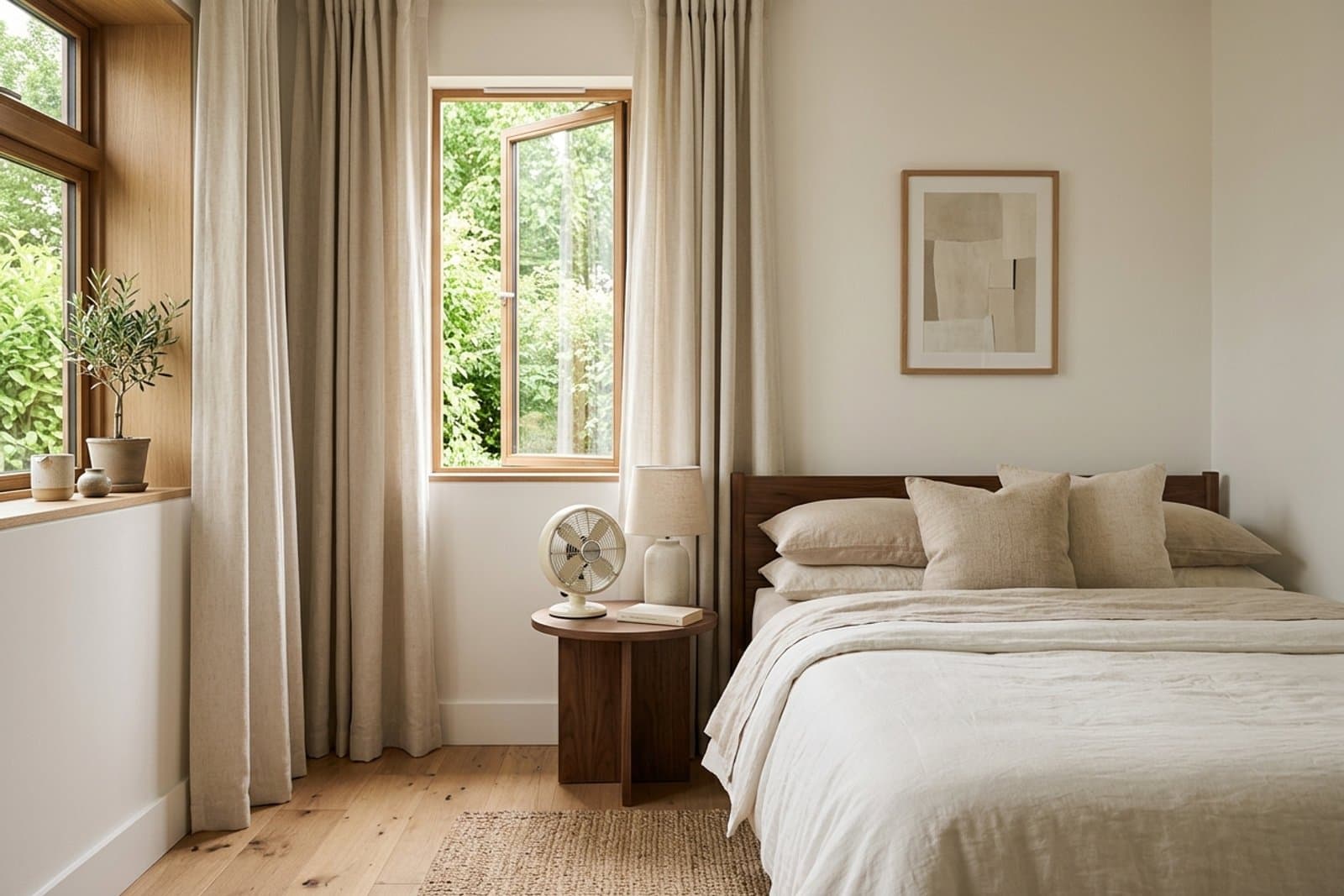
How to Cool a Room With One Window Without AC (West or South)
Cool a room with one window without AC: shade the glass before the sun lands, aim a fan at your body, then flush stored heat out after sunset.