Home Cafe Corner in a Small Apartment: 5 Steps to Build One
A home cafe corner fits a small apartment in a 24 by 16 inch footprint. Get the four brewing tools, cost tiers, and the material shift that marks the zone.

A home cafe corner in a small apartment takes about 24 inches of width and 16 inches of depth, enough for a hand grinder, a temperature controlled kettle, a ceramic pour over dripper, and a 0.1 gram scale. Keep the tools in one cabinet or shelf, pull seating from elsewhere in the room, and mark the zone with a single material shift instead of a wall.
An entry level pour over kit runs roughly $150 to $250; espresso doubles the footprint and the budget, which is why pour over wins in most apartments under 800 square feet.
This guide is for renters and refresh owners in apartments under 800 square feet who want morning coffee to feel like a slow ritual without giving up a whole wall to it. If you already have a kitchen island or pantry with room for an espresso machine, skip step 1; the tradeoffs here assume the cafe corner shares space with the rest of life. Spatia's solo living interior design guide covers the wider frame of a one person home, and if the corner you want is for books rather than brewing, the reading nook ideas for a small apartment guide applies the same corner logic to a different ritual.
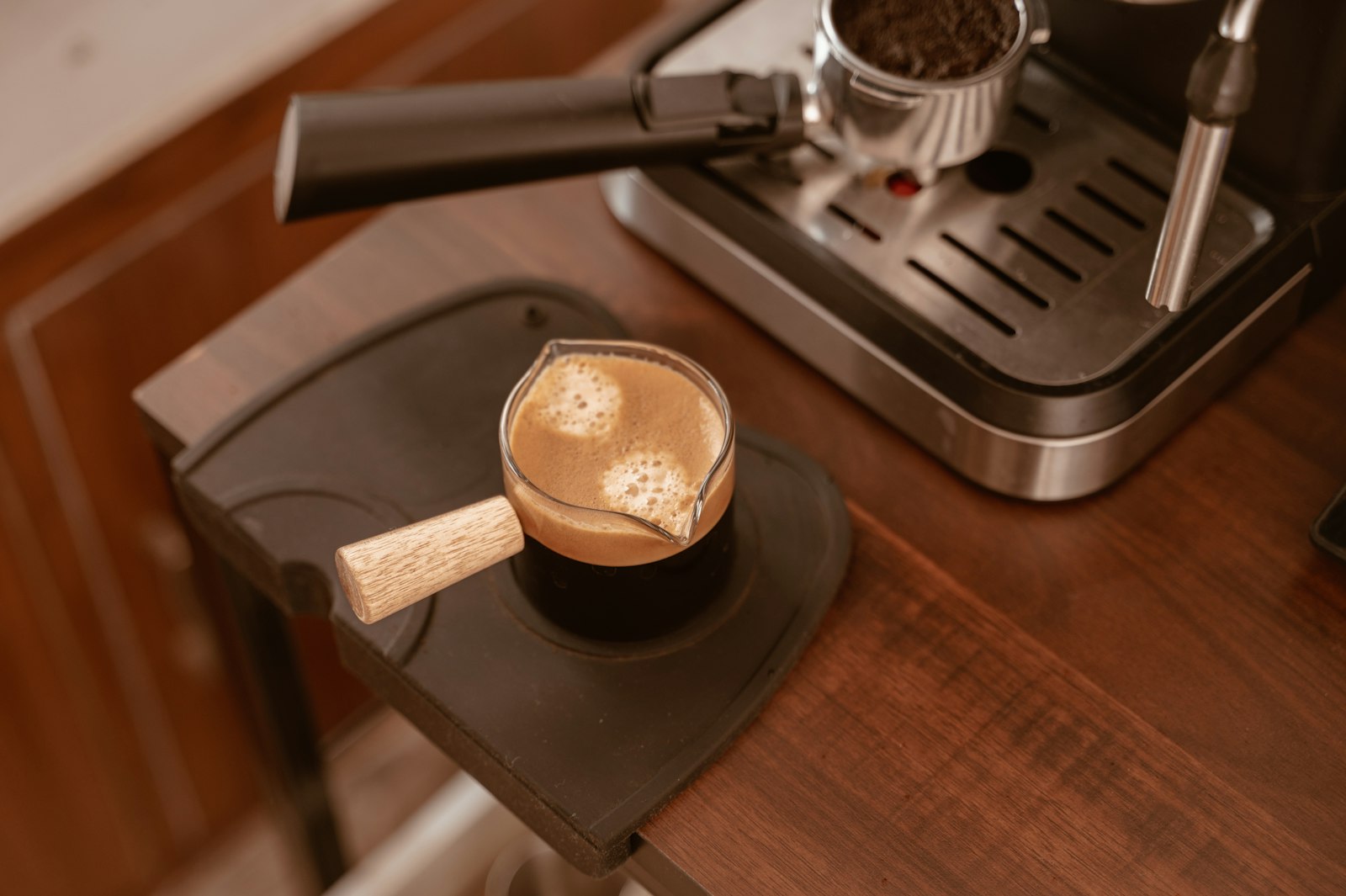
What is a home cafe corner?
A home cafe corner is a small dedicated area in an apartment, usually 24 to 48 inches wide, where the daily coffee or tea ritual is set up to feel like walking into a small independent cafe. It is not a built in kitchen feature and it is not a bar cart. The corner holds the brewing tools (grinder, kettle, dripper, scale), one or two cups in regular use, a small stash of beans, and one design anchor that signals the mood, often a plant, a single textured object, or a piece of art at eye level when seated. Compared with a coffee station on a counter, a home cafe corner is treated as a small room within a room: the lighting shifts, the materials shift, and the visual rhythm slows down. Done well, the corner reads as quiet ceremony.
How do you build a home cafe corner in 5 steps?
Pick the footprint, decide whether the corner hides or stays open, buy four brewing tools, shift one material to mark the zone, and anchor it with one plant. The steps run in that order because each one depends on the one before it: the footprint decides whether a cabinet fits, the cabinet decides how much tool you can store, and the material and plant only make sense once the working surface is set.
Step 1: Pick the smallest workable footprint
Claim a footprint about 24 inches wide, 16 inches deep, and 60 inches tall, which fits inside a shallow bookshelf, a narrow console, or a single cabinet bay. Below that footprint, the brewing kit cannot sit in working order, and rituals that require setup before every brew get skipped on the days that matter. A more comfortable footprint is 36 inches wide by 18 inches deep, which adds room for two cups in regular rotation, a small canister of beans, and space for an espresso machine if one enters the picture later. Vertical space matters as much as horizontal: a corner that climbs to 60 or 72 inches lets storage and display stack, which keeps the working surface clear. If the apartment is under 400 square feet, the working surface itself can fold down from a wall cabinet, the way a small writing desk does.
Step 2: Decide hidden or open
A hidden corner is a converted cabinet: doors at the front, a small LED strip inside that turns on when the doors open, and the brewing kit lined up at working height behind them. Closed, the unit reads as a standard cabinet beside the sofa; open, the cafe is in full setup. The trick is power: put the cabinet next to a wall outlet and run the cords out the back, so the kettle, the LED strip, and the scale stay plugged in or charge in place without visible cords. Other small apartment versions of the same move: a roll top desk repurposed as a brewing station, a tall narrow pantry cabinet with the kettle on a sliding tray, or a shelf with a curtain at the front that gets pulled aside in the morning. An open shelf is the right call if the corner gets used every day; hidden suits a corner that sits idle most of the week. For renters who cannot mount a cabinet, Spatia's small bedroom storage hacks covers no drill storage options that adapt easily.
Whichever you choose, judge it by how it opens, not how it looks. A shop wins or loses a customer at the threshold, and a cabinet cafe obeys the same rule at home. What matters most is the very first gesture: opening the door, lifting the kettle, switching on the small lamp. Make that opening move pleasant, with a door that swings smoothly, a light that comes on by itself, and tools at hand height, and the ritual repeats daily. Make it awkward, with a cord to untangle or a scale buried behind mugs, and the corner quietly stops getting used. When I review a setup, I watch how it begins.
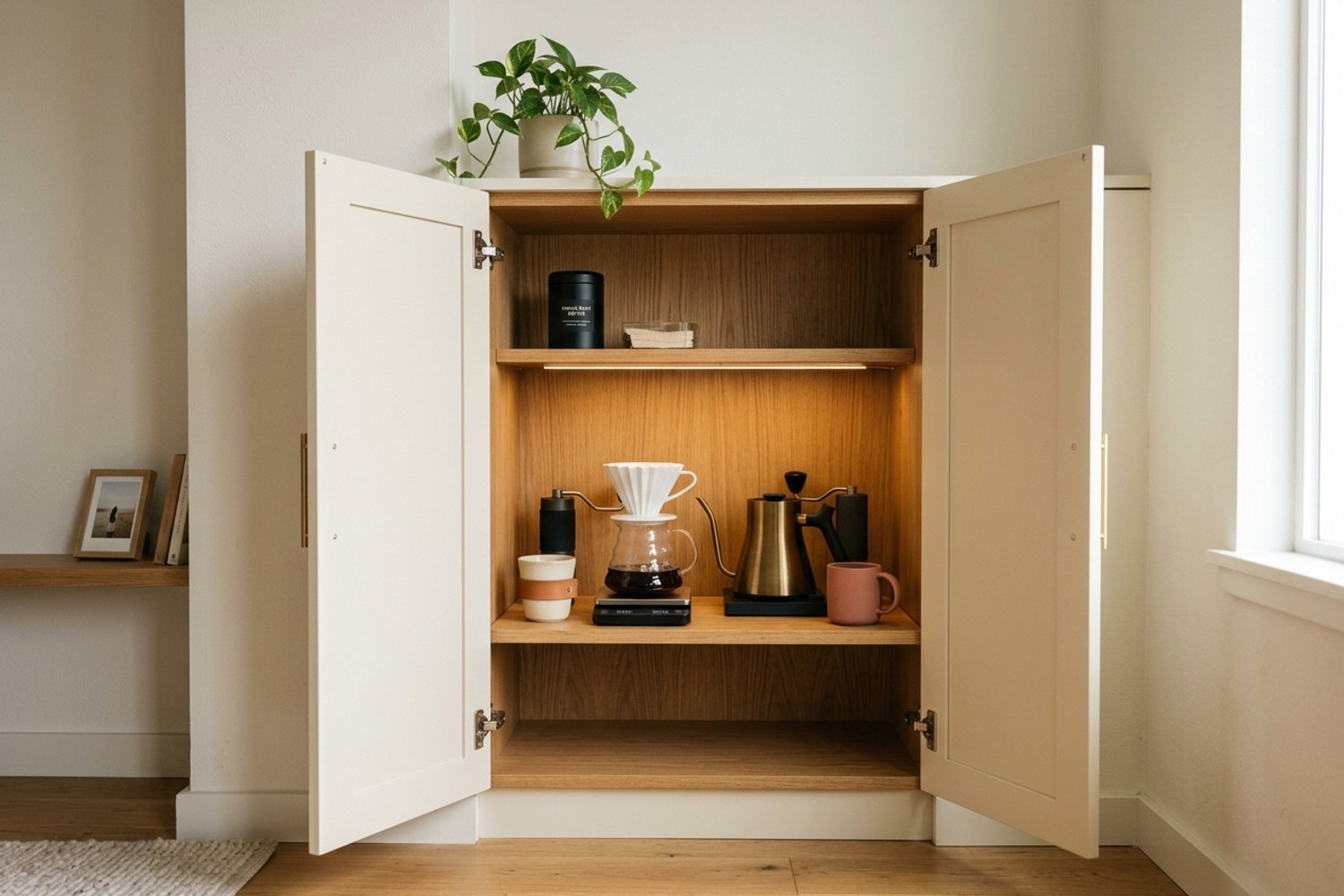
Step 3: Buy four brewing tools that earn their place
Four tools do real work in a small apartment cafe corner. The hand grinder is the highest leverage purchase: a better grinder holds its grind setting consistently, which is what every pour over recipe depends on, while a starter grinder gets you brewing but caps the ceiling on flavor. The temperature controlled kettle replaces the guesswork: the Specialty Coffee Association's standard for home coffee brewers (SCA Standard 310-2021) calls for brewing water between 90 and 96°C (about 194 to 205°F), and many roasters suggest the hotter end of that range for light roasts. A ceramic pour over dripper with deep vertical ribs holds heat better than plastic and gives the brewer more control over flow; the Origami dripper, made of Mino porcelain in Gifu, Japan, with 20 inner ribs, is the best known example. A small digital scale that reads to 0.1 grams turns recipes into something repeatable. Skip espresso unless the corner has 36 inches of clear counter, an outlet on a circuit that can carry a machine of about 1,500 watts, and room in the budget for a machine and grinder that cost several times a pour over kit. Pour over fits a small footprint and opens a wider range of beans for the same spend.
Step 4: Shift one material to mark the zone
The fastest zone divide in one room is a material shift, not a wall. Pick the cafe corner's material: warm wood, woven texture, or matte ceramic. Keep that material out of the other zones, so the living area might stay in neutral upholstery and painted surfaces while the cafe corner gets the only warm wood shelf in the room. The eye reads the shift as a room within a room. A small rug, a different lamp color temperature (warmer for the cafe, cooler for the living area), and a low pendant that brings the light down over the brewing surface finish the separation without taking floor space. The warm wood plus quiet minimal approach has a longer history covered in Spatia's japandi style guide, and if the whole apartment is one room, dividing a studio apartment into zones runs the same move at full scale.
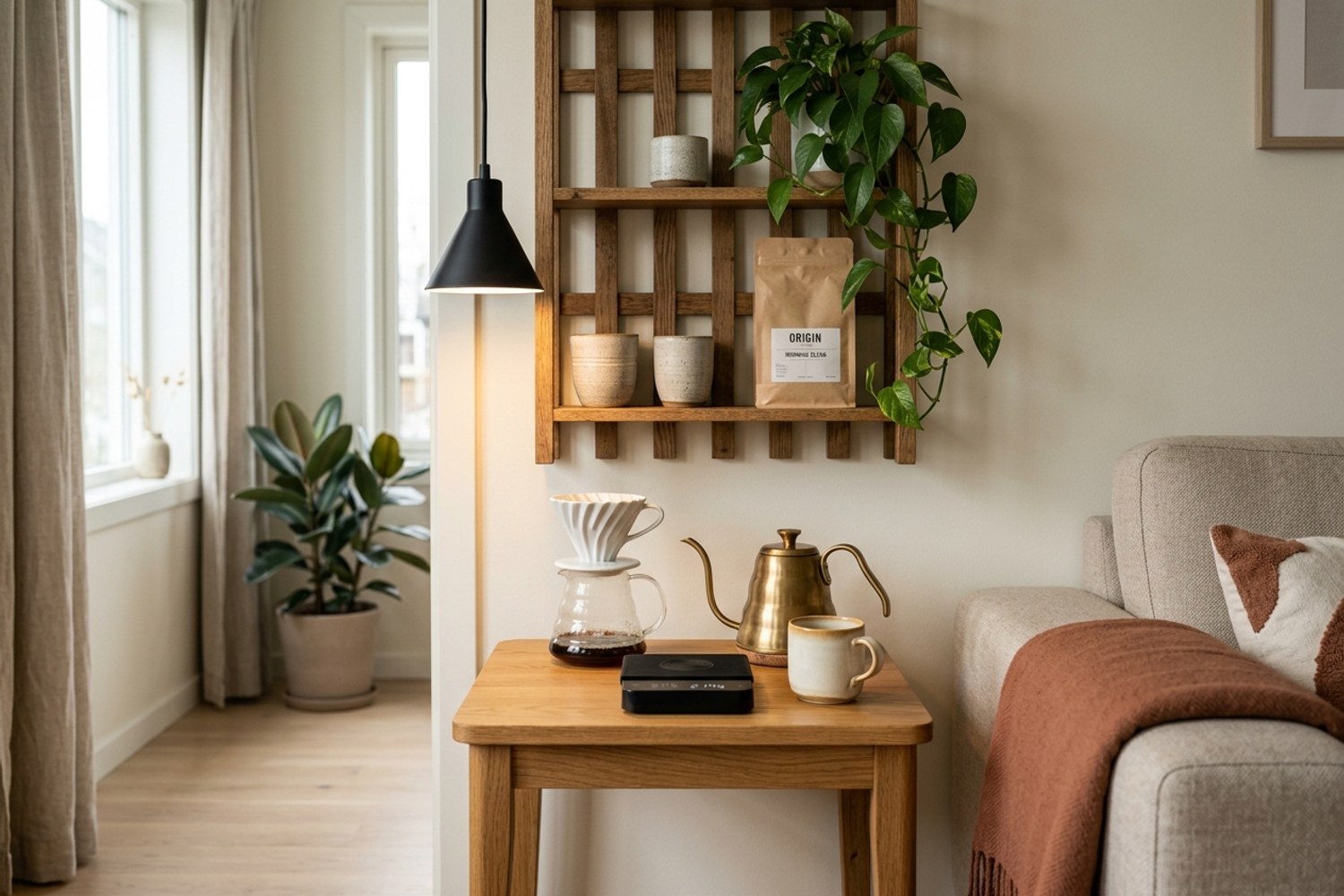
Step 5: Anchor with one textured plant
Plants in a cafe corner do two jobs that nothing else does as cheaply. They soften the visual edge between the corner and the rest of the room, which is what makes a small zone read as deliberate instead of cramped. And they signal "this is a slow space" before the brewing kit even comes out. A textured leaf plant beside the brewing surface, plus one trailing plant on a high shelf, is enough. Pick plants whose light needs match the corner, and fold the watering into the morning brew so it actually happens. Spatia's guide to why a room feels cluttered even when it is clean covers why a few living things calm a small room more than a shelf of objects.
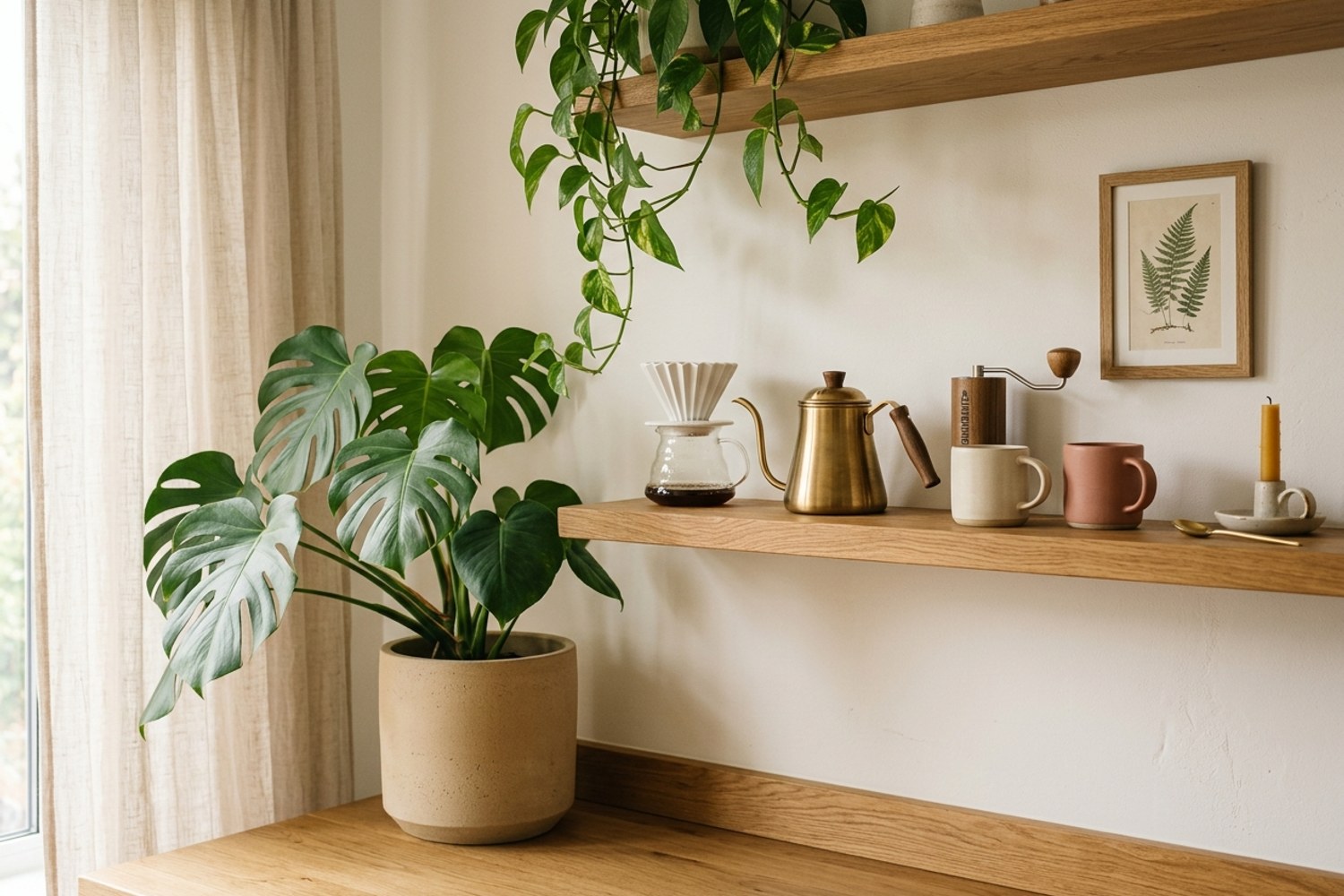
What should you invest in versus save on for a cafe corner?
Invest in the tools that decide whether the cup is repeatable and save on everything you only look at. The grinder and the kettle are where money changes the result: a grinder that holds its setting and a kettle that holds its temperature are the difference between a good cup some mornings and a good cup most mornings. The dripper, the scale, the mugs, and the shelf itself can stay inexpensive, because a basic ceramic dripper and a 0.1 gram scale do the job about as well as premium versions. The same logic applies to the furniture around the corner: spend on the piece you touch every day, such as the cabinet doors and the working surface, and keep the decorative pieces simple. Spatia's guide to why a room feels cramped covers why fewer, better pieces matter more in compact spaces.
What does a home cafe corner cost to set up?
A home cafe corner costs roughly $150 to $250 at entry level, $400 to $600 at mid tier, and past $1,000 for a serious setup. Mid tier is where the brew gets repeatable, because the grinder holds its setting and the kettle holds its temperature. The table breaks down where each dollar tends to go; treat the figures as rough ranges for typical US retail prices, not quotes for specific products.
| Tier | Budget | What the money buys |
|---|---|---|
| Entry | $150 to $250 | Starter hand grinder, gooseneck kettle (manual temperature read), plastic dripper, basic scale, starter beans, one mug |
| Mid | $400 to $600 | Grinder with a stable setting, temperature controlled kettle, ceramic dripper, scale reading to 0.1 grams, single origin beans, a mug from a local maker |
| Serious | $1,000 and up | Premium hand grinder, premium kettle, glassware and ceramics, beans rotated monthly |
Entry level brews cleanly; it just demands more attention every morning.
Final thought
Treat the corner as a small room within a room, set up to slow one part of the day, rather than as a kitchen feature scaled down. The footprint is small enough that the tradeoffs are honest, and the tools are few enough that each one earns its place. Build it for the morning you actually have, not the morning you imagine hosting friends for: one material shift to define the zone, one plant to anchor the mood, and a brewing kit chosen for repeatable cups rather than for show.
A small apartment cannot give you a separate cafe room. What it can give you is a corner that feels like one.
Frequently asked questions
Can I build a home cafe corner in a studio under 400 square feet?
Yes, with one constraint: the working surface has to fold or pull out, not sit permanently. A wall mounted drop down shelf holds a kettle, dripper, scale, and a single mug; check that its rated load covers a full kettle with room to spare. Closed, it disappears into the wall. The brewing tools live in a slim cabinet bay below. The corner reads as a complete cafe when set up and as a clean wall when folded. The tradeoff is that espresso is off the table at this footprint; pour over is the method that fits the available counter and outlet load. Studios under 400 square feet do best with a clear visual language that reads as deliberate, which is the same logic discussed in Spatia's guide to French country, rustic, and Scandinavian style.
Is a home cafe corner the same as a coffee bar?
No. A coffee bar is usually a wider built in feature, often six to eight feet of counter with cabinetry, plumbing for a machine, and the brewing tools out on display. A home cafe corner is a 24 to 48 inch zone that reads as quiet ritual: the brewing tools may be hidden, the seating is pulled from elsewhere, and the material identity is what defines the space, not the cabinetry. A coffee bar is the kitchen extending into a hosting feature. A cafe corner is the apartment carving out a slow ritual for one or two people.
Do I need an espresso machine to make a home cafe feel real?
No. Espresso costs footprint and budget: a capable machine plus grinder costs several times a pour over kit and needs about 36 inches of clear counter, an outlet that can carry the load, and storage for a portafilter, tamper, and knock box. A pour over setup runs roughly $150 to $600 depending on tier, fits a 24 inch corner, and opens a wider range of single origin beans for the same money. What makes the corner read as a real cafe is how the space is set. The brewing method barely registers.
What is the single biggest mistake people make building a home cafe corner?
Building it for the cafe they wish they had, not the one they will use. A corner stocked with three brewing methods, six cups, and an espresso machine that gets pulled out twice a year is just clutter dressed up. The corners that work are the ones built around a single repeatable ritual: one method, two cups in rotation, beans replenished on a known schedule. The other common mistake is skipping the material shift; without it the corner reads as overflow storage. One material change, used only in the corner, is the cheapest design move in a small apartment.
Does a home cafe corner add real value to my daily routine?
It will not save time; a pour over takes longer than a pod machine. What it changes is how the first part of the morning feels, because the ritual has a fixed place instead of happening wherever there is counter space. In a small apartment where work, meals, and rest share the same few rooms, giving one daily habit its own corner is a cheap way to make the home feel less like one undivided space. Whether that is worth a cabinet bay is a judgment only you can make; the 24 by 16 inch footprint keeps the cost of trying low.
If your coffee spot can move outdoors in summer, the same thinking scales to a small cottage patio.
Jihyun Lee writes for Spatia from a 580 square foot apartment where the cafe corner takes up roughly 30 inches of one wall and gets used twice every morning before work.
The Noticer
For thoughtful people who notice spaces.
What did you notice?
Did something in this story make you see your own space differently?
Plan a cafe corner that fits your room
Archie maps how brewing tools, lighting, plants, and the furniture you already own sit together in your actual square footage, so the corner gets built once and used every morning.
Plan my room with ArchieAdvertisement. Archie is made by STUDIO DID IT, the studio that publishes Spatia.
Related Articles
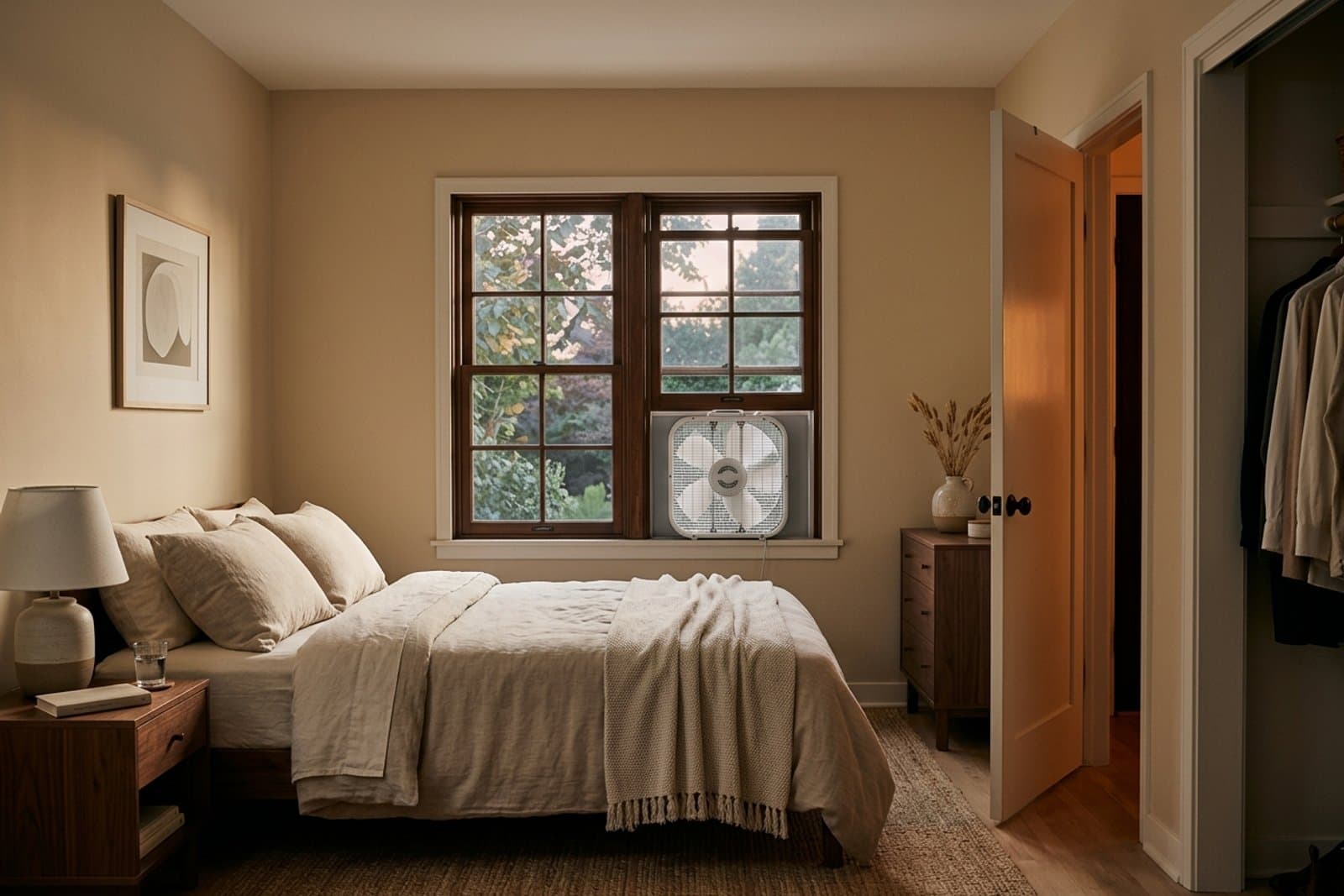
How to Ventilate a Room With One Window (No Cross Breeze)
To ventilate a room with one window, face a box fan out, crack the door for intake, and flush 10 to 20 minutes, or about 5 in winter. See the full routine.
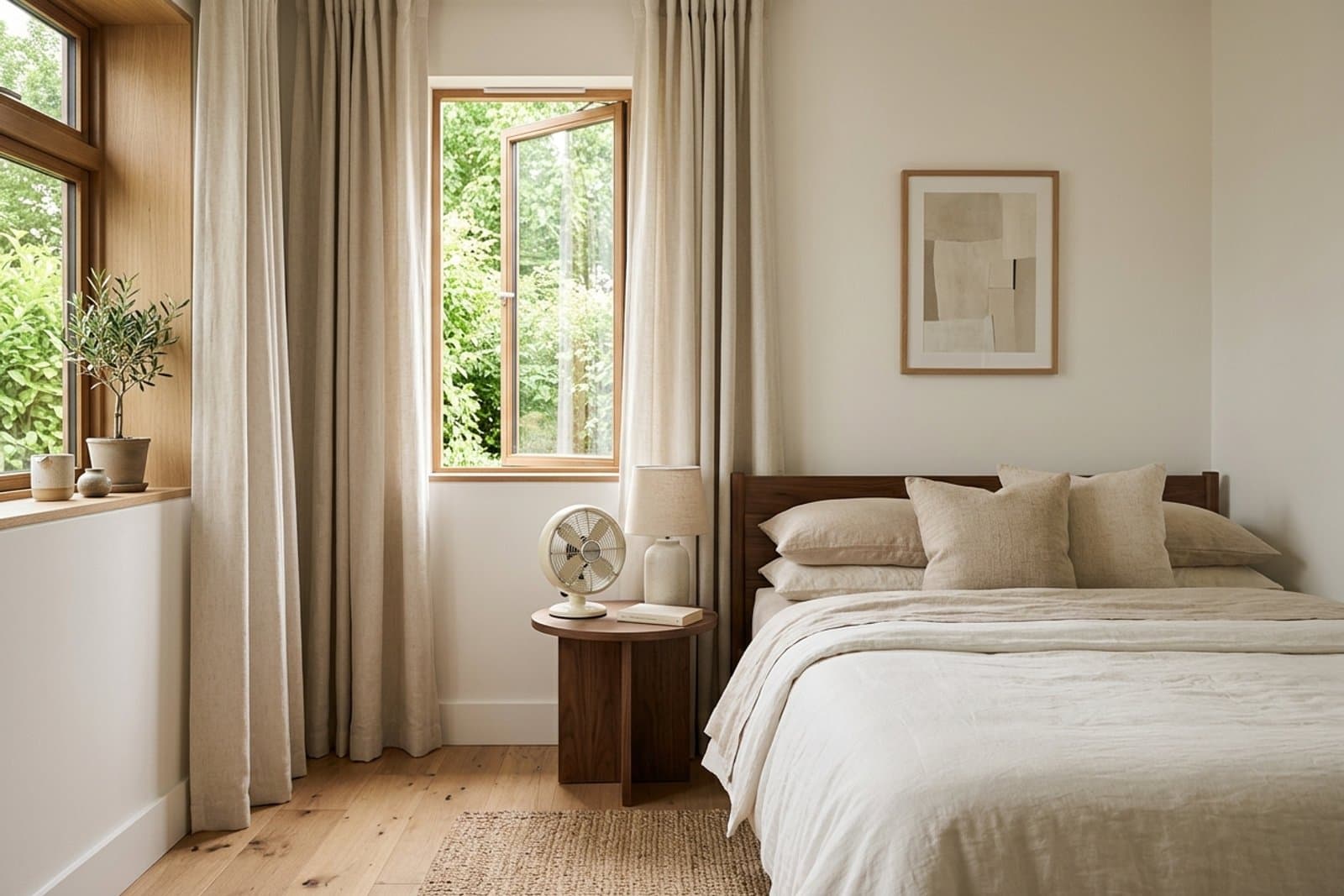
How to Cool a Room With One Window Without AC (West or South)
Cool a room with one window without AC: shade the glass before the sun lands, aim a fan at your body, then flush stored heat out after sunset.
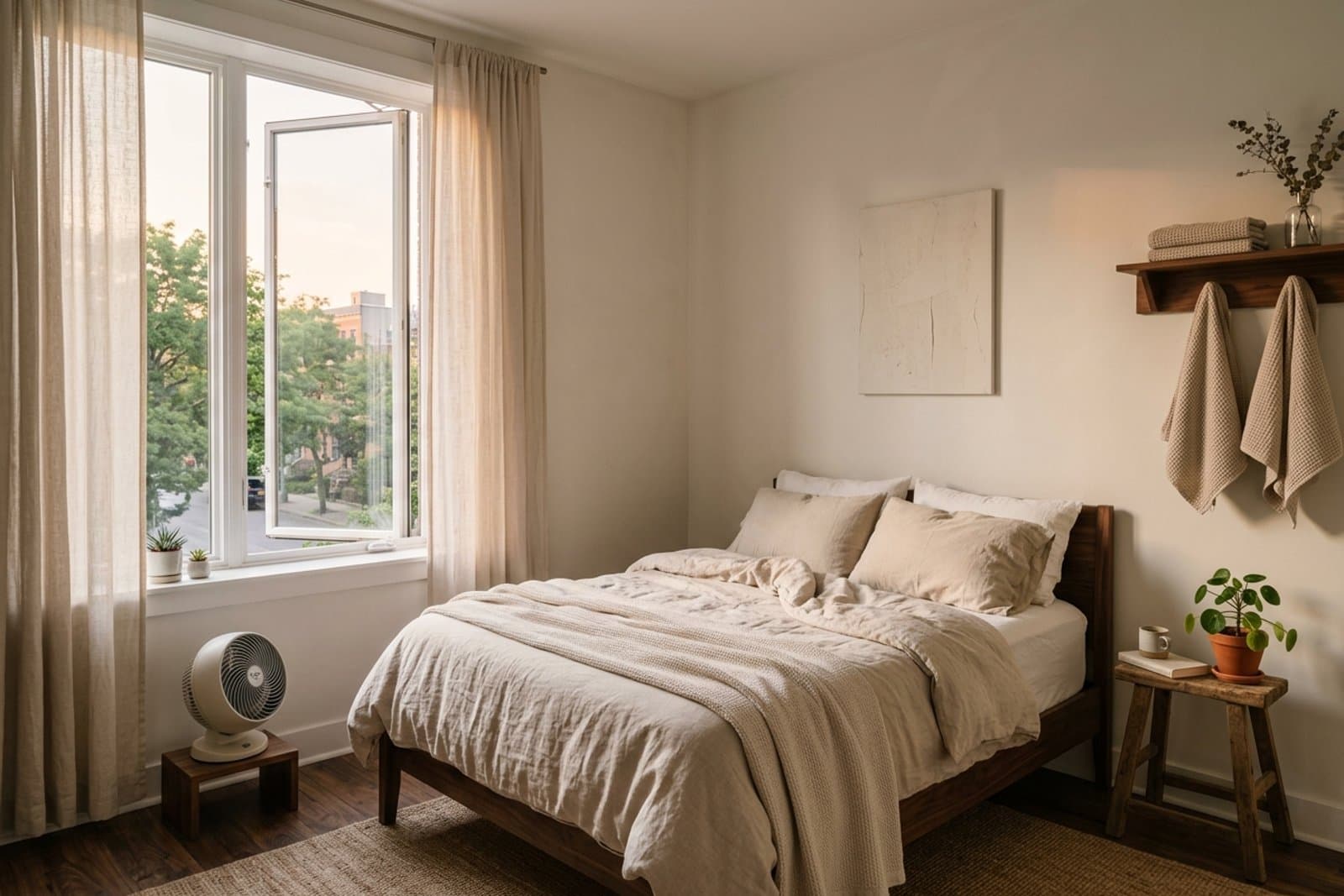
How to Cool a Humid Room Without AC (7 Steps)
Cool a humid room without AC by controlling moisture first, then airflow. A renter safe routine to exhaust damp air, dry textiles, and place fans right.