Bedroom Lighting Ideas: 3 Layers to Set the Mood
Bedroom lighting works best in three layers. See how to combine ambient, task, and accent light at 2700K for a room that shifts from morning to night.

Good bedroom lighting uses three layers: ambient (a ceiling fixture on a dimmer), task (bedside lamps or sconces at chin height), and accent (LED strips or candles for depth). Keep every bulb at 2700K to 3000K warm white and put the ambient layer on a dimmer, so the same room shifts from bright morning to wind down evening with one control.
This works whether you rent or own. Most of it is bulbs and lamps, with no rewiring.
One overhead light is never enough
If your bedroom has a single ceiling fixture controlled by a wall switch, you're using a fraction of what lighting can do. It sets the mood, marks zones, and makes the same room feel different at 7 AM and 10 PM. If the room also reads dim even with the lights on, start with why a room feels dark.
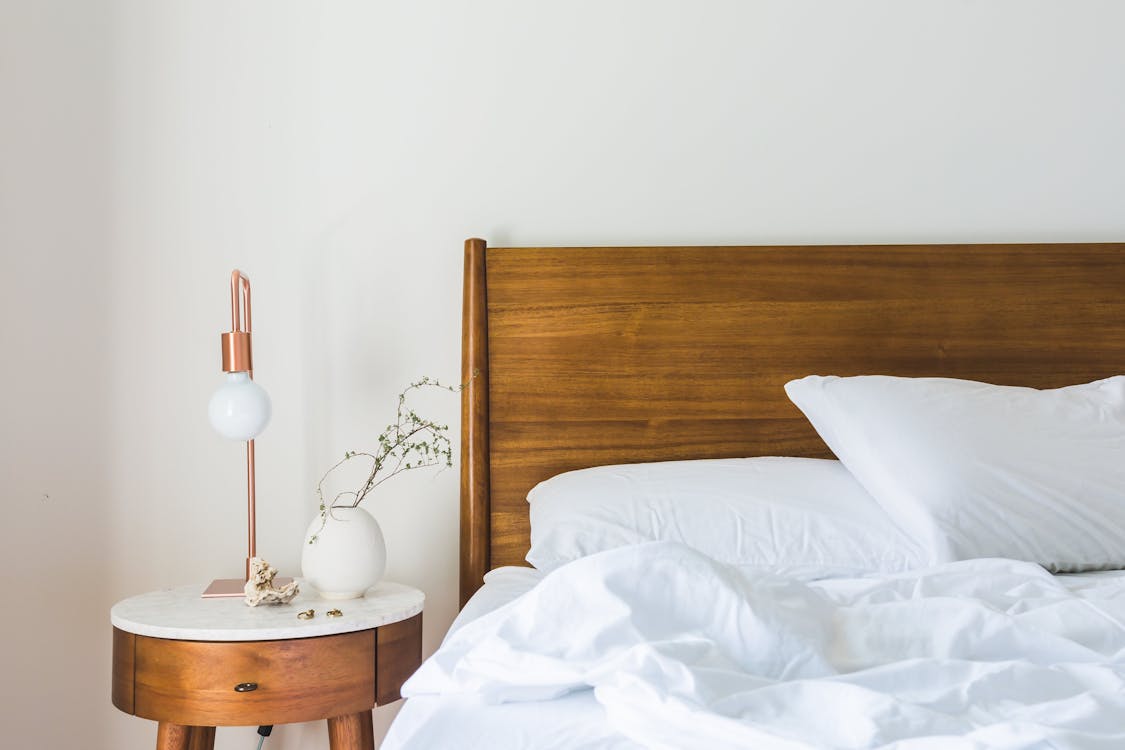
How do you layer bedroom lighting?
Layer a bedroom in three passes: ambient for even base light, task for focused activities like reading, and accent for atmosphere. Start with ambient on a dimmer, add task lights at the bed and any workspace, then finish with accent for depth. Skip any one layer and the room feels flat or harsh.
Layer 1: Ambient (general) lighting
This is your base layer, the light that fills the room evenly. Options include:
- Flush mount or semi-flush ceiling fixture: Simple and effective
- Recessed lighting: Clean and modern, but harder to retrofit
- A statement pendant or chandelier: Adds personality while serving a function
Pro tip: Put ambient lighting on a dimmer. It transforms a bedroom from "getting ready for work" bright to "winding down" warm with a single adjustment.
Layer 2: Task lighting
Focused light where you need it for specific activities:
- Bedside table lamps: The most common task light, perfect for reading
- Swing arm sconces mounted on the wall: Save nightstand space and are adjustable
- Desk lamp: If you have a vanity or workspace in the bedroom
The key rule: Task lights should be at the right height. For reading in bed, the bottom of the lampshade should be at chin level when you're sitting up.
Layer 3: Accent lighting
The layer that adds atmosphere and visual depth:
- LED strip behind the headboard: A warm glow that creates a floating effect
- Picture lights above artwork: drama worthy of a gallery
- A candle cluster on the dresser: Nothing beats real flame for ambiance
- A small table lamp in a dark corner: Eliminates harsh shadows
What color temperature is best for a bedroom?
Use 2700K warm white for a bedroom. It is the golden, relaxing tone that flatters skin and signals wind down, and every source in the room should sit between 2700K and 3000K. Cooler 4000K and up reads clinical and is better left to kitchens and offices. Color temperature is measured in Kelvin (K):
- 2700K (warm white): The sweet spot for bedrooms. Golden, relaxing, flattering
- 3000K (soft white): Slightly brighter but still warm. Good for closets and bathrooms
- 4000K+ (cool/daylight): Too harsh for bedrooms. Save it for kitchens and offices
| Color temperature | Feels like | Best room |
|---|---|---|
| 2700K | Golden, relaxing | Bedroom |
| 3000K | Soft warm | Closet, bathroom |
| 4000K and up | Bright, clinical | Kitchen, office |
Warm light also protects sleep. Harvard Health Publishing reports that a Harvard study found blue light suppressed melatonin for about twice as long as green light of comparable brightness, and shifted circadian rhythms twice as much (about 3 hours versus 1.5). Warmer 2700K bulbs emit less of that sleep disrupting blue wavelength, which is why they are the safer choice near bedtime. For the temperature side of good sleep, see how to keep a bedroom cool for sleep.
Rule of thumb: Every light source in your bedroom should be 2700K-3000K. Mixing warm and cool temperatures creates visual chaos.
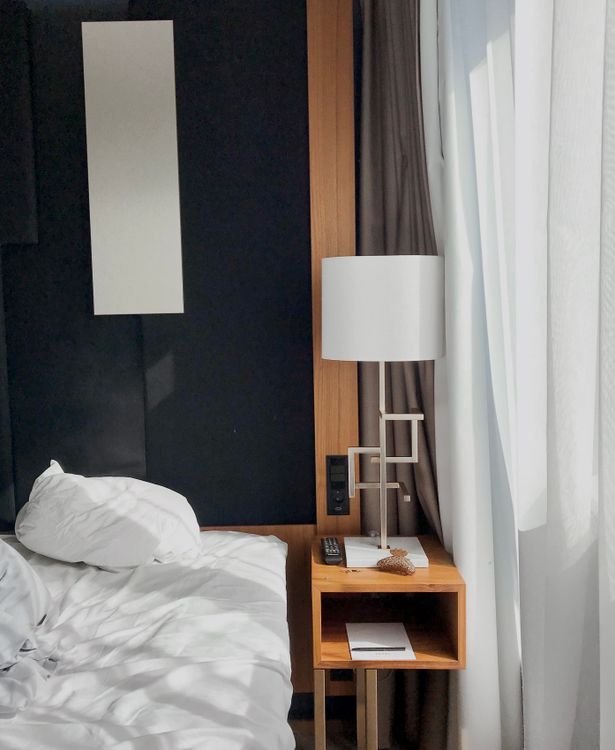
Are smart bulbs worth it for the bedroom?
For most people, yes. A basic smart bulb like the Philips Hue White (a 2700K, E26 dimmable LED) lets you dim from bed, schedule a gradual evening fade, and wake to slowly brightening light instead of a jarring alarm. A set of smart bulbs or smart switches pays for itself in convenience:
- Set schedules that dim automatically in the evening
- Wake up to gradually brightening warm light instead of a jarring alarm
- Control everything from bed without getting up
- Create scenes: "Reading," "Movie," "Morning," each with different brightness and color settings
How do you light a bedroom with no overhead light?
With no ceiling fixture, build the light from the floor up: two bedside lamps or plug-in wall sconces for task light, one floor lamp in a dark corner for ambient fill, and an LED strip or smart bulb on a timer for accent. Put the lamps on a plug-in dimmer so the room still shifts warm at night. Renters can do all of it with no wiring.
- Two bedside lamps (2700K): your main task layer, one per side
- A floor lamp with an upward shade: bounces ambient light off the ceiling to mimic overhead fill
- Plug-in wall sconces: free up the nightstand, no drilling for renters
- A smart bulb on a plug-in dimmer or timer: recreates the convenience of controlling everything from one switch
The nightstand setup
The ideal nightstand lighting setup:
- A lamp or sconce with a warm bulb (2700K)
- On a dimmer or smart bulb so you can adjust
- Positioned so light falls on your book, not your partner's face
- A separate, very dim night light for midnight trips to the bathroom
The test I run lying down
The check I give clients for a bedroom is done from the pillow. Lie on the bed the way you actually sleep, then look around: if you can see any bare bulb from there, the layout fails no matter how correct the color temperature is. Fixtures get planned from the doorway, standing up, but a bedroom is the one room you experience horizontally. Shades should sit low enough to shield the source at pillow height, and the ceiling fixture, if you keep one, should never sit directly over the mattress. Light you feel without seeing its source is what makes a bedroom restful, and that quality never shows up on a spec sheet.
What are common bedroom lighting mistakes?
Four recur. One harsh overhead light doing all the work, warm and cool color temperatures mixed in the same room, too many sources crowding the space, and everything wired so you cannot switch it off from bed. Fix those and the room reads calm instead of chaotic.
- Relying on harsh overhead light: Always have dimmable alternatives
- Mismatched color temperatures: Warm lamp + cool overhead = visual conflict
- Too many light sources: Three to four in a bedroom is plenty
- Forgetting switches: Make sure you can turn off everything from bed
Good lighting mostly goes unnoticed until it's wrong. Layer yours properly and you'll wonder how you lived with that single ceiling fixture.
Frequently asked questions
What color temperature is best for bedroom lighting?
2700K (warm white) is the sweet spot for bedrooms. It's golden, relaxing, and flattering. Every light source in your bedroom should be between 2700K and 3000K. Avoid 4000K or higher, it's too harsh and disrupts sleep.
How many light sources should a bedroom have?
Three to four is ideal. One ambient source (ceiling fixture on a dimmer), two task lights (bedside lamps or sconces), and one accent light (LED strip or candle cluster). More than four starts to feel cluttered.
Are smart bulbs worth it for the bedroom?
Yes. The convenience of dimming from bed, setting schedules that wake you up with gradually brightening warm light, and creating scene presets makes smart bulbs one of the best value bedroom upgrades. Basic smart bulbs cost under $15 each.
Should I use recessed lighting or a pendant in the bedroom?
Both work, but they serve different purposes. Recessed lighting is clean and modern but harder to retrofit. A pendant or chandelier adds personality and becomes a design focal point. Either way, put it on a dimmer.
If the room still feels wrong once the lighting is right, why a bedroom feels hard to sleep in works through the other causes.
The Noticer
For thoughtful people who notice spaces.
What did you notice?
Did something in this story make you see your own space differently?
Want to try this in your own space?
Upload a photo of your room and let Archie, our AI design assistant, show you personalized recommendations.
Try Archie FreeAdvertisement. Archie is made by STUDIO DID IT, the studio that publishes Spatia.
Related Articles
How to Cool a Bedroom Without AC for Sleep: 12 Moves for Summer 2026
Cool a bedroom without AC for sleep: 12 layered moves that stack curtains, airflow, and bedding so the room stays cooler all night, from under $250.
Why Are My Bedroom Windows Wet in the Morning? (6 Fixes)
Bedroom windows wet every morning? It is your room's humidity meeting cold glass. See the humidity numbers to aim for and 6 fixes a renter can make tonight.
Why Is One Room in My House So Cold? (6 Causes You Can See)
Why is one room in my house so cold? Usually a surface problem, not a furnace problem. See the 6 causes you can spot by eye and the free fix to try first.