11 Small Studio Apartment Ideas for 2026 (400 Sq Ft Formula)
The 2026 small studio playbook is no longer white walls and a giant mirror. It is warm earth tones, three zones split by rugs and light, and one classic shape per area. Here is the full 11 step formula for a 400 sq ft renter.

The small studio playbook changed in 2026. The "white walls and a giant mirror" advice that ruled the last decade has been replaced by something warmer, more zoned, and a lot harder to fake.
This guide is for renters in studios between 350 and 450 sq ft. If you own a home with multiple rooms and want a similar warm classic direction, read our quiet luxury interior guide instead.
Why the old small studio playbook stopped working
For a decade the dominant advice was: paint everything white, hang a big mirror, buy fold-down everything, and the room will feel bigger. It worked as a photo trick, less so as a place to live. The follow on wave was the japandi look: oak, linen, restraint, neutral palette. Cleaner than the white mirror era but, for many renters, sterile. By early 2026, the rooms getting saved and copied online had moved again. Walls in caramel or chocolate brown. One rug per zone instead of one rug under everything. A real desk, not a fold-down. Floor level seating, plants doing the work that partitions used to do, and at least one classic shape (a curved sofa arm, a turned table leg) softened by texture. The mood is composed, but lived in. The formula below is what shows up, again and again, in the studios people actually want to be home in.
11 ideas that make a 400 sq ft studio feel warm and zoned
The list moves from color to layout to furniture to the small final layers. Most items are reversible, none require drilling beyond a curtain rod, and most pieces can leave with you when the lease ends. Start with item one and skip what is already in place. If you are still figuring out which direction fits you, the interior design style guide is a good first read.
1. Trade greige for caramel, terracotta, or chocolate brown on one wall
Greige (the gray beige hybrid) flattened studios for most of the last decade. In 2026 the dominant direction is warm earth: caramel, terracotta, soft chocolate, olive brown. You do not need to paint four walls. One wall is enough to anchor the room, and one wall is renter safe to repaint when you move out. Pick the wall behind the bed or behind the sofa, whichever the eye lands on when you enter. The other three walls stay quiet: a warm off-white, a soft oat, or a muted putty. The earth tone reads as a backdrop for the room, not as an accent feature. For the psychology behind why warm walls outperform cool ones in small spaces, see our small apartment design psychology guide.
2. Run three rugs instead of one
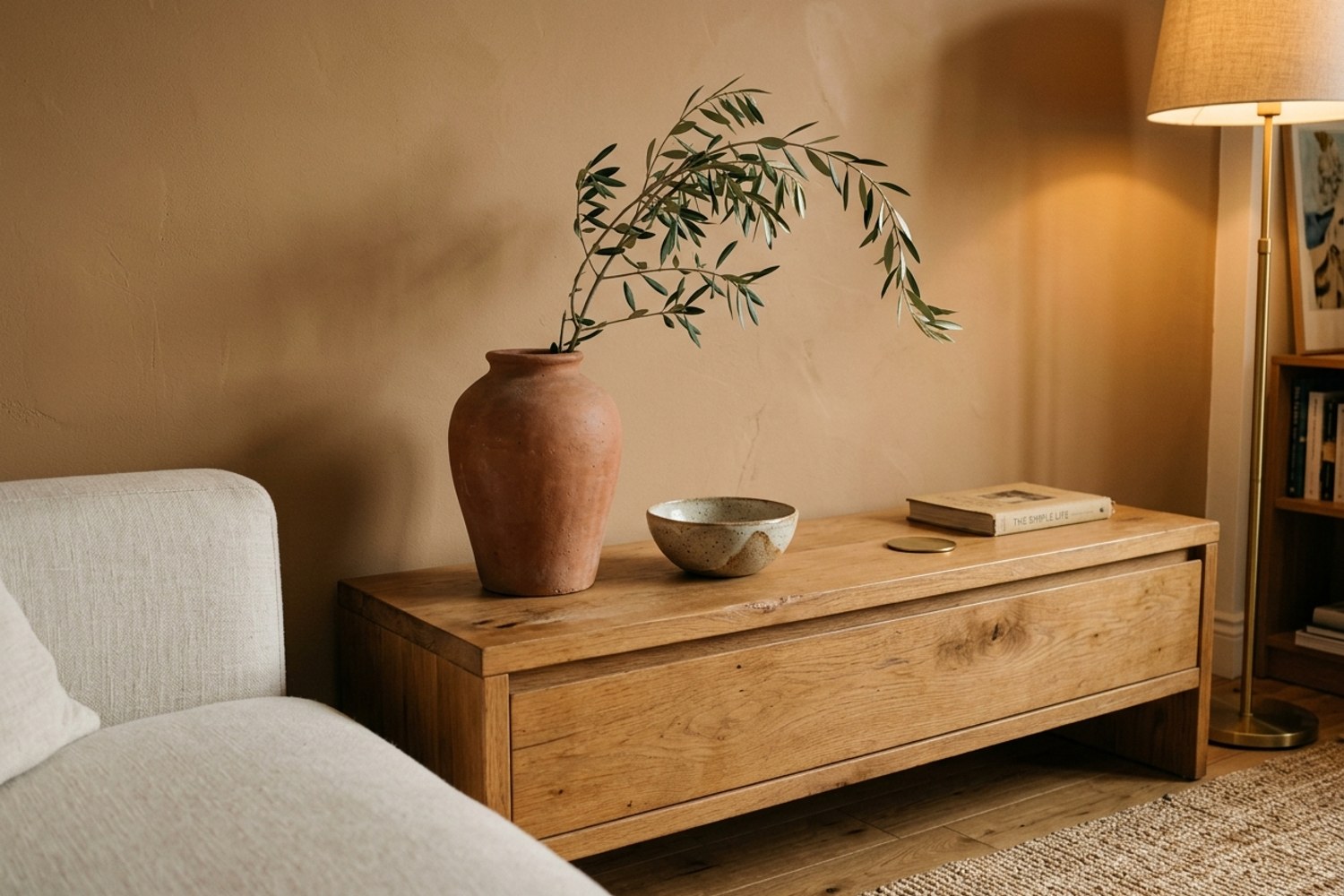
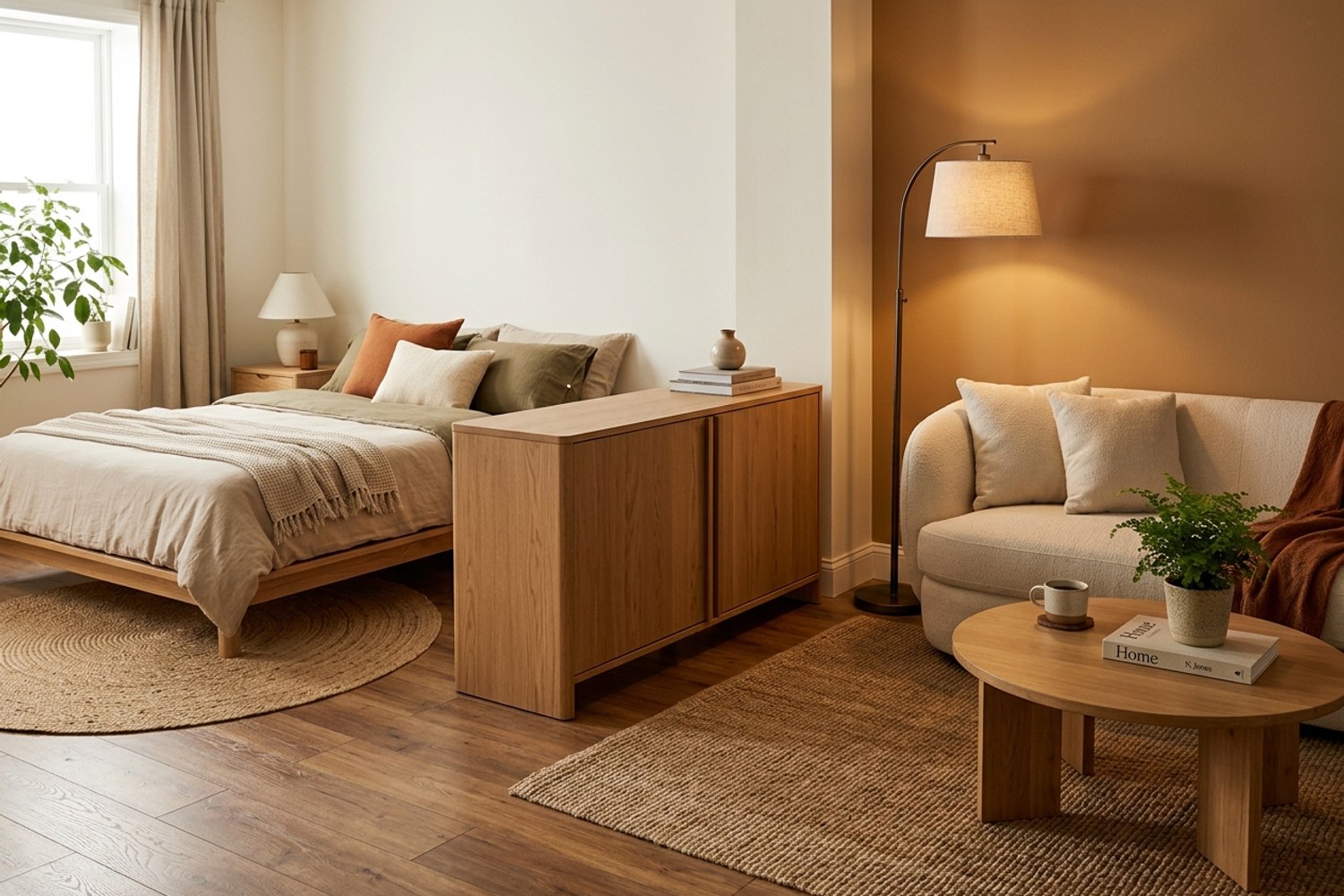
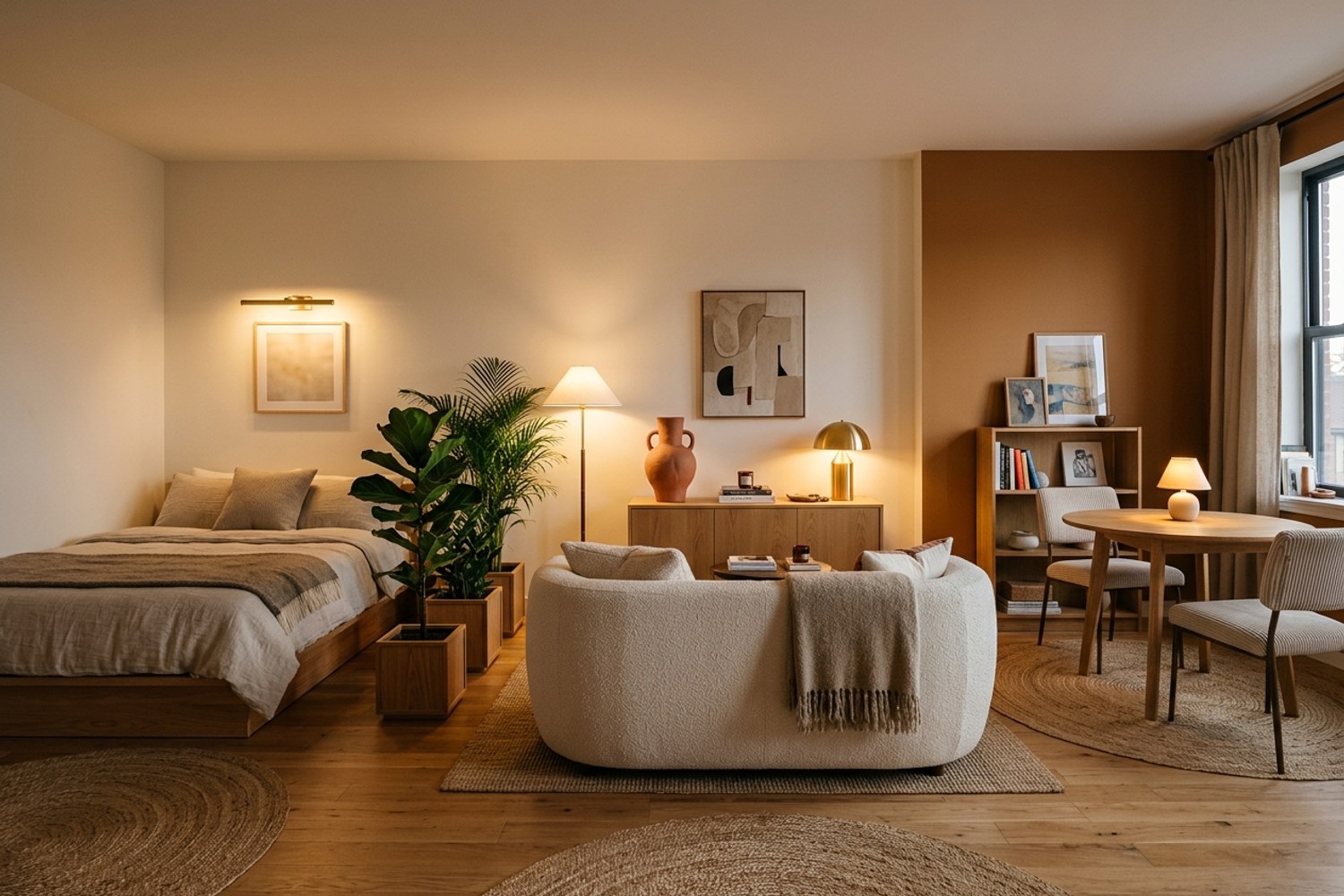
The biggest spatial change in the 2026 small studio formula is rug count. Conventional advice put one large rug under the sofa and called it done. The new layout uses three: one under the bed, one under the seating zone, one under the dining or work zone. Each rug becomes a quiet floor wall. The eye reads three distinct rooms even though no real walls divide the space. Pick the same fiber family across all three (jute, wool, low pile) but vary the size and tone slightly so the zones feel related, not matched. A 400 sq ft studio reads as three rooms once the floor is broken into three pieces.
3. Pick a low credenza, not a tall bookshelf, as your divider
A bookshelf is the most common studio divider, and almost every client I've designed for already owns one. Pull it out. A 6 ft tall shelf blocks light, blocks sightline, and signals "wall" in a room that should still feel like one space. The 2026 alternative is a low credenza, usually under 32 inches tall, placed between the sleep zone and the living zone. It holds the same amount of storage as a tall shelf, hides what should be hidden behind doors, and stops at eye level. Light passes over it. The room still reads as one volume. Zoning happens visually, not architecturally.
4. Make the dining table count for two zones
A small studio cannot afford a single use dining table. Pick a round table around 36 to 42 inches across, in solid oak or walnut, that doubles as your work desk by day and your dinner table at night. The round shape is critical: it shares space with the sofa more gracefully than a rectangle, and it seats two to four without the dead corners that rectangular tables waste. Pair it with two chairs, not four. Four chairs make the room feel like a dining room. Two chairs make it feel like a studio that hosts well.
5. Replace the fold-down desk with a real one
The fold-down desk was the icon of the small apartment makes it work era. The 2026 direction abandons it. A small studio is your full home and your workplace; the desk needs to be a piece you actually want to sit at. If your dining table is doubling as a desk (idea 4), the dining table is the desk. If you need a dedicated workstation, pick a real one: 40 to 48 inches wide, solid wood top, no folding mechanism. The fold-down signals "this is temporary." Removing it lets the room read as a real home.
6. Use plants as soft walls, not decor
Plants are the most overlooked zoning tool in a small studio. Three or four medium tall plants (fiddle leaf, parlor palm, kentia, monstera) placed in a line between two zones do the same visual work as a divider, with two added benefits: light still passes through, and the air moves better. Place them in matching planters (oak, ceramic, woven) and stagger heights between 3 and 5 ft. The line of green reads as a soft wall. The zone behind it feels separated. The studio still feels like one space with breath in it.
7. Anchor each zone with its own lamp
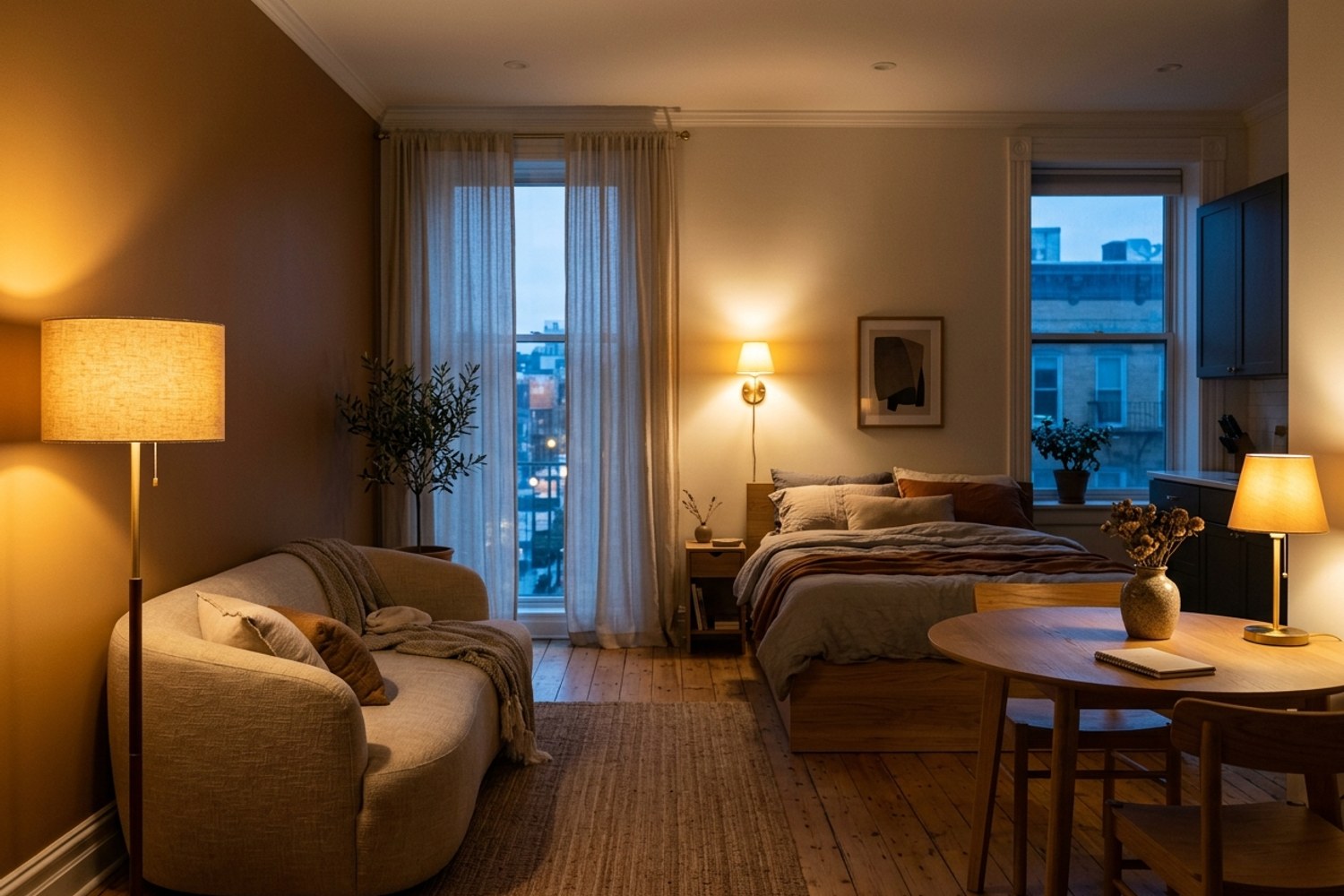
Overhead light is the single biggest reason small studios feel like rentals. The 2026 formula uses zero overhead light at night. Each zone gets its own warm lamp: a floor lamp by the sofa, a wall sconce or pendant over the bed, a table lamp on the dining table or desk. Color temperature stays at 2700K or warmer. The three lamps light only their zone, which makes the zones feel separate at night even when daytime sees the whole studio as one room. Light, not walls, divides the space after dark.
8. Buy curtains long enough to puddle
Renters skip curtains, and the room pays for it. Long curtains (floor length, an inch of puddle on the floor) make a 9 ft ceiling read 12. Hung from a rod 4 to 6 inches above the window frame and extending 8 to 10 inches past each side, they turn a small window into a full architectural feature. Pick a heavy linen or cotton in a warm off-white, oat, or soft caramel. Avoid sheer panels alone. The formula needs weight on the wall, not just light filter.
9. Pick one classic shape per zone, then soften with linen
A turned wood leg, a curved sofa arm, a ribbed wood headboard, a brass picture light. One classic shape per zone keeps the studio from feeling flat or generic. Pair each classic shape with a soft fabric in the same zone (linen sofa, linen bedding, cotton table runner) so the room reads composed but lived in. The combination is what separates the 2026 direction from both the cold modern era before it and the all rustic farmhouse look that overcorrected the other way.
10. Keep the floor visible in only one zone
If every zone has a rug, the studio reads as too much rug. Pick one zone (usually the sleep zone or the entry path) to keep mostly visible floor. The contrast between rug and bare floor adds a layer of variation the eye reads as depth. It also keeps the room from looking like a hotel suite, which is the failure mode when every surface is dressed. A studio with three rugs and visible floor in one band reads as a designed room, not a furnished one.
11. Add one ceramic piece big enough to count
The final layer is one large ceramic object: a 12 to 18 inch vase, a sculptural bowl, a turned wood lamp base, a stoneware pitcher. One large object reads more composed than ten small ones. Place it where the eye lands when you walk in: the credenza, the dining table, the floor next to the sofa. The object should be tonal with the room (warm off-white, terracotta, sand, chocolate) and tall enough to break a horizontal line. The detail that finishes the room is one well chosen piece, not a styling tray of five.
What's the right warm color for a small studio without windows?
The instinct in a low light studio is to lean lighter, but lighter cool tones read gray and depressing in low light. The 2026 direction goes the opposite way: pick a warm earth tone with a yellow or red base, never a blue one. Caramel (Benjamin Moore Stone Hearth), soft terracotta (Farrow & Ball Red Earth), and chocolate brown with a warm undertone (Sherwin-Williams Urbane Bronze) all read luminous in low light because they reflect warm wavelengths that the rest of the room bounces back. Put the color on the wall the bed or sofa faces, leave the other three walls in a warm off-white (Benjamin Moore Swiss Coffee, White Dove, or Soft Chamois), and layer three warm light sources at 2700K or lower. The room will read warmer at 8 p.m. with two lamps on than a white studio reads at noon.
How do you zone a studio when you can't add walls?
Three layers do the work in 2026: rugs, height, and light. Each zone (sleep, living, work or dining) gets its own rug from the same fiber family, a different piece of furniture under 32 inches tall as a soft divider (low credenza, low bench, line of plants), and its own warm lamp at 2700K or lower. The eye reads three rooms because three independent visual signals reinforce each other on the floor, at waist height, and at night. No drilling, no installed millwork, no partitions taller than seated eye level. The result is a 400 sq ft studio that reads as a one bedroom in photos and lives like a thoughtful one bedroom in person. For more on why solo dwellers benefit most from this kind of zoning, see our living alone interior design guide.
What does this formula not need?
A common trap in small studio advice is the urge to buy more solutions. The 2026 formula skips most of them. You do not need a Murphy bed, the room is large enough for a real bed. You do not need a fold-down desk if a 36 inch round dining table is doing two jobs. You do not need three storage ottomans, two of them will sit in the corner unused. You do not need a tall room divider, the low credenza already does the work. You do not need every wall painted, one earth tone wall and three warm off-whites read more refined than four bold walls. You do not need overhead light at night, three warm lamps will do better. The studio reads more intentional with five well chosen pieces than with twenty pieces fighting for room.
Final thought
I have designed dozens of studios under 450 sq ft over the last ten years. The ones I would actually want to live in all share these moves: warmth on the walls, separation of activities, intentional layers of light, and pieces sized to one person's actual day. None of it is irreversible. None of it requires owning the place. A 400 sq ft studio that follows this formula will still feel right in 2030, with or without the next aesthetic wave.
Matt Jang is an interior architect at Spatia. He has spent the last decade designing small urban homes for solo dwellers, most of them under 600 sq ft.
Plan your studio layout with Archie
Send Archie a quick sketch of your studio. Archie returns a zoned layout with the exact furniture sized for your 400 sq ft.
Plan my studio with ArchieRelated Articles

Living Alone Interior Design: How Solo Living Is Redefining Modern Spaces (2026 Guide)
Living alone is no longer a temporary phase. It is becoming a dominant lifestyle, and interior design is shifting with it. Homes are no longer built for families. They are built for one.

Quiet Luxury Interior Design: What It Really Means in 2026
Luxury used to announce itself with marble and chandeliers. Quiet luxury moves in the opposite direction. Here is what has changed, and how to bring it into your own home.

Can Your Home Cause Stress? How Design Shapes Mental Wellbeing
Your home is not a passive background. It is in constant conversation with your brain, and that conversation either calms your nervous system or keeps it slightly on edge.