Can Your Home Cause Stress? How Design Shapes Mental Wellbeing
Your home is not a passive background. It is in constant conversation with your brain, and that conversation either calms your nervous system or keeps it slightly on edge.

The source of stress most people never name
We tend to think of stress as something arriving from outside the home. Work pressure. A long calendar. Money. The bills that show up at the start of each month.
There is another source that almost no one names. The room you are sitting in right now.
From a spatial psychology standpoint, your home is not a passive background. It is in constant conversation with your brain, and that conversation is either calming your nervous system or holding it slightly on edge.
The home that looks fine on the surface, and quietly costs you every day.
How your brain reads a room
Your brain processes a room the moment you walk into it, without asking permission. It is reading three things at once:
- Visual complexity. How many objects, patterns, and surfaces are competing for attention.
- Lighting. Whether the light is layered and warm, or flat and uniform.
- Spatial organization. How clearly the room is divided into zones, and how easily the eye moves between them.
When a room is cluttered, inconsistent, or poorly lit, all three readings come back loud. The result is a steady background of stimulation that you stop noticing on a conscious level. Your body does not stop noticing.
Over weeks and months, that hum shows up as:
- Mental fatigue, especially in the evening at home
- Reduced focus during the workday from home
- A quiet emotional flatness with no obvious cause
The frustrating part is that none of this looks like stress. The room appears fine. It simply does not let you rest.
The hidden stress triggers most homes carry
Four patterns appear over and over in homes that feel tiring. None of them are dramatic. All of them are fixable.
Cluttered surfaces
Every visible object asks for a small share of attention. A counter holding twelve items is asking for twelve small acknowledgments, every time you walk past it. Multiply that by every surface in the home and the cognitive load is real.
The fix is unglamorous. Clear most flat surfaces. Keep one or two intentional objects on each. The eye stops scanning a room that has nothing left to scan.
Flat lighting
A single overhead bulb creates one kind of light, evenly distributed and emotionally neutral. The eye reads flat light as a public space. A waiting room, a hallway, an office at night.
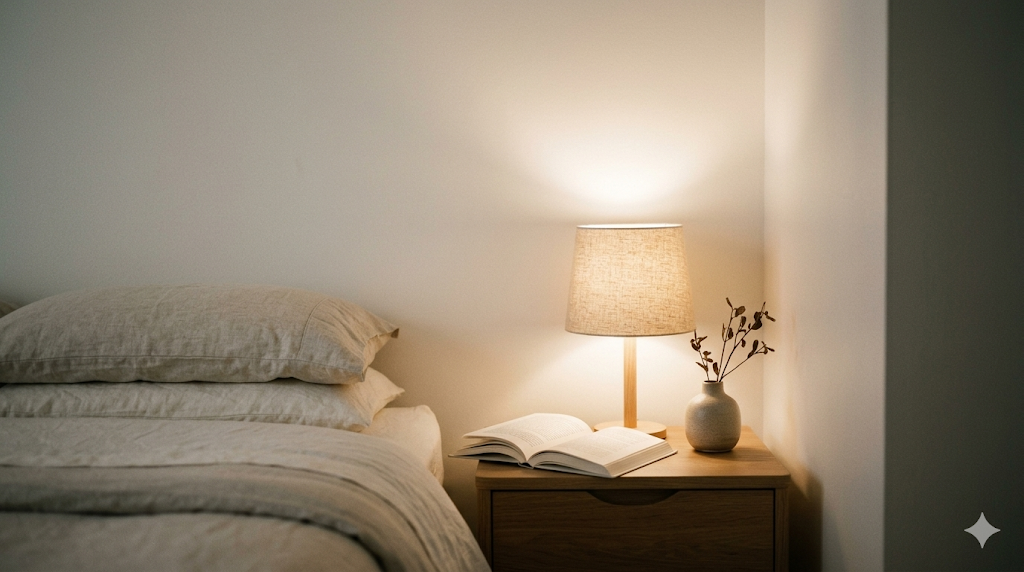
A home needs depth. Lamps at three different heights, on the warm side of 3000K, change a room's emotional register completely. Light should pool in some places and fade in others.
Fragmented layouts
A room with no clear zones is a room the brain has to keep solving. Where do I sit. Where do I read. Where does conversation happen. Each unanswered question is a small piece of friction.
Anchor each room around one or two clear functions, then arrange furniture to support them. Even a studio benefits from a defined sleeping zone, a defined sitting zone, and a defined working zone, separated by something as light as a rug or a lamp.
High contrast colors
Strong color contrast is stimulating. That can be exactly right in a kitchen or a powder room, where energy is welcome. It is the wrong call for a living room or bedroom, where the body is asking for the opposite signal.
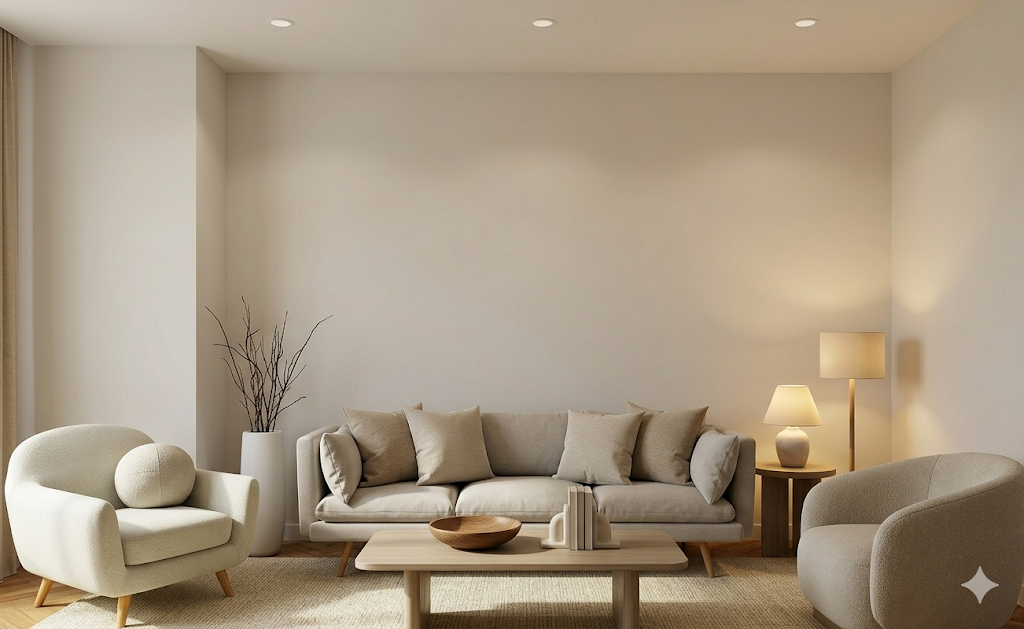
Soft, tonal palettes give the eye a place to settle. Warm beige, muted green, oat, taupe, mushroom. These read as safety to the nervous system, not as stimulation.
What a supportive space does
A well designed home is not a decorated home. It is a regulated one.
A supportive space:
- Reduces the total visual input the brain has to process
- Creates a predictable flow from one zone to the next
- Layers light at human heights, not on the ceiling
- Leaves enough empty surface for the eye to land and rest
The result is not minimalism for its own sake. It is a room that asks less of you. Over a year, the difference shows up in how tired you are when you sit down at the end of the day.
Your home is either calming you or keeping you active
A home is never neutral. It is either lowering the volume on your nervous system, or holding it slightly elevated, all day, every day.
Once you know which one your home is doing, you can change it. The work is rarely a renovation. It is most often a list of small, considered decisions. Less on the surface. More layers of light. Clearer zones. Softer color.
The home that supports you does not have to look impressive. It has to feel quiet.
Frequently asked questions
How do I tell if my home is causing me stress?
A practical test: when you come home, does your body feel like it can exhale within ten minutes? If you find yourself still tense an hour later, the room is likely contributing. The most common culprits are visible clutter, harsh overhead lighting, and high contrast color choices in rooms meant for rest.
Which room should I fix first?
Whichever room you spend the most awake time in. For most people that is the living room or the home office. Bedrooms matter, but the body is unconscious for most of the time spent there. A calmer living room delivers the biggest daily return.
Do I need to redecorate to lower stress at home?
No. The most effective moves are subtractive, not additive. Clear flat surfaces, replace one overhead light with two lamps, and consolidate to a tighter color palette. None of that requires new furniture.
Is open plan or zoned layout less stressful?
A clearly zoned layout is almost always calmer than a pure open plan. Even an open space benefits from gentle visual breaks. A rug, a low bookshelf, a change in lighting. The brain wants to know where it is in the room.
Can color alone change how a room feels?
Color carries a large share of the emotional reading of a room. Repainting one room in a warm, desaturated tone is the highest leverage single change most people can make at home, especially in rooms that currently use bright whites or strong contrast blocks.
Want to try this in your own space?
Upload a photo of your room and let Archie, our AI design assistant, show you personalized recommendations.
Try Archie FreeRelated Articles

Living Alone Interior Design: How Solo Living Is Redefining Modern Spaces (2026 Guide)
Living alone is no longer a temporary phase. It is becoming a dominant lifestyle, and interior design is shifting with it. Homes are no longer built for families. They are built for one.

11 Small Studio Apartment Ideas for 2026 (400 Sq Ft Formula)
The 2026 small studio playbook is no longer white walls and a giant mirror. It is warm earth tones, three zones split by rugs and light, and one classic shape per area. Here is the full 11 step formula for a 400 sq ft renter.

Quiet Luxury Interior Design: What It Really Means in 2026
Luxury used to announce itself with marble and chandeliers. Quiet luxury moves in the opposite direction. Here is what has changed, and how to bring it into your own home.