Why Does My Room Feel Cluttered When It's Clean?
Your room is clean but still feels cluttered because tidy fixes mess while calm lowers visual load. Four moves quiet the room, plus the light and the seating.
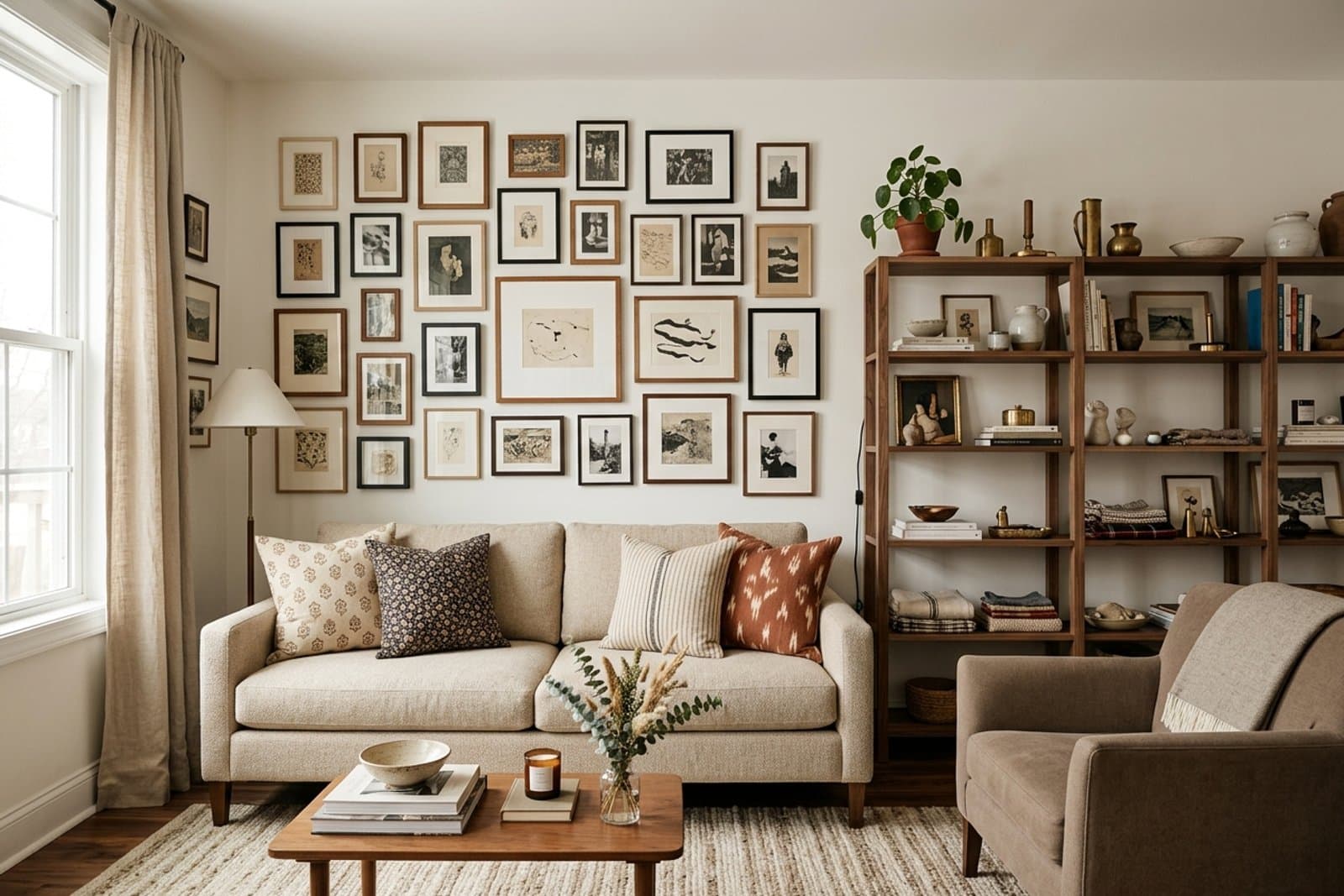
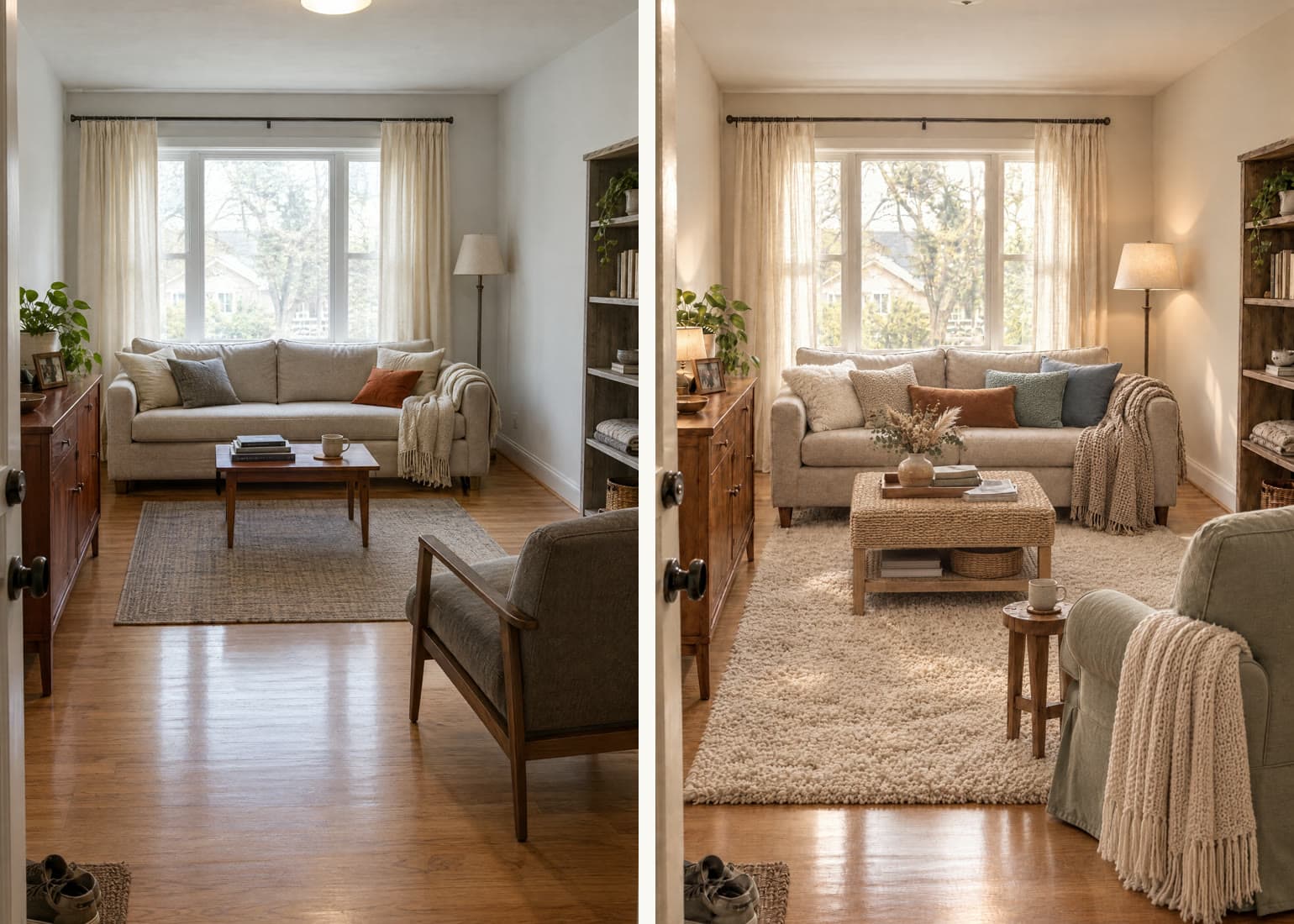
A room can be clean, everything put away, and still feel busy the moment you sit down in it. The gap is visual load: how many separate objects, colors, and unfinished edges the eye has to process. Tidying answers mess. Lowering visual load is what makes a room feel calm, and it takes four edits to what the eye counts, then a change to the light, and in a living room a change to the seating. Cut the load and the room settles.
This is for the room that passes a white glove test and still will not let you relax. If your room feels empty and lifeless rather than busy, the problem is the opposite one, and our guide to rooms that feel flat is the better starting point. Come back here when the room is full, clean, and somehow still loud.
Why does a clean room still feel cluttered?
Because your brain reads a room whether you ask it to or not. It scans every visible object, edge, and color, and it cannot switch that scan off. A room can hold zero actual mess and still hold forty visible objects, and each one is a small tax on attention.
Two studies mark the edges of this. At the Princeton University Neuroscience Institute, Stephanie McMains and Sabine Kastner showed in a 2011 Journal of Neuroscience paper that objects in view compete for attention and suppress one another, so the more a room holds, the harder the brain works to filter it. Then in a 2010 Personality and Social Psychology Bulletin study, UCLA psychologists Darby Saxbe and Rena Repetti found that women who described their own homes using more clutter and unfinished project language showed less healthy cortisol patterns and more depressed mood across the day. The attention research explains the moment you walk in. The cortisol work is the reason a busy room is worth fixing rather than tolerating.
Designers now call this visual load, and the 2026 shift toward "considered calm" is really a shift toward lowering it. Tidy asks whether things are put away. Calm asks how many things the eye has to process and whether it has anywhere to rest. A styled shelf, an open cable, four throw pillows in four patterns, and a gallery wall can all be perfectly clean and still keep you on low alert. The four moves below lower the load, in order of how much they change.
| Tidy | Calm | |
|---|---|---|
| Measures | whether things are put away | how many things the eye has to process |
| Fails when | there is visible mess | visual load is high, even with no mess |
| Fixed by | cleaning up | one focal point, a lower object count, closed loops, a tight palette |
1. Give the eye one place to land
Most rooms give the eye nothing to land on first. Every object competes at the same volume, so the eye keeps scanning for a main character and never finds one. That constant small movement is the busy feeling. A room with no focal point reads as unresolved, the visual version of a sentence with no verb.
Calm rooms almost always have one clear anchor the eye goes to first and returns to: a fireplace, a large piece of art, a bed with a real headboard. It gives the scan a home base, and the rest of the room is free to be quiet background.
Pick the anchor before you add anything else. Let the largest wall element win on purpose. One oversized piece beats a grid of nine small frames, the same way a single substantial object marks a zone in our studio zoning guide. Then edit everything near it down.
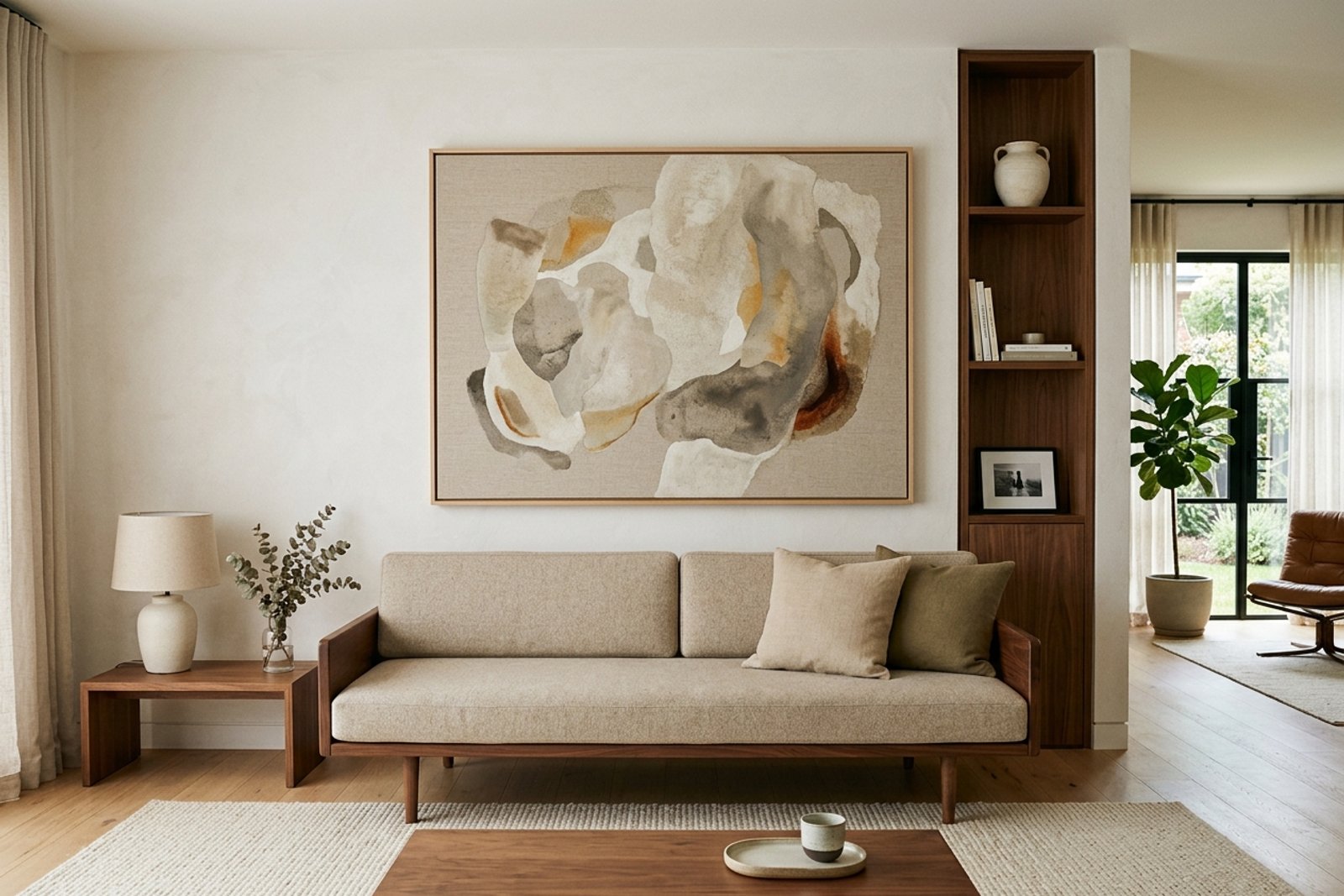
2. Cut the visible object count
Surfaces collect. A coffee table gathers a tray, a candle, two books, a remote, a coaster, a small plant, none of it mess. It is just a high count of visible things, and the count is what your brain reacts to.
Calm rooms are not emptier, they are lower count. Every object on display is a decision the eye has to make. Twelve small things on a shelf is twelve decisions; three larger ones is three. The calm in a styled Scandinavian room is mostly this, a low count inside a full room.
Start with the surfaces you see from the doorway and from the seat you actually use, and stay out of the drawers. Hidden clutter can wait a week; the visible count is what changes the room tonight. Clear those surfaces into one temporary box, then put back about a third of what came off, keeping the pieces that are useful, large enough to register on their own, or already related to the colors around them.
Height decides how loud an object is. The band roughly 4 to 6 feet off the floor is where a standing person's gaze lives, so anything hanging or stacked inside it competes directly with windows, art, and faces. Objects below the band read as grounded weight instead. Walk the room, note everything sitting at your own eye height, and keep only what deserves that position. Most of it does not have to leave the house. It just moves lower.
Then use a rule of thirds on what is left. Leave about a third of any shelf or table empty, and swap three small objects for one larger one: a tall vase instead of five trinkets, one stack of books instead of eight spread out. The empty space is what lets the pieces you kept register.
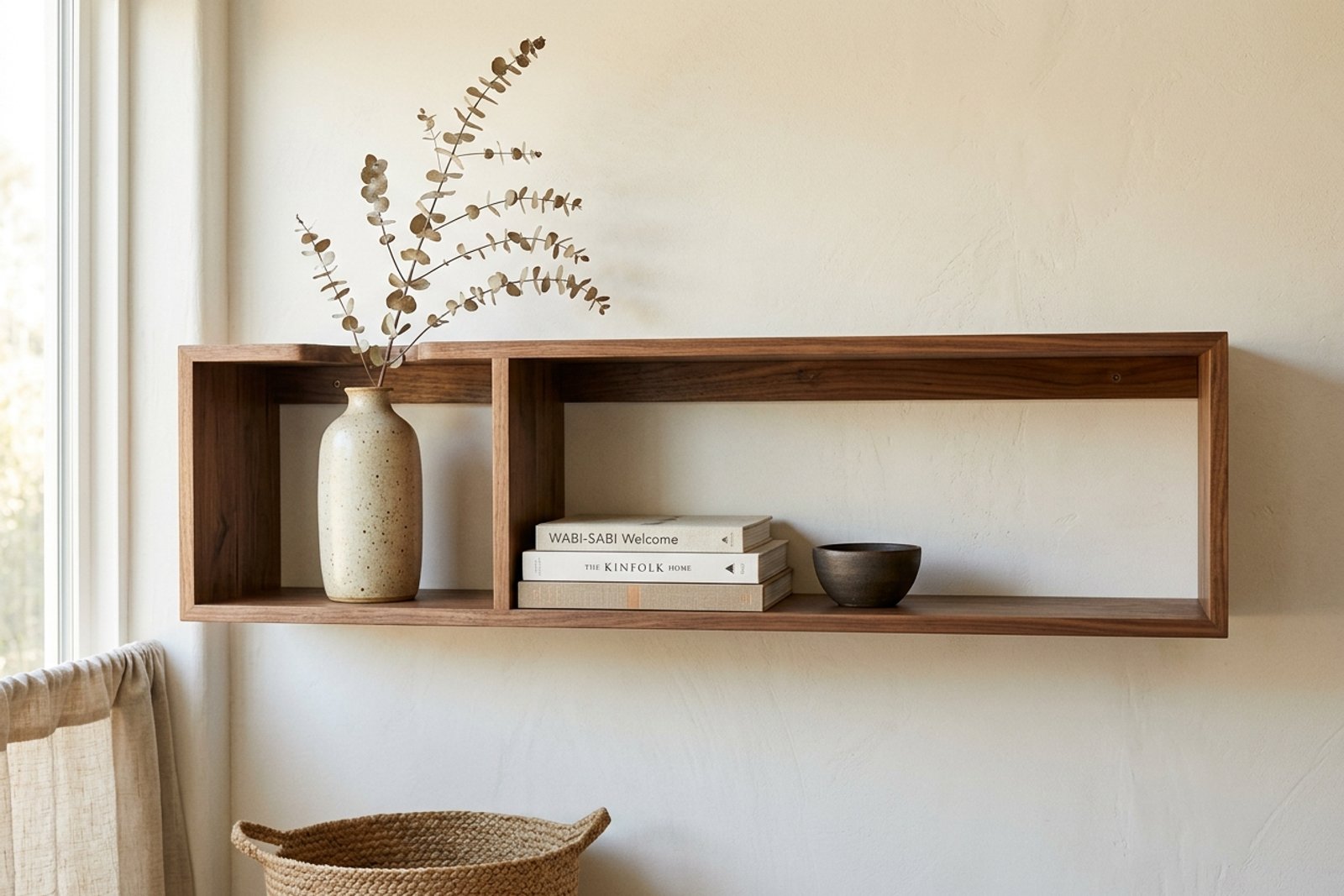
3. Close the open loops
Most rooms are full of visual sentences that never finish. A charging cable running to nowhere. Cords behind the TV. A basket half full of blankets. Open shelving where the backs of things show. The eye reads each one the way the mind reads a task you have not done, low grade unfinished business that adds up to feeling behind in a room that is technically clean.
Closing the loop removes the prompt, and the eye moves on.
Start with the loops that show most. Run cords behind a leg so no wire crosses open floor. Swap open baskets for lidded ones. Style open shelves to a clean front line instead of a view into the backs of things. Move remotes and chargers into a drawer. The hidden charging setups popular in 2026 do exactly this.
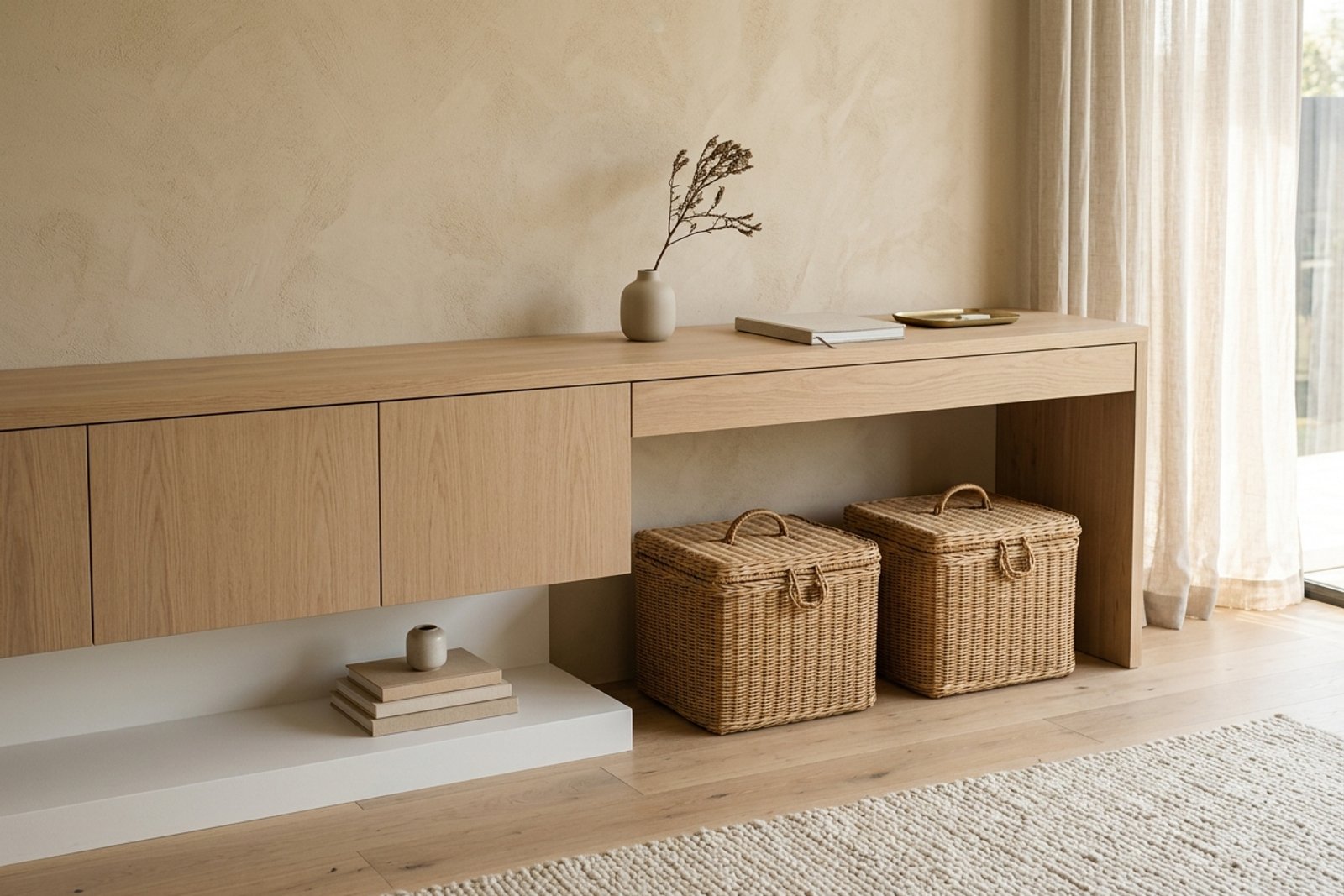
4. Unify the color and material field
Most rooms accumulate one color at a time. A blue pillow, a brass lamp, a walnut table, a black frame, a green pot, a jute rug. Nothing clashes, but the eye has to register a new color or material every few inches, and every break is a small reset. Six colors and five metals make the brain recount the room over and over.
A tighter field lets attention settle. When most of the room shares a small palette, the eye reads it as one calm surface instead of forty separate items.
Grouping does half the work before color does. Scattered items read louder than grouped ones because the eye restarts at each one: three frames on one wall are quieter than three frames on three walls, and one stack of books is quieter than the same books spread over a table, a console, and a windowsill. Once things are grouped, repeat a material at least three times so the repetition reads as a decision.
- A walnut table, a wood picture frame, and a woven tray.
- A white shade, a cream pillow, and a warm white vase.
- A black floor lamp, a black frame, and a dark metal bowl.
- A linen curtain, a linen pillow, and a matte ceramic lamp.
Then choose two or three quiet tones and let them cover most of the room, the way the muted palette does in our Scandinavian small bedroom guide. The 60/30/10 rule is the usual guide: one dominant tone across about 60 percent of the room, a secondary tone on 30, and a single accent on the last 10. The quiet band to pick from runs through beige, oat, taupe, mushroom, and the muted greens between sage and olive. For the dominant tone, Benjamin Moore White Dove OC-17 stays clean, while Pale Oak OC-20 and Sherwin-Williams Accessible Beige SW 7036 sit warmer without going cold. Repeat one metal. Keep wood tones in the same family. Then spend your contrast on purpose, on the focal point from move one. A unified field still has color in it. The color just arrives where you chose to put it.
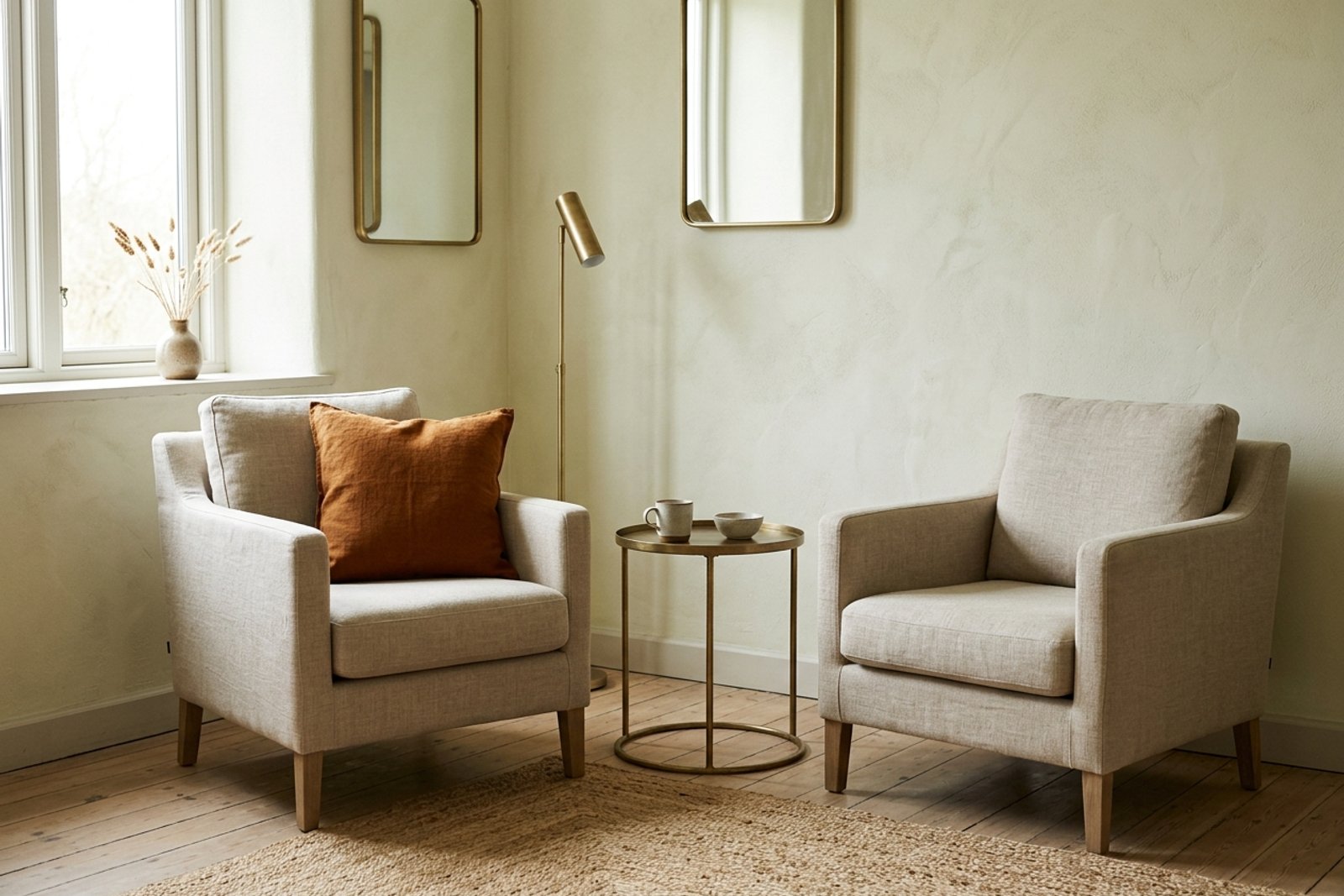
Why does the same room feel calmer at night?
Because light decides which edges you can see. Most people notice the effect without naming it: at 9 p.m. with two lamps on, the room feels better than it did at 2 p.m. under the ceiling fixture, and nothing has been removed. One bright overhead makes every object equally visible, including the cords, the labels, the backs of things on open shelves, and the pile you meant to deal with tomorrow. Lower, warmer light chooses what the eye reads.
Use three smaller sources instead of the ceiling fixture:
- A floor lamp beside the main seat.
- A table lamp near the focal point from move one.
- A low shaded lamp on a console or dresser to fill the darkest corner.
Keep the bulbs at 2700K, and 3000K at the coolest; a Philips Hue White 2700K E26 or any warm LED of the same rating does it. Put the brightest source on the focal point and let the corners fall away, so the room has a hierarchy after dark instead of even coverage. If a television is in the room, set the lamp beside or behind the viewer rather than opposite the screen, or the reflection cancels the whole effect. Wire the lamp you reach for most into a switch you can hit from the seat, because a lamp that needs you to stand up gets used half as often. For the placement logic room by room, our guide to where lamps go in a dark room covers the harder cases.
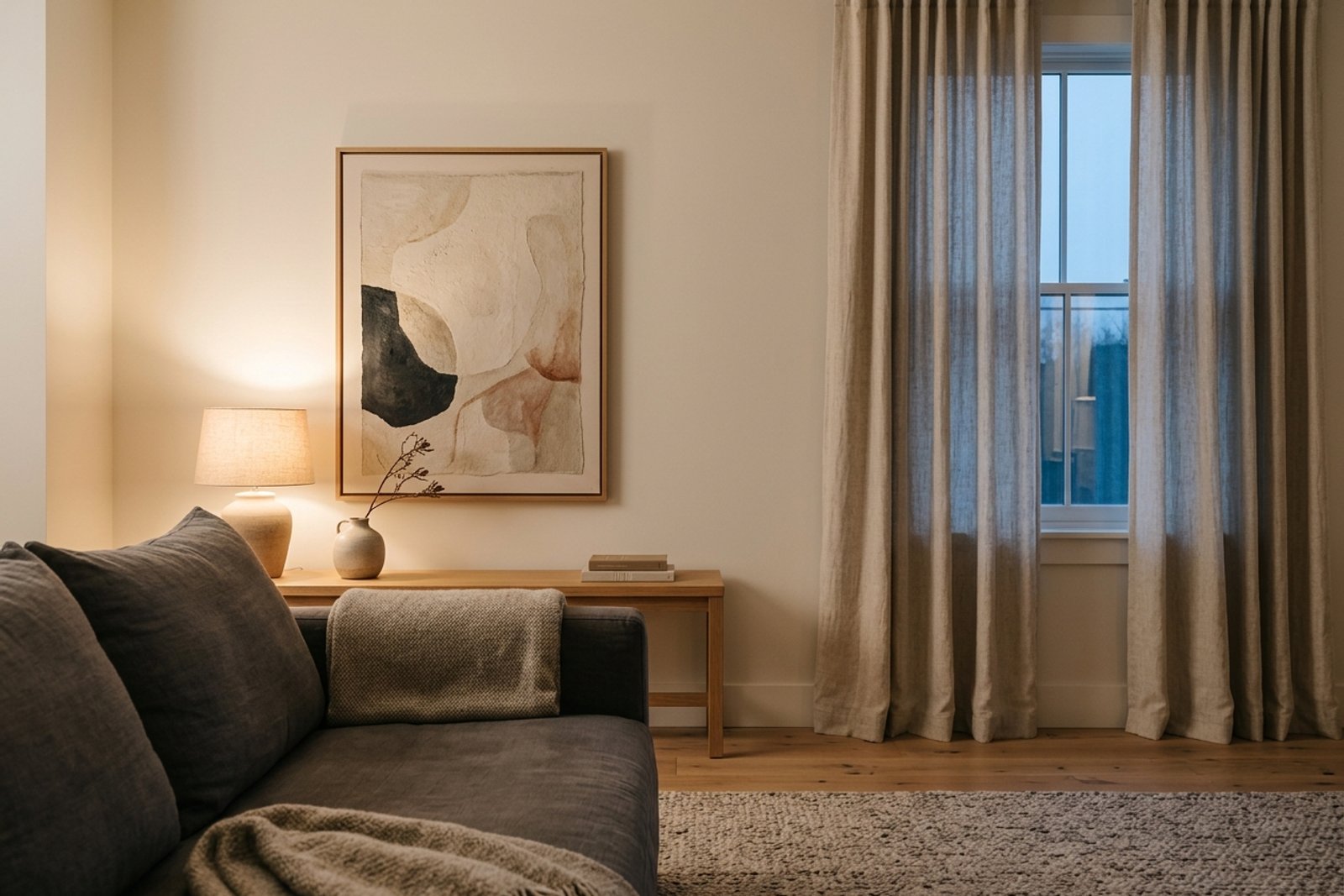
Why is a living room the hardest room to get calm?
Because it is the room asked to do the most jobs, and because you judge it sitting down. A living room can pass every test above and still be hard to settle into, for reasons that have little to do with object count. Read it from the seat you actually use, then check five signals.
| Stress signal | What keeps you alert | The relaxed fix |
|---|---|---|
| Unclear seating | Seats face several purposes at once | Point the sofa at one honest activity |
| Glare | A bare overhead bulb at eye level | Warm 2700K lamps at sitting height |
| Visual noise | Open shelves, cords, loose objects | One tray, closed storage, one anchor |
| Hard edges | Metal legs, sharp corners, firm seats | One round edge, a rug, a back cushion |
| No landing place | Nowhere to set a drink down | A reachable surface beside the seat |
Layout comes first. The sofa should face the room's main activity rather than sit halfway between three of them. Leave 16 to 18 inches between sofa and coffee table, and about 30 inches for the main walkway beside the seating group; 24 inches can pass for a secondary path in a small apartment, as long as chair legs and plant stands stay out of it. Let one rug connect the seating pieces instead of several small rugs floating alone. Furniture that almost lines up and almost leaves enough room creates a small snag every time you cross the room.
There is a name for the arrangement that settles people fastest. Prospect and refuge, a theory the geographer Jay Appleton set out in 1975, holds that people relax when they can see across a space while keeping something solid at their back. In a living room that means a sofa with a wall behind it and an open view ahead, rather than a seat stranded in the middle of the floor.
Then check the sofa itself, because seat geometry decides whether the body can stop. Waiting rooms are built to keep people upright, with shallow seats, firm foam, and a straight back, and plenty of sofas sold for living rooms carry that geometry by accident. A seat around 22 inches deep or more lets you sit back instead of perch. A back that reclines a few degrees past vertical lets the spine rest. A seat height near 17 inches lets the feet sit flat. If a sofa fails all three, no amount of lamp warmth will finish the job.
Last, soften what your body touches and quiet the main view. A room of glass, polished stone, thin metal legs, and lacquer reads alert even when it is empty. A rug large enough to catch the front legs of the sofa and chairs, curtains in linen or wool rather than blackout polyester, one cushion that supports the lower back, and one round table among the rectangles all do more than another decorative object would. Rugs and heavy curtains also absorb sound, which is part of why a softened room registers as quieter. Then sit down and look straight ahead. If the first thing in view is a laundry basket, a work bag, or a crowded shelf, the room is handing you a task list; move those objects to the room they belong to and simplify the largest wall in the view.
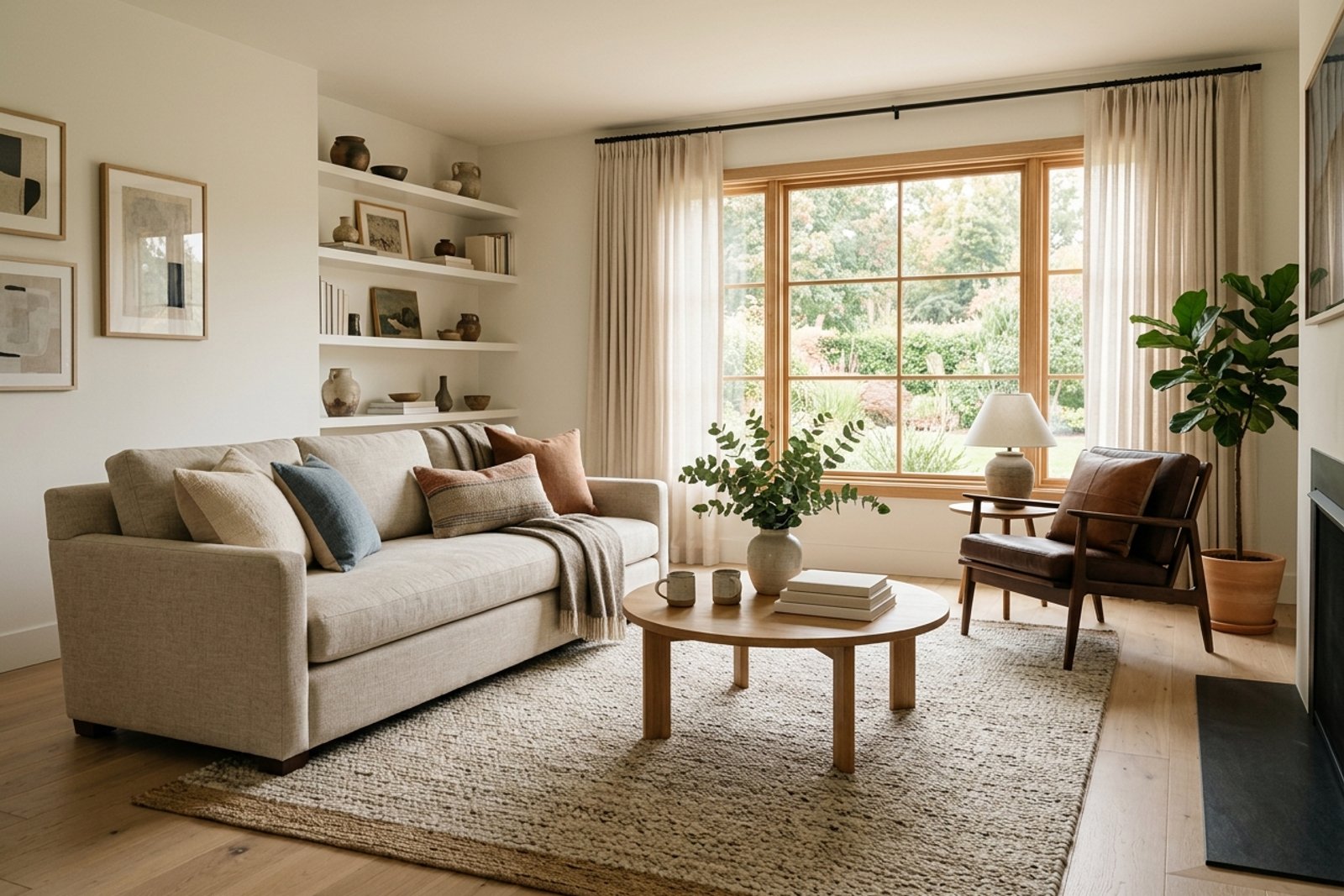
What is a 30 minute calm room reset?
A 30 minute reset changes what the eye reads first. It will not solve a closet or a purchase decision. It buys one quieter evening, which is enough to show you what still bothers you tomorrow. Set a timer and work in this order.
- Five minutes: clear the doorway view and the view from the main seat.
- Seven minutes: take the small loose items off the surfaces in those two views.
- Six minutes: group what is left by color or material.
- Five minutes: hide cords, labels, bags, and open storage.
- Four minutes: turn off the ceiling light and set two lamps.
- Three minutes: photograph the room from the doorway and see what still shouts.
Step six is the one that does the work, and it is worth explaining why.
The camera has no loyalty to your things
Photograph the room from the doorway, then look at the picture instead of the room. Your brain has spent months editing out your own belongings, so standing in the space you literally cannot see the count anymore; the camera has no such loyalty. Every visible object reappears in the frame as a separate thing. I use this on project walkthroughs because a photograph shows me a room the way a first time visitor's eye receives it. Count the objects in the picture that you had stopped noticing in person. Those are the ones raising the load, and they are usually the easiest to remove, because you were not really living with them anyway. You were storing them in plain sight.
Which move should you start with?
Start with the one that changes the most for the least effort, and that is almost always move one. Find the anchor, then edit the objects nearest it down until nothing competes. Most rooms feel noticeably quieter after just that, before you touch a single cord or repaint anything.
The moves compound, though, the same way they do in a room that feels flat. A focal point cannot do its job if forty objects still shout around it. Cutting the object count does little if six colors keep resetting the eye. Closing the loops matters more once the count is low enough to notice them. Warm light at three heights makes all of it read better, and in a living room the seating decides whether any of it is enjoyable. None of these edits is impressive alone. That is the point: a calm room is a stack of small corrections, none of which a visitor could name.
When should you stop editing?
Stop when the room has one clear anchor, one open walking path, and one or two surfaces with real breathing room. Past that point a room tips from calm into bare, and bare is not the goal for most homes. A calm room still shows evidence of a life in it. The books can stay, the blanket can stay, the family photos can stay. They just sit in some hierarchy instead of all at the same volume.
If you cannot tell which object is the problem, stop removing things at random, because that is how rooms go bland. Go back to the doorway photograph instead. A room needing a focal point and a room needing a lower object count look identical from the sofa, but in the photograph the first one has no obvious subject and the second one has eight. Archie reads the same photograph if you want a second opinion on which it is.
Frequently asked questions
What makes a room feel calm?
A room feels calm when visual load is low: the eye has one clear place to land, a manageable object count, no open loops, and a tight palette. Calm is not an empty room. It is a room where most surfaces share a few quiet tones, so attention settles instead of recounting the space every time you look up.
How do I make a room feel less crowded when it is already clean?
Cut the visible object count first. Swap several small pieces for one larger one, leave about a third of each shelf empty, and give the eye a single anchor to return to. A clean room feels crowded when too many separate objects compete for attention, not when it is holding actual mess.
Why does my room feel overwhelming even when nothing is out of place?
Because your brain processes every visible object, edge, and color whether you want it to or not. A spotless room can still hold dozens of competing things, and each one taxes attention. That is visual load, and it is separate from tidiness. Lower the count, close the open loops, and unify the palette.
How do I make my living room feel more cozy?
Layer warmth in three places: light, texture, and scale. Swap the overhead for two or three 2700K lamps at sitting height, add a rug and one soft textile your body actually touches, and hang one larger piece of art so the eye rests instead of scanning. Cozy is warmth plus fewer loose ends.
Why can't I relax in my own house?
Usually the space is making small demands your body keeps answering: bright overhead light, no obvious best seat, visible clutter, or a walkway that forces you to dodge furniture. Remove the friction one signal at a time, starting with the light and the view from the seat, and the room stops keeping you on alert.
The Noticer
For thoughtful people who notice spaces.
What did you notice?
Did something in this story make you see your own space differently?
Ask Archie which move your room needs
Send Archie a photo of the room that feels busy. Archie names the one thing raising the visual load, whether that is a missing focal point, too high an object count, an open loop, or a scattered palette, and returns the single smallest change that settles the room.
Quiet my room with ArchieAdvertisement. Archie is made by STUDIO DID IT, the studio that publishes Spatia.
Related Articles
Why Does My Room Feel Flat?
Your room feels flat because everything sits below three feet. Four fixes push the eye up: raise the sight line, float the sofa, layer the light, add depth.
Why Does My Room Feel Off? A Designer's 3-Question Context Check
A room usually feels off when a choice doesn't fit its context. Use three designer questions about the people, the space, and the whole to find what's wrong.
Small Living Room Layout With a TV and Fireplace (4 Setups)
Four wall setups decide a small living room layout with a TV and fireplace. See which one you have, the seating distance that fits, and when not to mount the TV.