9 Scandinavian Living Room Ideas That Feel Warm, Not Cold
Scandinavian living rooms read warm when you swap stark white for cream, the overhead for two lamps, and the matched set for layered pieces gathered slowly. Nine moves under $1,800.

Scandinavian living rooms read warm when you swap stark white for cream, the overhead for two lamps, and the matched set for layered pieces gathered slowly. Nine moves below take a cold IKEA showroom version of the look and turn it into a room that holds you in.
This is for homeowners refreshing a living room of 180 to 350 sq ft as the next chapter starts, kids gone or rooms reassigned. If you are styling a small studio or a bedroom, the small studio ideas and the bedroom lighting guide cover the adjacent rooms instead.
9 moves that take the room from showroom to lived in
The list runs in suggested order, from the walls inward to the surfaces. Most homeowners can finish ideas 1 through 4 in one weekend and the rest over the following two months. The underlying principles, if you want them in full, live in our Scandinavian style guide.
1. Start with a warm white, not a bright white
Pure white walls are what makes the look read cold. The fix is a warm white with a cream or linen undertone: Farrow & Ball's Wimborne White, Benjamin Moore's White Dove, Sherwin Williams Alabaster. In a room facing north, push warmer still: Pale Powder, Strong White, or Dunn Edwards Swiss Coffee. The undertone matters more than the saturation. A wall in cool white throws blue back at the room at 4 p.m. in November. A wall in warm white throws gold. Both read as "white" at noon, but only one is comfortable at dinner.
If you are unsure which warm white matches your room's natural light, Archie at studiodidit.com can suggest paint options from a photo of the space, so you do not have to buy six sample pots and live with them for a week.
2. Anchor with a low, soft sofa in oat or pale gray
The sofa is the largest single signal the room sends. Pick a low frame (18 to 19 inches deck height), a soft fabric (washed linen, brushed cotton, performance bouclé), and a quiet color: oat, soft gray, dusty taupe, warm putty. Avoid charcoal, navy, and chocolate brown for the main piece. Those work as accents, not foundations. The common mistake here is the matched three piece set in dark leather, bought together. That is what makes the room feel like a hotel lobby. The version that reads as a real home: one sofa, two chairs in a different but related material, no two pieces from the same showroom.
3. Layer two wool textures, one sheepskin
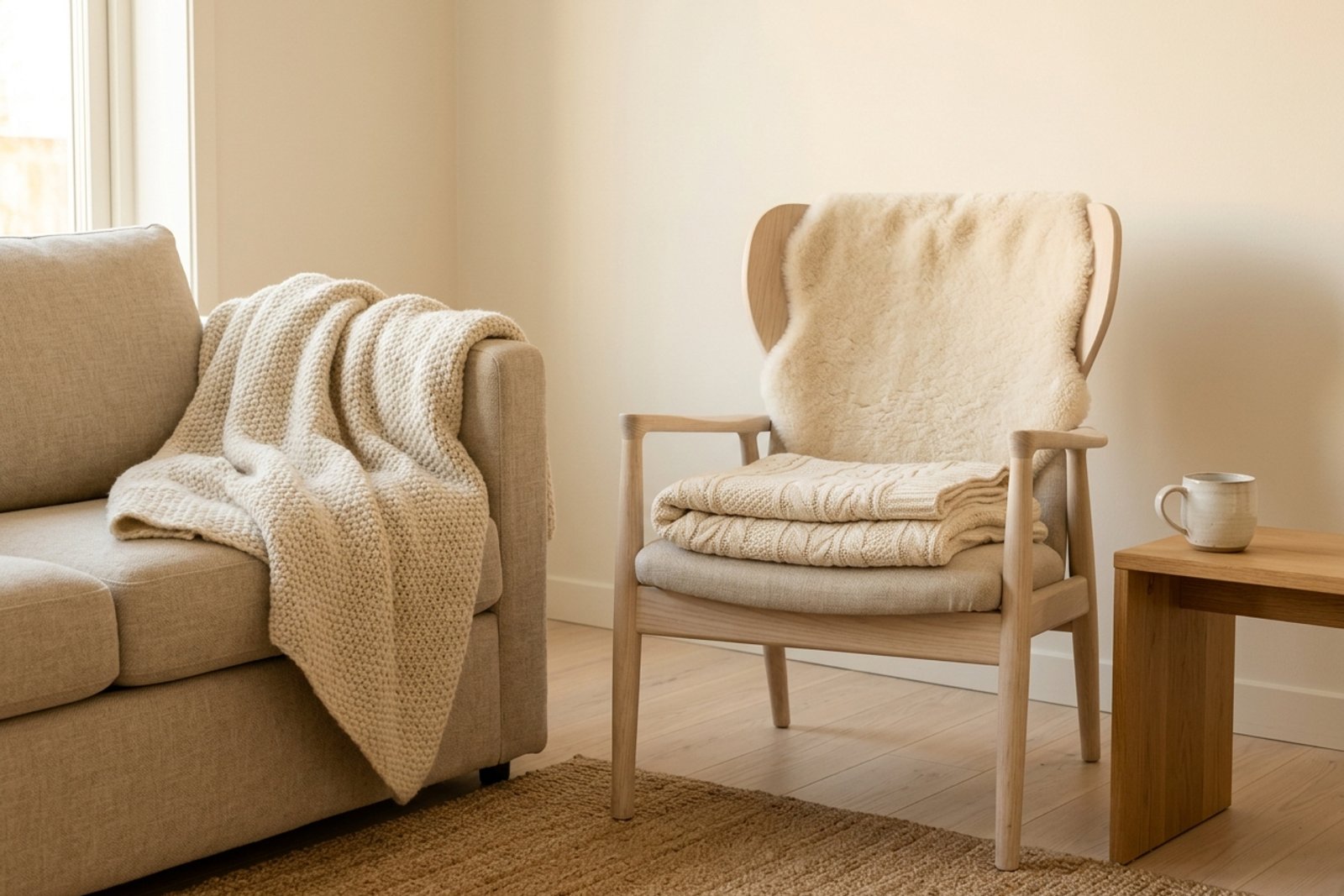
Hygge is texture, not theme. One wool throw at the corner of the sofa, one second wool blanket (a different weave, a slightly different cream) at the foot of an armchair, one sheepskin draped over the back of a wood chair. Three layers, three textures, all in the same warm white family. The room photographs as edited and feels, in person, like it has lived through two winters. Sheepskin specifically is the fastest way to take a cold looking room and warm it up. One in the right spot does more than four throw pillows.
4. Choose curved silhouettes over hard right angles
2026 living rooms are moving back toward curves: bouclé barrel chairs, rounded sofa arms, kidney shaped coffee tables, low arching floor lamps. The shift fixes a specific problem with Nordic rooms, which can feel boxy when every piece is square. One curved piece (a single armchair, a round side table, an arched lamp) softens the whole room. Do not go full curve, the room will read like a 1970s commercial. One or two curved silhouettes against straight ones is the balance. The same logic guides the living room layout mistakes we see most often: rooms with no curved object anywhere are the ones that feel uninviting on first sit.
5. Add one piece of vintage warmth from the 1970s
A single old piece does more than ten new ones. A reclaimed teak credenza, a vintage burl wood coffee table, a wood paneled accent wall behind the sofa: any of these break up the new furniture from one store feel that ruins most attempts. The 70s revival in 2026 living rooms is real, but the way to use it is one piece, not a full set. Estate sales, Facebook Marketplace, Chairish, and 1stDibs all carry the look. Look for warm wood with visible grain, soft shapes (no chrome legs, no hard chevron), and a patina that says lived in. The patina is the point. A reproduction does not carry the same weight.
6. Replace the overhead with two lamps and one candle
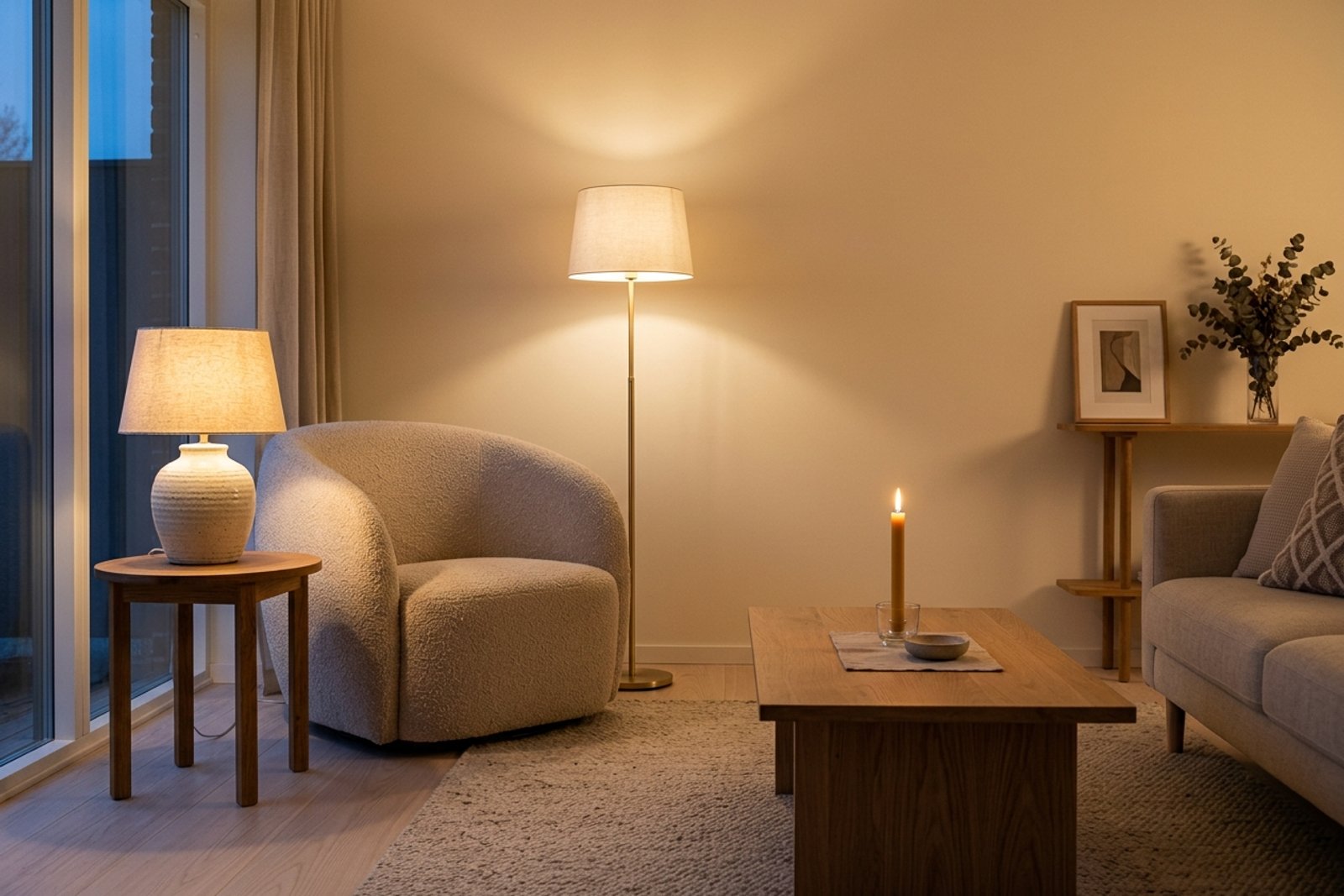
The single fastest fix in any Scandinavian look attempt is to turn off the overhead. Two lamps at different heights (a floor lamp by the chair, a table lamp on a side table or shelf) plus one warm 2200 to 2700K candle on the coffee table replaces the lobby glare with something close to firelight. The rule worth keeping: any room you sit in after 5 p.m. should have at least two warm light sources, none of them on the ceiling. The same instinct on layered evening light shows up in the interior color psychology guide, which gets into which bulb temperature pairs with which wall color.
7. Use one bold accent color, sparingly
2026 is the year the fully neutral Nordic room gets one bold note. Deep blue, mustard yellow, emerald green, or rust orange, used in exactly one place: one throw pillow, one ceramic vase, one piece of framed art. The reason this works is contrast. Against ten warm whites and three woods, a single deep emerald reads as alive. Spread across three or four pieces, the same color reads as a theme. The discipline is the point. The bolder color also gives the eye somewhere to land first, which is part of why a single bold cushion can rescue a room that otherwise feels flat.
8. Choose modular pieces that earn their place
Nordic living rooms are sized for compact homes, so most pieces do two jobs. A storage ottoman that holds throws and works as extra seating. A nesting coffee table that pulls apart for a small dinner party. A bench at the window that hides the season's wool blankets in summer and the linen in winter. Pick one or two pieces that work this way and the room stays uncluttered through every season. Archie can mock up a layout from a photo of your living room if you want to test how a storage ottoman or a nesting set fits before buying.
9. Edit the surfaces, then stop
The last move is subtraction. Pick up everything on the coffee table, the side tables, the console behind the sofa. Put it all on the floor. Then put back only what you used in the last week: one book, one candle, one bowl, one small plant. Anything else lives in a drawer or another room. A Nordic living room is not empty: it is edited. The difference is whether each object earns its place by being used, not by matching the color scheme.
How do you keep a Scandinavian living room from feeling cold?
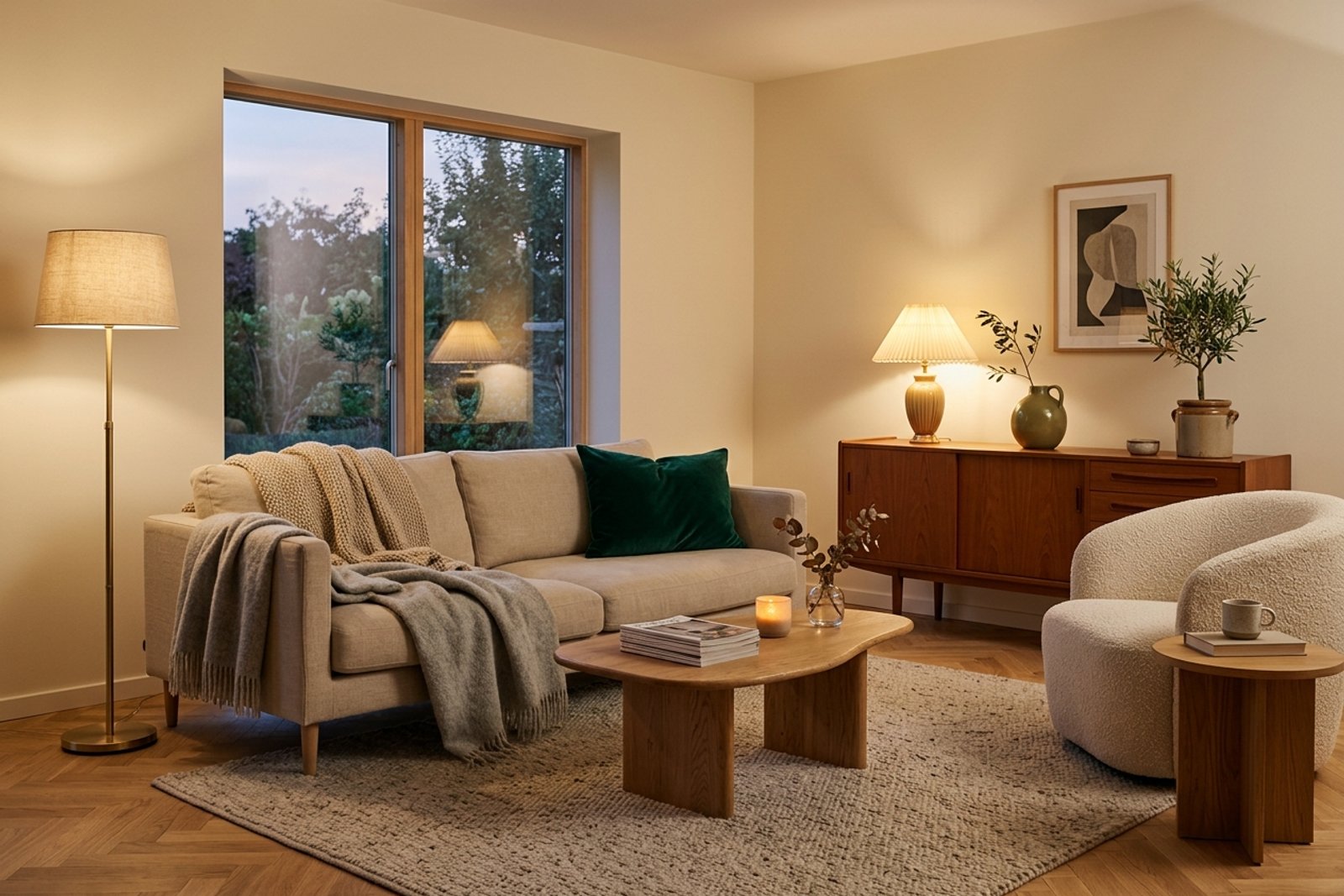
A Scandinavian living room reads cold when three things go wrong at the same time: the white walls are too cool (pure white or with a blue undertone), the lighting is one overhead fixture, and every piece of furniture is new from one showroom. The fix is also three things, in this order. First, sample warmer whites (Wimborne White, White Dove, Alabaster). Second, swap the overhead for two lamps and a candle. Third, add one vintage piece (a 1970s teak credenza, a worn leather chair, an inherited rug) to break the matched showroom look. Most rooms that feel cold need all three, and most homeowners try only the first. The other two carry more weight than the paint does. A room with warm yellow paint, ceiling glare, and a matched showroom sofa still reads cold. A room with cool white walls, two lamps, and one old piece reads warm enough.
What colors work in a Scandinavian living room in 2026?
The 2026 palette is built around four temperatures of warm white plus three small accent moves. The four whites: a wall white (Wimborne, White Dove), a sofa white (oat, putty, soft gray), a wood white (pale ash, light oak with cream grain), and a textile white (cream linen, ivory wool, bone sheepskin). Layering these four next to each other is what gives the room depth without color, and it is the move that most attempts miss. Then, three small accent slots: one warm wood note (1970s burl, walnut, reclaimed teak), one quiet plant note (eucalyptus, dried grass, pale olive), and one bold color used in exactly one place (deep blue ceramic, emerald velvet pillow, mustard throw). Skip charcoal walls and skip black furniture. Both push the room toward modern industrial, not Nordic. The 2026 direction also differs from Japandi, which uses similar materials but darker wood and more negative space.
What's the difference between a Scandinavian and a Japandi living room?
Both styles share warm light, edited surfaces, and honest materials. The difference is wood color and seating posture. Scandinavian living rooms lean lighter (pale ash, white oak, blond birch) and softer (low sofa with deep cushions, wool throws, layered textiles). Japandi rooms lean darker (walnut, ebonized oak, black wood accents) and more disciplined (a low platform sofa, less textile layering, more negative space around each object). A Scandinavian room reads warm and cozy by 5 p.m. A Japandi room reads calm and intentional. Same materials, different posture. The simplest way to decide: if you want the room to hold you in (wool, sheepskin, books visible), go Scandinavian. If you want the room to clear your head (open floor, one object per surface, less color), go Japandi. The fuller comparison lives in our Japandi style guide, which walks through both side by side.
Final thought
A living room that has held a family through high school graduations and college move outs has earned a refresh. The Nordic version is mostly subtraction: lift the white, drop the overhead, edit the surfaces. Add slowly. One vintage piece this month, two lamps next, a sheepskin in November. By the third winter the room has the layered, warm quality of a Stockholm apartment in February, which is the version of "Scandinavian living room" that actually holds up. The whole list runs $400 to $1,800 depending on whether the sofa stays. Most of the work is reorganization, not replacement.
The Spatia Editorial Team writes about long term home refreshes drawn from three living rooms in their second decade of use: a 1970s split level in upstate New York, a brownstone parlor in Boston, and a 1950s ranch outside Portland.
Refresh your living room with Archie
Send Archie a photo of your living room. Archie returns a warm white paint pick, a layout test, and a vintage piece shortlist for the room you actually have.
Plan my living room with ArchieRelated Articles

Why Does My Living Room Feel Hard to Relax In?
A living room can look finished and still make you feel tense. Check the room for five common stress signals: unclear seating, glare, visual noise, hard edges, and no obvious landing place.

How to Cool a Living Room Without AC
A living room cools down faster when you block sun early, move air by time of day, and remove heat holding decor. Use this practical summer plan before buying another fan.

12 Scandinavian Small Bedroom Ideas for a 120 Sq Ft Rental
A Scandinavian bedroom works at 120 sq ft when you trade matched sets for one warm white, one piece of wood, and three textures of cream. Twelve rental safe moves under $600.