How to Cool a Room With Fans and Curtains
Fans and curtains work best as a timed system, not separate fixes. Use this renter safe cooling routine to block heat before it enters, move air at the right hour, and make a hot room feel calmer without AC.

Fans and curtains cool a room best when they work on a schedule: curtains block heat before it enters, then fans move air only in the direction that helps at that hour. During hot daylight, close pale thermal curtains, cellular shades, or a reflective liner before sun reaches the glass. Keep the window shut while outdoor air is hotter than indoor air, and use a fan for personal airflow across the bed, sofa, or desk. After sunset, when outdoor air is cooler, open the window and place one fan facing outward to exhaust stored heat while a second opening pulls cooler air in. This sequence matters more than buying a stronger fan. A 20 inch box fan used at the wrong time can pull heat inside; a modest circulator used after the temperature crosses over can clear a room in 30 to 90 minutes.
If your room feels hot even after you bought a fan and blackout curtains, the problem is usually timing and fit. This guide is for renters, small apartment dwellers, and homeowners who want a reversible summer setup before buying a portable AC. It builds on our recent cooling cluster: why an apartment gets hotter than outside, how to cool a west facing room, top floor apartment cooling, and best curtains to keep heat out.
This is for rooms where you can control curtains, fans, doors, and furniture. If the bedroom is still above the mid 80s at night after a week of this routine, treat that as a comfort and sleep problem, not a decorating problem.
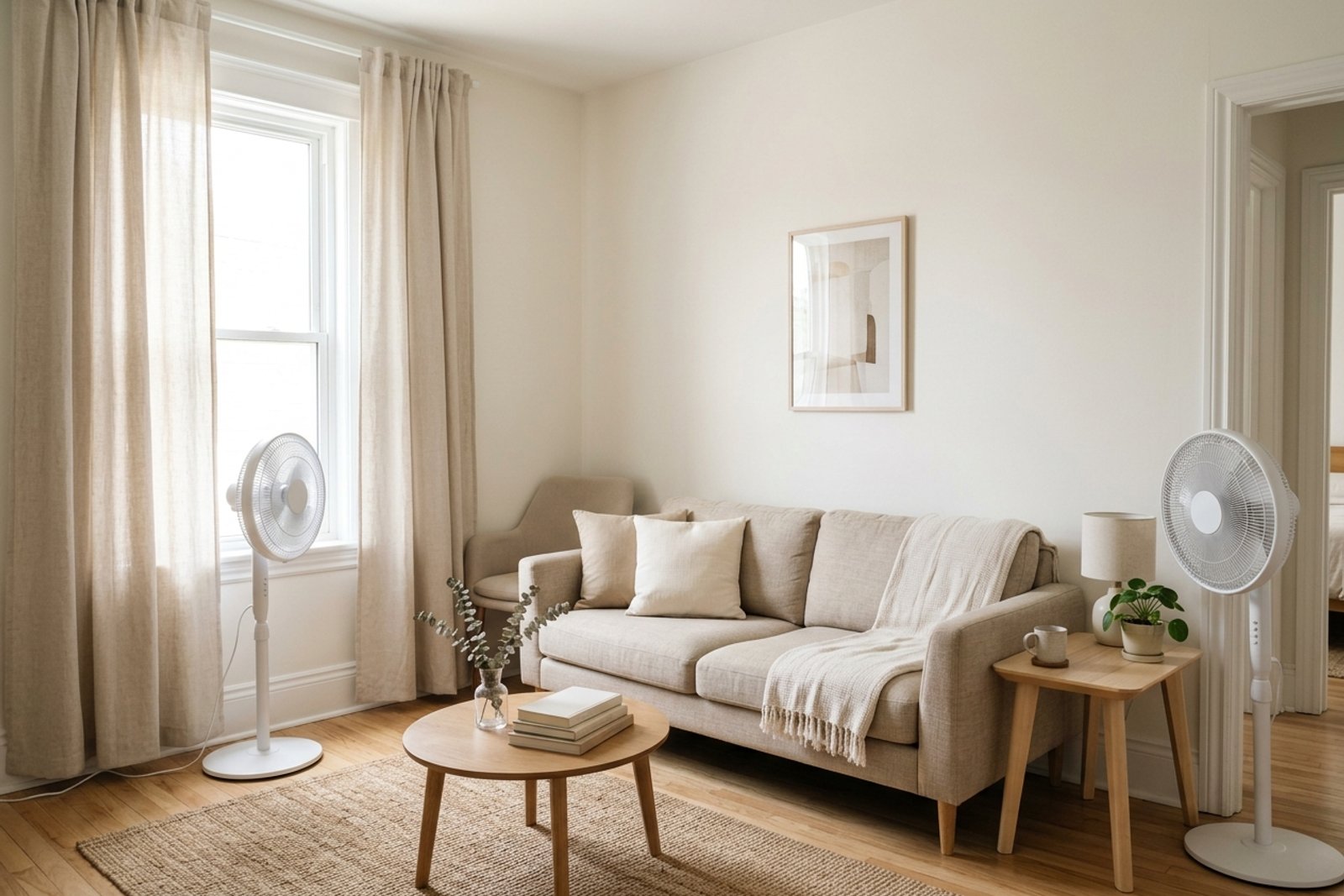
Do fans cool a room or just move air?
Fans do not lower the room temperature by themselves; they cool people by moving air across skin and helping sweat evaporate. That is useful, but it changes where the fan should point. In the hot part of the day, aim the fan at the person, bed, sofa, or desk, not at a sunny window. A fan in the wrong window can pull in hotter outdoor air and make the room worse. At night, fans can cool the actual room if the outside air is cooler than inside. Then one fan should face outward to push hot indoor air out, while a second opening lets cooler air replace it. Think of a fan as either a comfort tool or a ventilation tool. Daytime use is usually comfort. After sunset, it becomes ventilation, and placement matters much more than speed.
For a quick test, stand near the window and compare the air outside with the air in the room. If the outdoor air feels hotter on your face, keep the window closed and use the fan on your body. If it feels cooler, switch to exhaust mode.
What curtains keep a room coolest with fans?
The coolest curtain setup is light colored, close to the glass, and sealed at the sides. A pale thermal blackout curtain, cellular shade, or reflective liner blocks more heat than a dark heavy panel that floats away from the wall. The U.S. Department of Energy notes that managed window coverings can reduce heat gain substantially, especially when they are closed before the sun reaches the room. Fit is the part most people miss. Late sun leaks around the top, side, and middle gap, so a wide rod, overlapping panels, magnetic clips, or a tension fit shade can matter as much as fabric. Fans then handle the air that remains. Without the curtain layer, the fan only blows across a room that is still absorbing solar heat. With the curtain layer sealed early, the fan has less heat to fight.
Use a simple sequence: close the window layer before direct sun, keep it closed until the outdoor temperature drops, then open the fabric enough for exhaust without letting the room bake again.
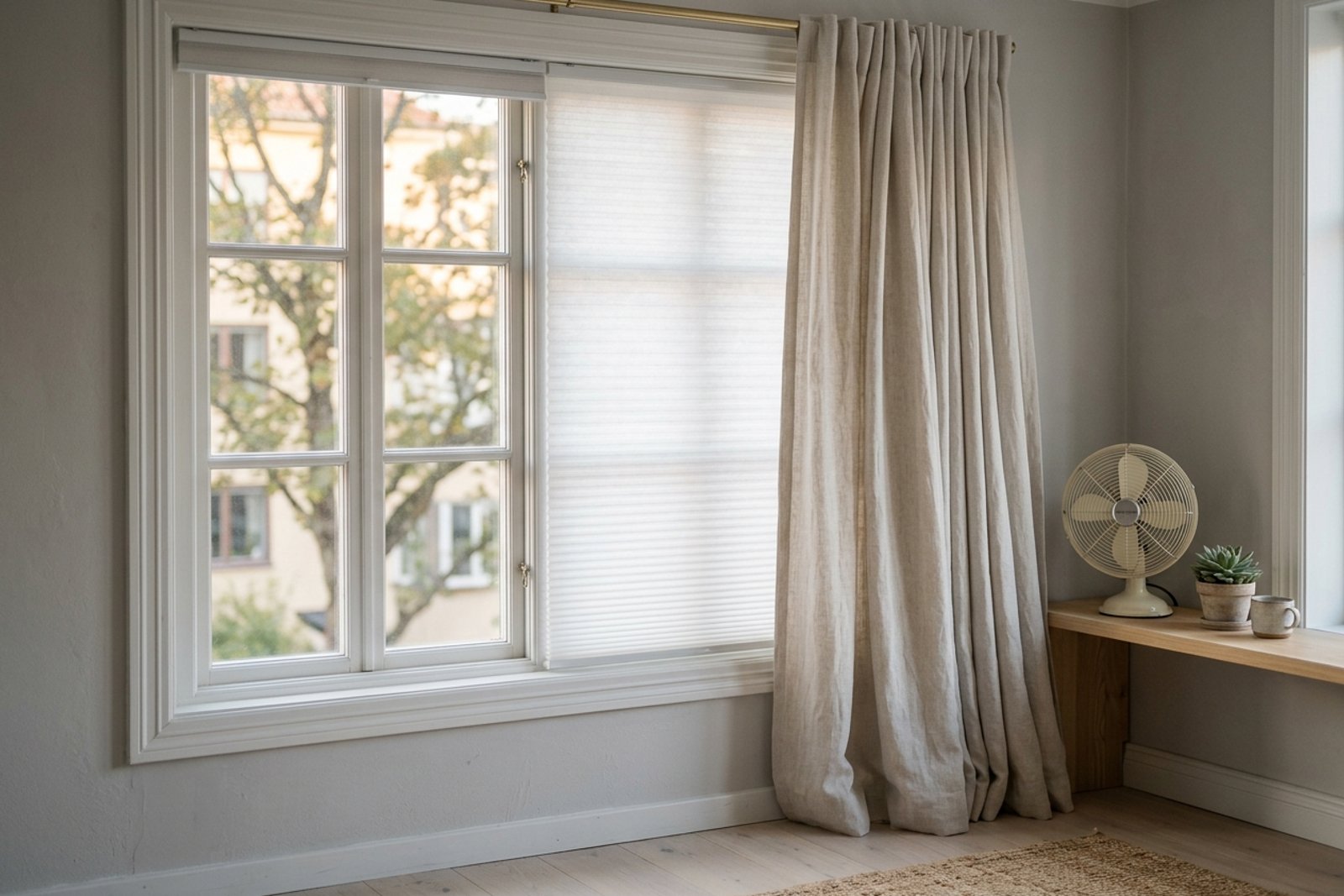
How should you place fans with curtains during the day?
During the day, keep the hottest window closed and covered, then place the fan where it cools the person using the room. A table fan aimed across the upper body at a desk, a tower fan sweeping across the sofa, or a small circulator across the bed all work better than a fan pointed at a closed curtain. Leave a few inches between the curtain and fan so the fabric does not get pulled into the blades, and keep cords out of walking paths.
If the curtain bows into the room from trapped hot air, do not open the window just to relieve it. That usually invites more heat in. Instead, improve the seal: overlap the middle, clip the side edge, or add a tension shade inside the frame. The goal is to stop sunlight at the glass and keep the room calm until outdoor air is useful again.
For south or west exposures, set a phone reminder 30 minutes before the sun hits the glass. Cooling starts before the room feels hot.
How do you use fans and curtains after sunset?
After sunset, change the room from sealed mode to flush mode. Open the window once outdoor air is clearly cooler than indoor air, then place one box fan or window fan facing outward. That exhaust fan pulls stored heat out of the room, including warmth sitting in curtains, rugs, bedding, and drywall. Open a second window, hallway door, or cooler side of the apartment so replacement air has a path in. If you have only one window, run the bathroom or kitchen exhaust fan while the window is open, or crack the apartment door briefly if building rules and safety allow. The flush usually needs 30 to 90 minutes. Close the curtains again before bed if outdoor light, privacy, or morning sun is an issue, but leave enough airflow around the fan until the room has dropped.
The mistake is opening everything too early. A room that stayed sealed at 4 p.m. can be saved at 9 p.m. A room that pulled hot air in all afternoon has more heat to dump.
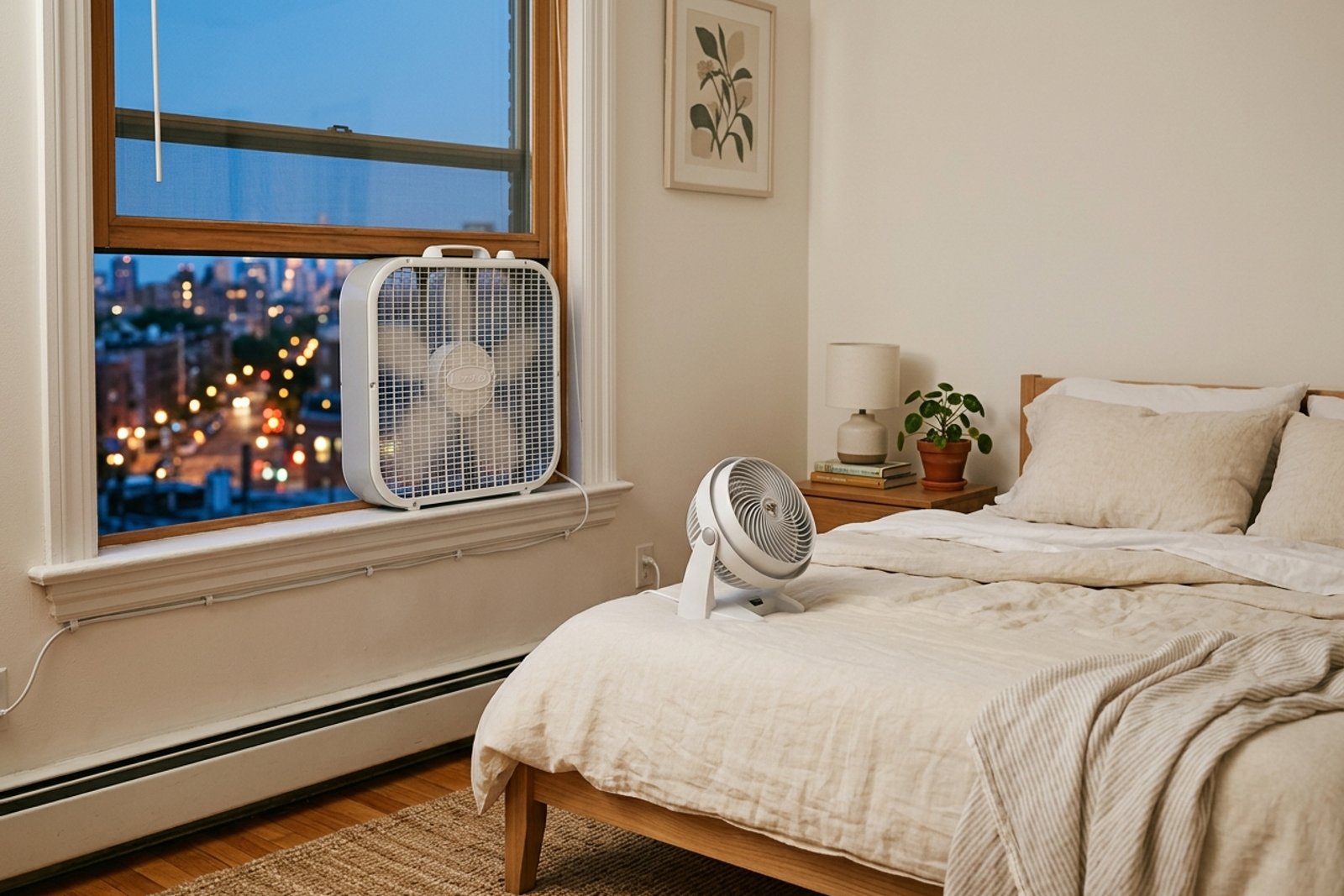
What if you only have one window?
A one window room can still improve, but it needs a stronger exhaust habit. Put the fan in the window facing outward after the outdoor air cools, then create any safe intake path you can: an open interior door, a gap under the door, a hallway window, or a bathroom fan pulling air from the room. The airflow will be weaker than true cross breeze, but it still removes the hottest air near the window and ceiling.
During daylight, one window rooms should be even stricter about curtains. Add the tightest window layer your lease allows, then keep the fan personal. If the room is also tiny, reduce heat stored in textiles: roll up a dark rug, move a dark chair out of the sun path, switch polyester throws to cotton or linen, and keep electronics off the window wall. Our small studio apartment guide has layout ideas that help airflow stay open instead of trapped behind tall furniture.
A simple 24 hour fan and curtain schedule
Use this as a starting point, then adjust for your window direction.
| Time | Curtain move | Fan move |
|---|---|---|
| Morning | Open briefly if outdoor air is cooler | Pull cool air in for 15 to 30 minutes |
| Before direct sun | Close shades and pale curtains | Turn fan toward the person, not the window |
| Hottest hours | Keep window sealed | Use low or medium personal airflow |
| Sunset check | Compare indoor and outdoor air | Switch only when outside feels cooler |
| Evening | Open curtain enough for airflow | One fan faces outward, intake path opens |
| Bedtime | Reset privacy and morning sun control | Keep gentle airflow across the bed |
The exact clock time changes by season and orientation. A west window may need serious protection from 1 p.m. to 7 p.m. A south window may need it earlier. A top floor room may need the night flush longer because the ceiling releases heat after the sun is gone.
Which mistakes make fans and curtains stop working?
The first mistake is closing curtains after the room is already hot. Curtains are best at prevention, not rescue. The second mistake is using dark fabric against the glass because it looks cozy from inside. Dark panels absorb heat, especially on sunny windows. The third mistake is opening windows during the hottest hour because moving air feels productive. If outdoor air is hotter, you are importing heat.
The fourth mistake is cluttering the air path. A fan cannot move air through a curtain puddled on the floor, a tall bookcase blocking the window, or a pile of cords behind the sofa. Keep the summer setup visually quiet: pale window layer, clear intake path, one fan for the body, one fan for exhaust when the hour is right.
When should you buy a portable AC instead?
Buy or borrow a portable AC if the sleep zone stays above the mid 80s at bedtime after you have sealed the window, flushed at night, and reduced indoor heat sources for a full week. Fans and curtains can make many rooms feel several degrees calmer, but they cannot remove humidity like AC, and they cannot make outdoor air cooler than it is.
If you do buy one, size it for the bedroom or the room you use most, not the whole apartment. A dual hose portable unit is usually more efficient than a single hose model because it does not pull as much cooled room air back outside. Keep the curtains in the plan even with AC. Blocking sun reduces the load, which means the machine cycles less and the room feels more stable.
Final thought
Fans and curtains are not weak fixes. They fail when they are treated like objects instead of a routine. Curtains handle the sun before the room absorbs it. Fans handle comfort during the day and ventilation after the temperature crosses over. Put those two jobs in the right order and a hot room feels less frantic, less improvised, and easier to live in.
If you want to test the plan before buying more gear, Archie can read the room like a system: window direction, fan position, curtain fit, furniture heat traps, and the path air takes. That is the difference between adding one more product and making the room work.
Written by the Spatia Editorial Team. Spatia covers small space design from a renter's lens, with practical rooms that work before they photograph well.
Plan a cooler room before you buy more gear
Archie maps your window direction, fan position, curtain fit, furniture heat traps, and the real air path through the room so each cooling move works with the room instead of adding clutter.
Plan my room with ArchieRelated Articles

7 Best Curtains to Keep Heat Out of an Apartment (No Drilling)
Afternoon sun bakes a no-AC apartment through the window. Here are 7 curtains and blinds that actually keep heat out, all renter safe and no drilling.

Why Is My Apartment Hotter Than Outside?
The thermometer says 82 outside, but your apartment feels like 88 with every window open. Here is why small apartments trap heat, and the renter routine that cools one down tonight without buying AC.

How to Cool a West Facing Room Without AC: A Renter's Afternoon Heat Guide
West facing rooms feel fine at breakfast and unbearable by dinner. Here is the renter-safe cooling sequence that blocks late-day sun, dumps stored heat after sunset, and makes a small apartment sleepable without installing AC.