Before You Buy More Furniture, Test These 3 Living Room Changes
Before buying new furniture, test your sofa placement, rug position, and lighting. See what your living room needs with this practical three-step check.
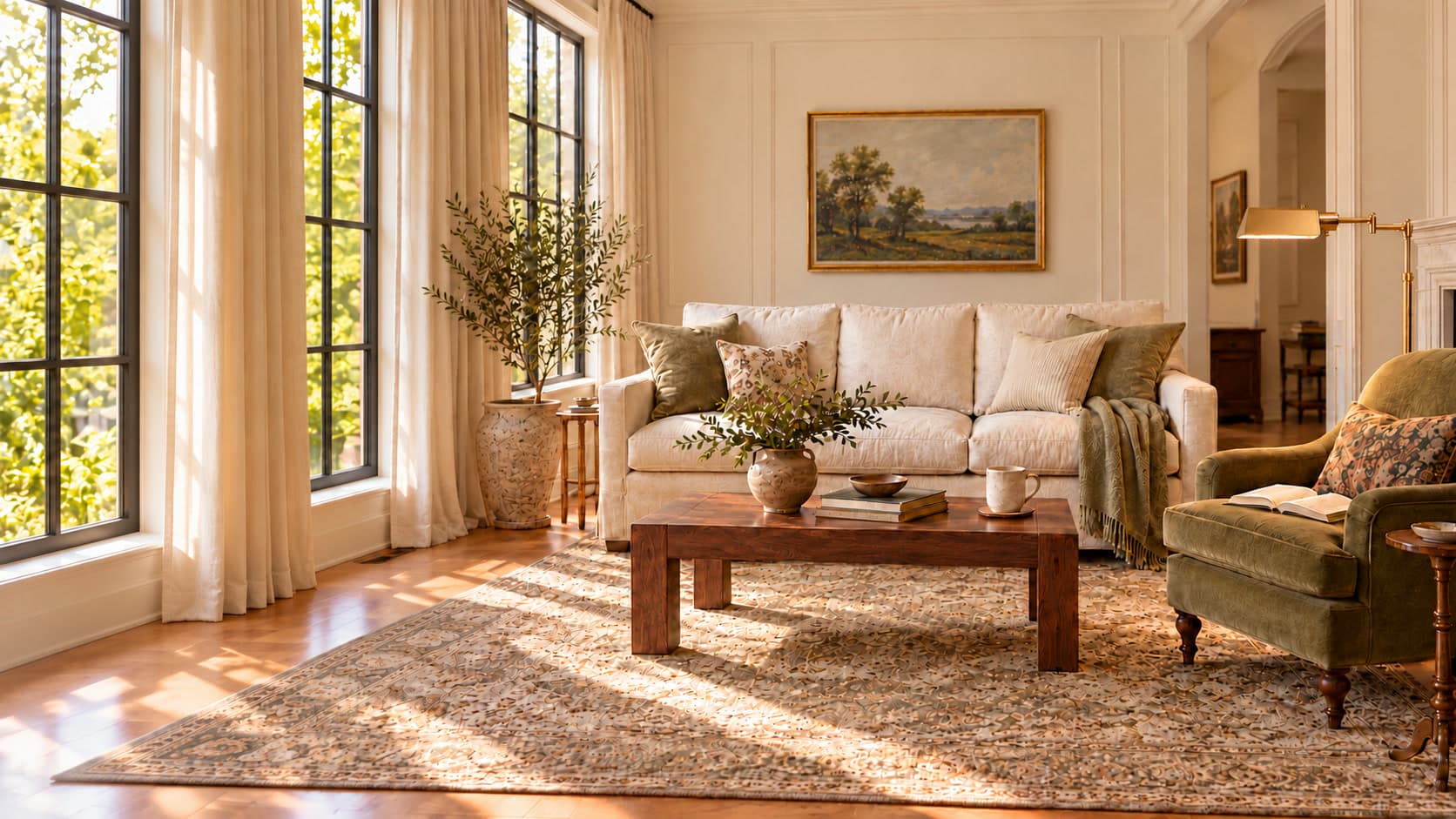
Short answer Before replacing a piece, test its placement. Check whether your sofa supports the way you use the room, your rug connects the seating, and your lighting reaches the places where you spend time. Change one thing at a time, then live with the result before buying.
You may have a perfectly good sofa, a rug you chose carefully, and a lamp you still love. Yet the room never quite feels settled. When you look around, it is easy to start a shopping list: a new chair, a larger coffee table, something to make that corner feel finished.
A room assembled over years deserves a closer look before another purchase. Some pieces carry memories. Others were real investments. The useful question is: What is making this room harder to enjoy?
That question gives your next purchase a job to do. First, try these three placement tests.
Before moving anything, name one problem
Stand at the entrance and take a photograph. Then sit in your usual spot. What bothers you most?
- You have to squeeze past the coffee table.
- The seats feel too far apart for an easy conversation.
- Your favorite chair is too dark for reading.
- The furniture feels like separate pieces rather than one seating area.
Choose one problem. "Make the room nicer" is difficult to evaluate. "Let me walk to the window without turning sideways" gives you something you can test.
Test the sofa against your daily life
Start with what happens in the room. Do you read after dinner, watch a movie together, or sit with a friend over coffee? The sofa's relationship to those activities matters more than whether it sits perfectly in the middle of a wall.
If conversation feels awkward, try bringing a movable chair closer and turning it toward the sofa. If a route feels cramped, consider whether a side table or ottoman can move before shifting the heaviest piece. In a larger room, a sofa pulled slightly inward may help bring the seating together, provided it leaves a comfortable path behind it. In a compact room, keeping it against the wall may work better.
- Try this: Use removable floor-safe tape to mark a proposed position before moving heavy furniture. Check doors, vents, recliner clearance, and the routes everyone actually uses. Have help for heavy pieces, and keep cords out of walkways.
- Consider a purchase if: reasonable layouts still leave the sofa blocking circulation, or the seat itself is uncomfortable. Placement cannot repair worn support or make an oversized sectional smaller.
Walk through with a laundry basket. Sit down, stand up, and reach for your drink.
A layout should work during an ordinary evening, not just in a photograph.
Test whether the rug connects the seating
A rug centered in the room may sit too far from the furniture it is meant to connect. Look at the seating group rather than the room's geometric center.
A useful starting point is to bring the front legs of the sofa and participating chairs onto the rug, where its dimensions allow. This approach also appears in Room & Board's rug-sizing guide. Treat it as a layout option, not a rule every room must obey.
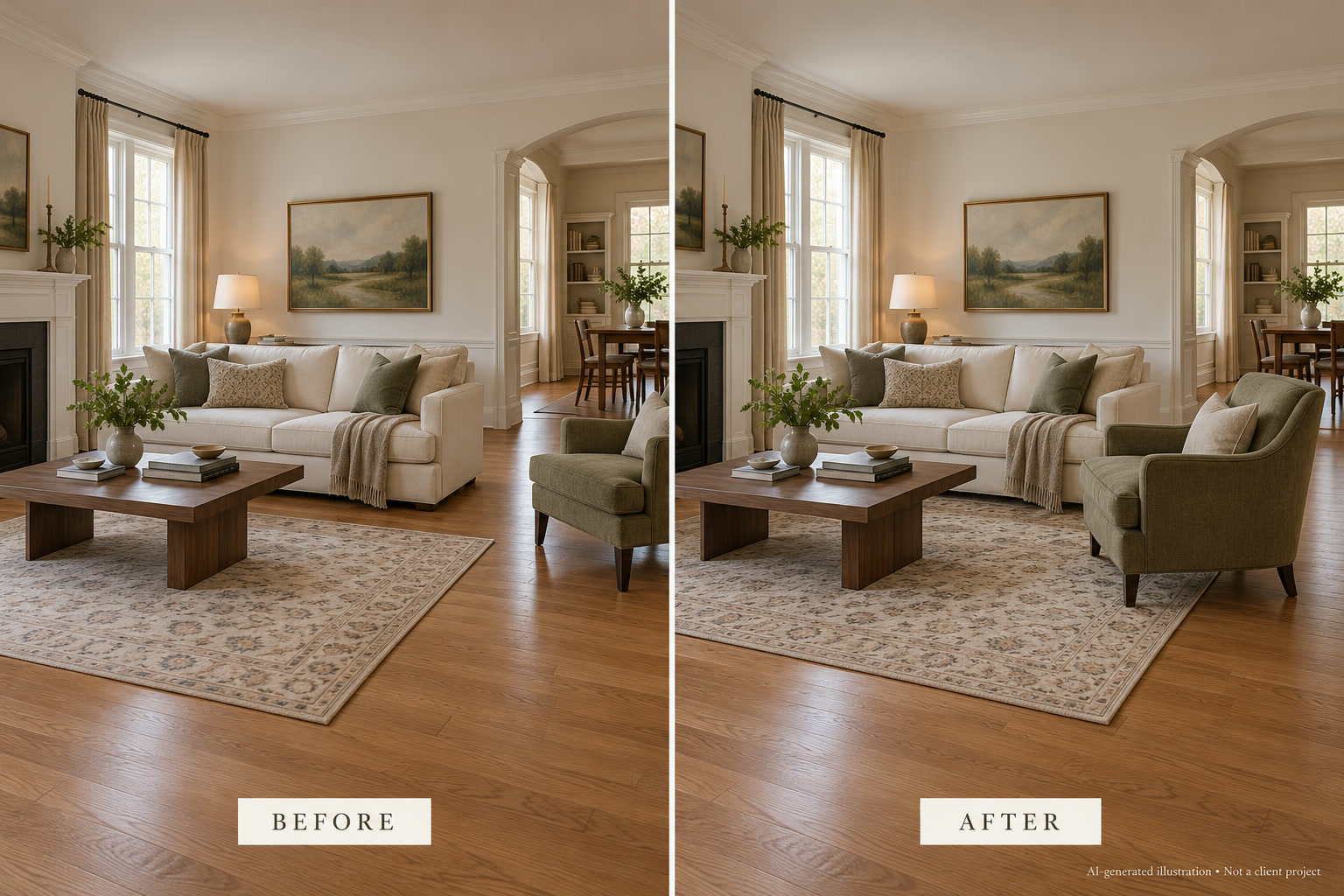 Same pieces. Moving the chair onto the rug connects the seating.
- Try this: Shift your existing rug toward the seats, or test a different orientation if the pattern and room allow. Photograph it again. Does the seating read as a group? Are the edges flat and clear of door swings? Is the furniture stable?
- Consider a purchase if: the rug cannot connect the seating without forcing the furniture into an uncomfortable arrangement. Measure the revised seating area before choosing a replacement size.
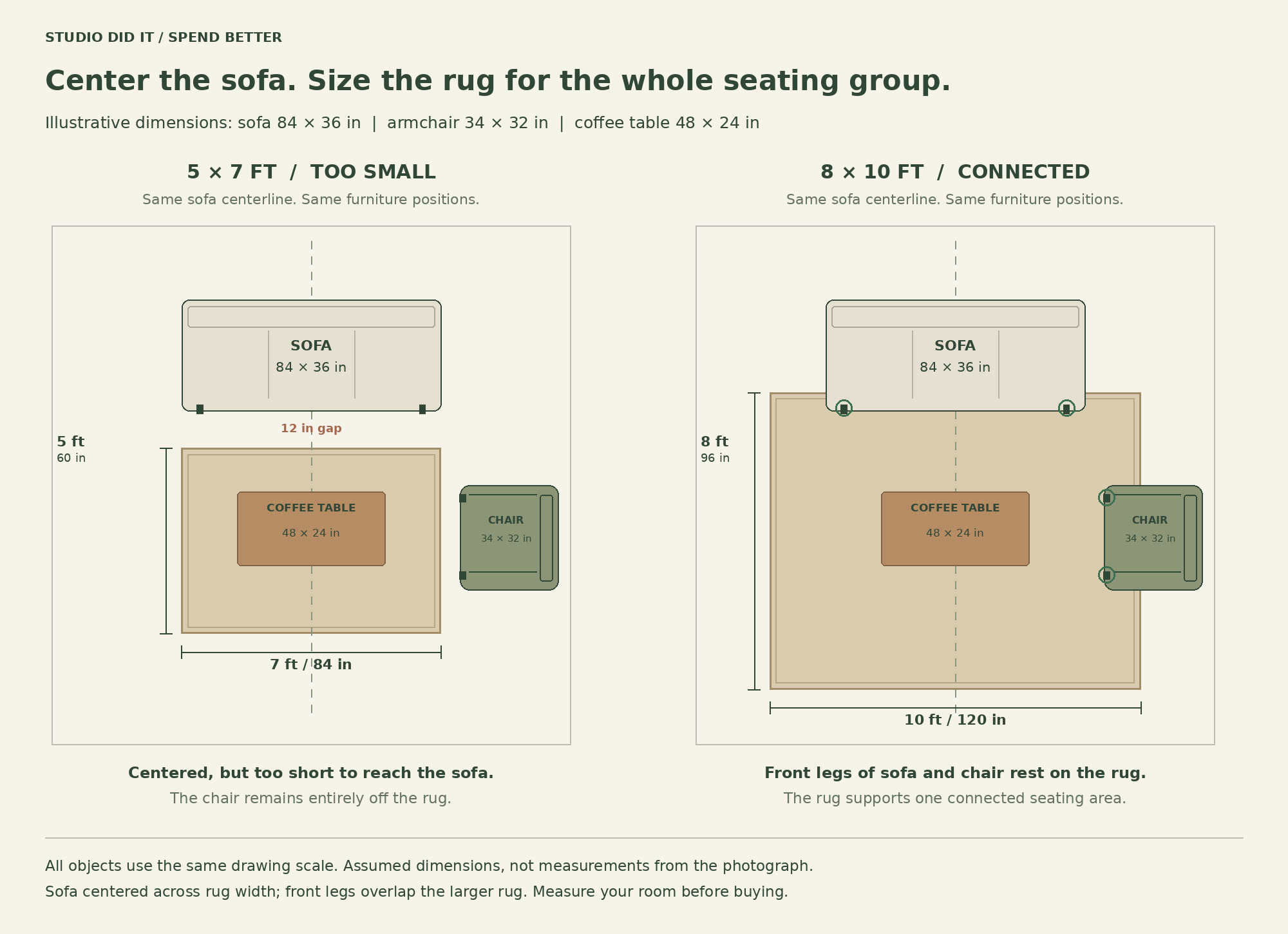 Same furniture, same positions: a 5x7 stops short, an 8x10 holds the front legs. Illustrative dimensions.
A small rug you love might work better beside a bed or in a quiet corner. It does not have to serve as the main living room rug simply because that was its first home.
Test the light where you actually sit
A room can look bright from the doorway and still leave your reading chair in shadow. Lighting needs to serve both the room and the activities inside it.
IKEA's living room lighting guide explains the different roles of general, task, and mood lighting.
- Try this after dark: Move an existing lamp beside the chair where you read, within safe reach of an outlet. Open a book. Adjust the lamp so the page is lit without a bare bulb glaring into your eyes. Check the television for reflections. Keep enough general light for comfortable movement around the room.
- Consider a purchase if: repositioning still leaves you without usable reading light, or a fixture's height and shade cannot direct light where it is needed. That gives you a specific brief: a reading light for this chair, rather than "another pretty lamp."
If you do need one, look for a lamp with an arm you can swing over the chair, such as the dimmable Brightech Leaf Pharmacy LED floor lamp, so the light lands on the page instead of in your eyes. We are not paid to recommend it.
Then use the room as you normally would. You may discover that a good lamp was simply lighting the wrong place.
Give each piece a clear job
Change one thing, use the room, then decide. This is the SDI before-you-buy check.
| Piece | Ask | Test |
|---|---|---|
| Sofa | Can I move and sit comfortably? | Test the route and the seating |
| Rug | Does the seating feel connected? | Test position before size |
| Light | Can I do what I enjoy here? | Test from your seat after dark |
- Better now? Keep it.
- Still unsure? Measure or test again.
- Clear mismatch? Shop for that specific need.
Turn the result into a better shopping brief
Imagine an evening reading corner: the chair is comfortable, but it feels disconnected from the sofa and the book is difficult to see. Moving the chair inward and relocating an existing lamp might solve both issues. This is an illustrative scenario, not a client result.
If those changes help, keep the chair. If reading remains uncomfortable, write down what is missing before you shop. Your note might say: "Adjustable reading lamp beside the armchair, no glare at seated eye level, cord kept clear of the walkway."
Take an after photograph from the same position, with similar lighting, and use the arrangement for a few evenings. Ask: Is movement easier? Is the seat more inviting? Does the room support what I want to do?
Want help deciding what to change first?
Studio Did It helps you connect how you live with the choices you make for your space. Start with your room and your priorities, then explore what to keep, what to change, and what deserves a closer look.
Explore your space with Studio Did It
You may still decide to buy something. You will be choosing it with a clearer purpose.
The Noticer
For thoughtful people who notice spaces.
What did you notice?
Did something in this story make you see your own space differently?
Want to try this in your own space?
Upload a photo of your room and let Archie, our AI design assistant, show you personalized recommendations.
Try Archie FreeAdvertisement. Archie is made by STUDIO DID IT, the studio that publishes Spatia.
Related Articles
Why Does My Room Feel Off? A Designer's 3-Question Context Check
A room usually feels off when a choice doesn't fit its context. Use three designer questions about the people, the space, and the whole to find what's wrong.
Small Living Room Layout With a TV and Fireplace (4 Setups)
Four wall setups decide a small living room layout with a TV and fireplace. See which one you have, the seating distance that fits, and when not to mount the TV.
Where To Put Mirrors In A Dark Room
Where to put mirrors in a dark room: aim them at a window, pale wall, or lamp to bounce light. See the safest spot before you buy another fixture.