Feng Shui Beyond Furniture Placement: A Korean Perspective on a Home That Feels Right
Before moving your bed or buying a lucky object, look at what surrounds it: a Korean take on feng shui through light, landscape, and connected rooms.
Short answer
Feng shui considers the relationship between people and their surroundings. Korea's related tradition, called pungsu, has historically examined how a place sits within its landscape. For your home, that perspective offers a useful starting point: look at the setting, light, entrances, and room connections before focusing on individual objects. The ideas below combine cultural context with practical design interpretation, rather than promises about luck.
Start with the place, not the object
Search for feng shui advice, and you will quickly find suggestions about beds, mirrors, plants, and the "wealth corner."
But before deciding where an object belongs, it helps to understand the place it belongs in.
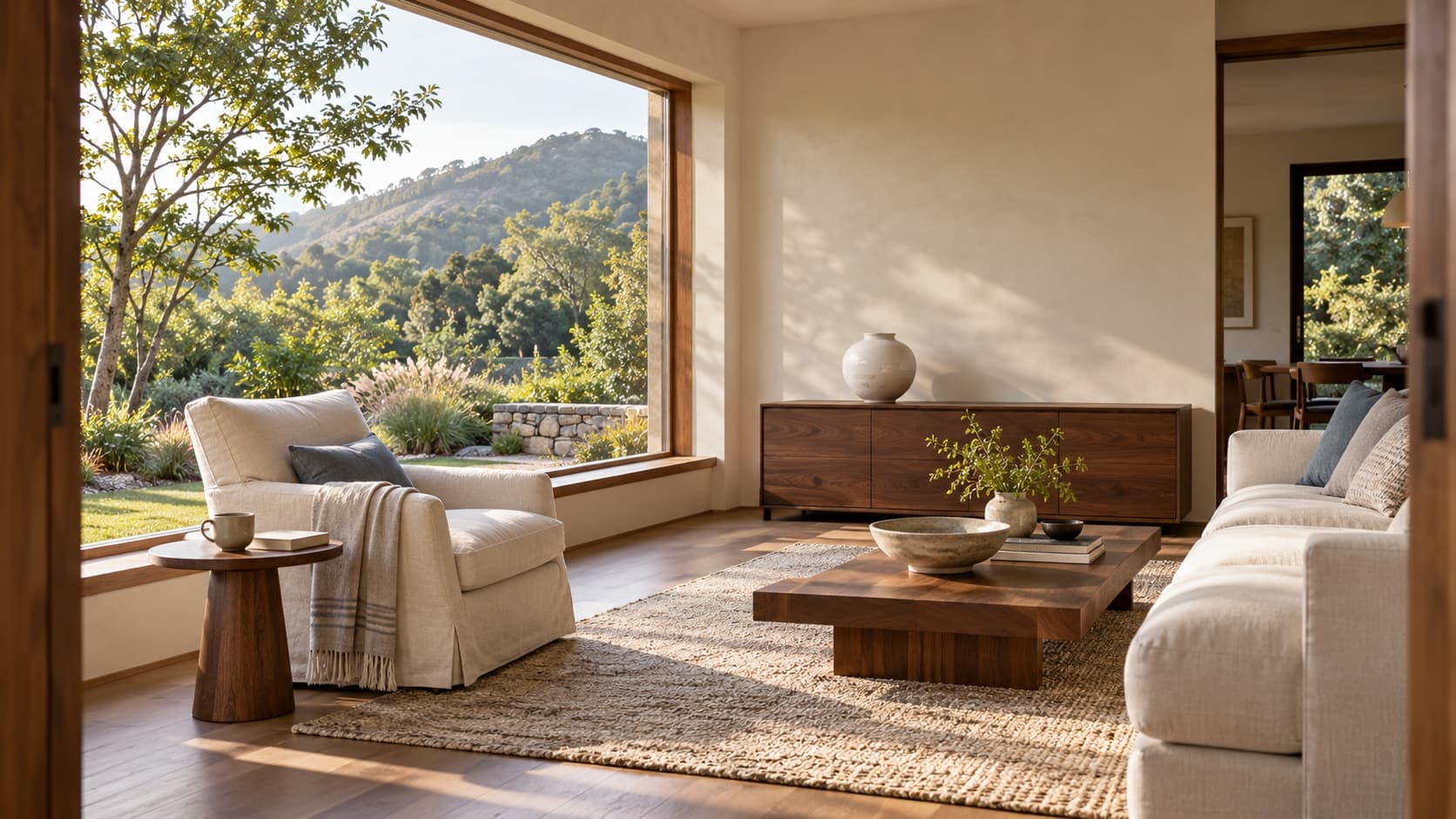
A sofa beside a shaded garden window creates a different experience from the same sofa beside a busy street. A bedroom may have a beautiful layout but still receive headlights across the wall every evening. A welcoming entry table can become an obstacle when it sits in the path you take with groceries.
The object has not changed. Its surroundings have.
This is where a Korean perspective on feng shui can add something useful to the conversation.
Pungsu, pronounced roughly "poong-soo," means "wind and water." It shares historical roots with Chinese feng shui and developed within Korea's landscape and culture. Historically, it informed decisions about sites for homes, settlements, and burial grounds, as a Korean Geographical Society study describes.
Its scope extends beyond decorating. It considers the relationship between a site and the land, water, orientation, and surroundings.
You can see that larger perspective in Korea's Joseon royal tombs. UNESCO describes how pungsu influenced their landscape settings, including the relationship between protective hills and the outlook toward water. This is a historical example of site planning, rather than a decorating formula for a modern home.
For today's homeowner, the invitation is straightforward: understand your surroundings before rearranging your belongings.
Why feng shui advice sometimes contradicts itself
If one article tells you to locate an area by the front door and another tells you to use a compass, you have probably encountered different approaches.
In the Black Sect Tantric Buddhist (BTB) approach, a bagua, or symbolic map, is aligned with the entrance. Classical approaches include methods that examine landforms and compass directions. These systems do not always produce the same recommendations, as the International Feng Shui Guild outlines.
Another familiar concept is the commanding position: placing a bed or desk where you can see the door without sitting or lying directly in line with it. Interiors publications such as Livingetc frequently introduce this as a basic feng shui principle.
These ideas are useful cultural context, but collecting rules from different systems can make decorating unnecessarily confusing.
For this introduction, we will focus on observing the home you have. The following suggestions are Studio Did It (SDI)'s practical design interpretation, inspired by pungsu's attention to the relationship between people and place.
Read the window before choosing the arrangement
A window is more than an opening that brings in light. It connects the room to something outside.
That might be a garden, a neighboring wall, a sidewalk, or an open stretch of sky. Each creates different opportunities and constraints.
Before placing a chair or desk beside it, spend a little time there at the hours you expect to use the room.
Notice:
- The light: Does sunlight land on your face, your screen, or the seat?
- The view: Is there something you enjoy looking at?
- The exposure: Can people outside see directly into the room?
- The surroundings: Does traffic, a nearby entrance, or another building affect how you use the space?
Then arrange the furniture in response.
A reading chair might sit beside the window, angled toward the garden. A desk may work better turned so bright light does not reflect directly on the screen. A street-facing sitting area might need adjustable privacy coverings before it needs another decorative object.
There is no single arrangement that suits every window.
The useful choice is the one that responds to what is actually outside yours.
Make the entrance a comfortable transition
In many contemporary feng shui interpretations, the entrance is an important place for welcoming energy into the home.
In everyday life, it is also where you arrive carrying bags, remove your shoes, greet someone, and shift from being outside to being home.
Look at that entire sequence, including what lies beyond the door.
Does the door open fully? Can two people pass comfortably? Is the first view a pleasant part of the house, or a collection of items waiting to go somewhere else?
You do not need a large foyer to make arrival easier.
A narrow shelf can hold keys. A bench can provide a place to sit while taking off shoes. Closed storage can contain the items that do not need to remain in view.
Choose those pieces according to the available space. A console that crowds the walkway is not helping, however beautiful it may be.
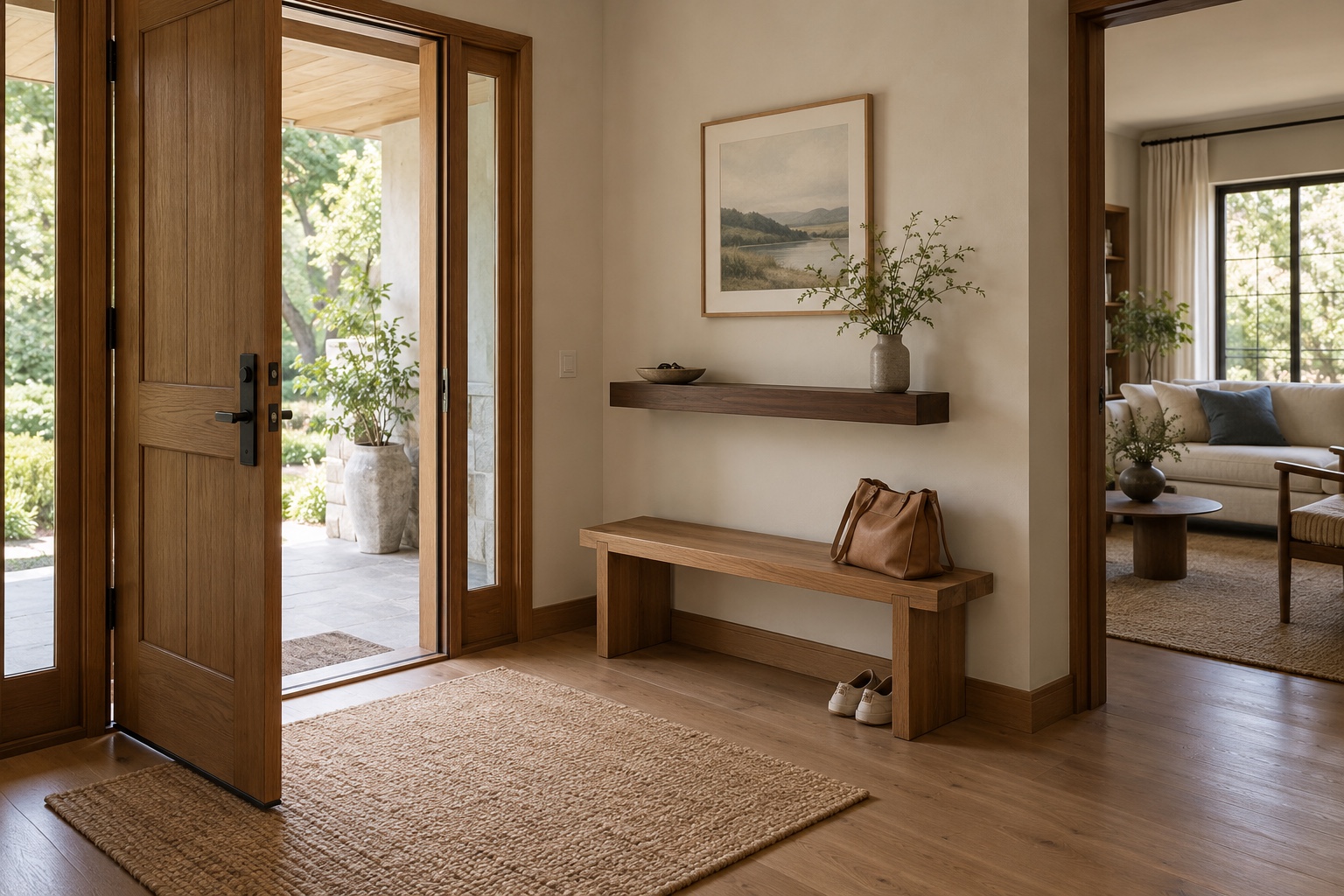 Make arriving home feel effortless.
Then consider what catches your eye from the entrance. One painting, a ceramic vessel, or a view into the next room may be enough to give the space character.
Leave room for the entrance to do its daily work.
Consider what is behind you, as well as what is in front
Furniture plans often focus on where a piece fits. The experience of sitting there deserves equal attention.
Consider a chair positioned in the middle of a room with a busy walkway immediately behind it. It may look balanced in a photograph, yet you might find yourself choosing another seat.
Or imagine a home-office desk facing a wall while family members regularly enter behind you. Depending on your preferences and the room, turning the desk may make working there more comfortable.
This connects with the feng shui idea of a commanding position. In practical design terms, it invites you to consider visibility, support, and nearby movement.
Try the seat before committing to the arrangement:
- Arrivals: Can you see someone entering without repeatedly turning around?
- Movement: Does the route behind you feel intrusive?
- Support: Is there a wall or another stable visual boundary behind the seat?
- Access: Can you get in and out without squeezing past furniture?
These are considerations, not requirements to force into every floor plan. Seeing the door is not worth blocking a closet, narrowing a walkway, or creating glare on your screen.
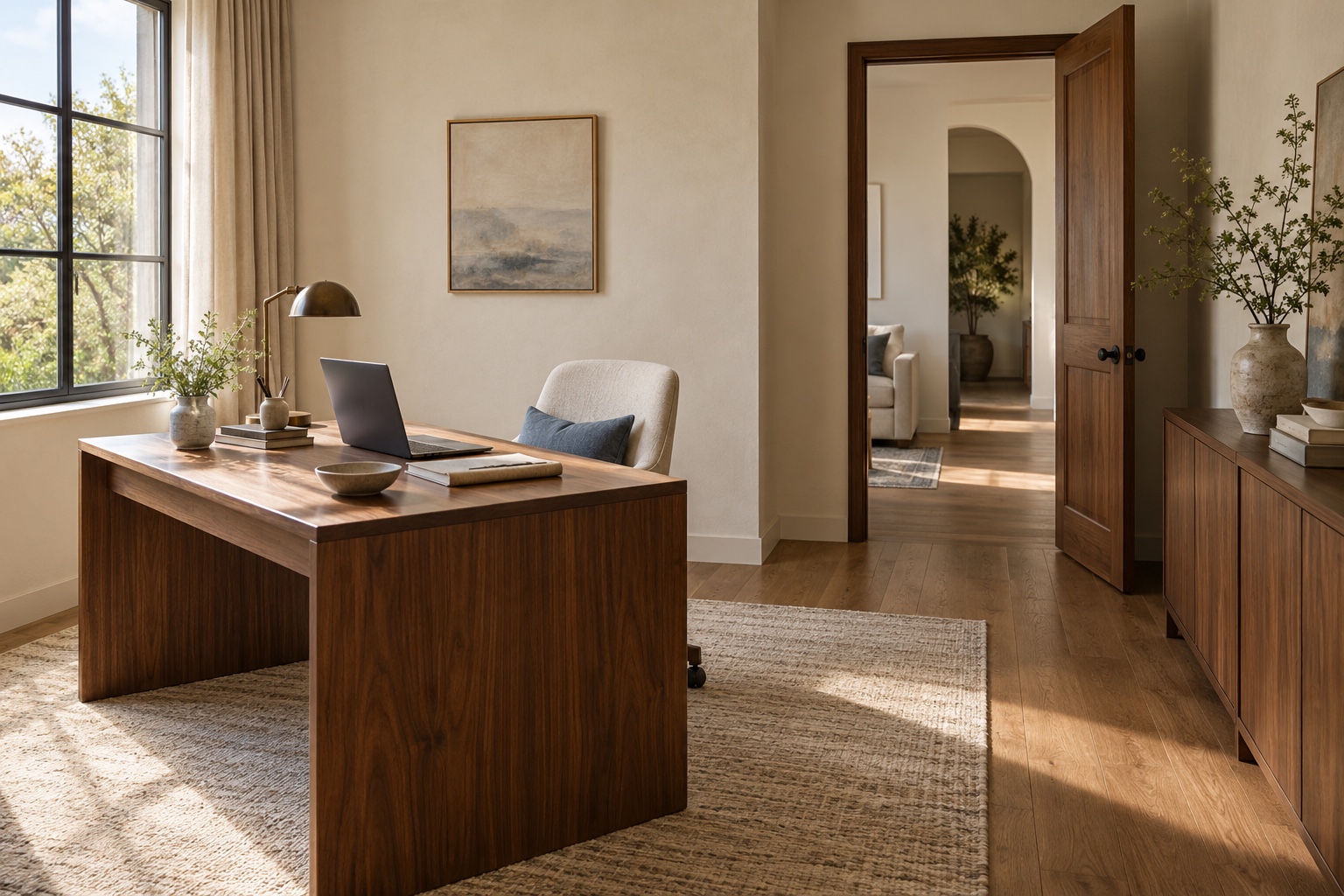 Consider what you can see from your seat.
For a bed, a solid headboard against a suitable wall may help the arrangement feel settled. Keep access, windows, outlets, and the needs of both sleepers in the decision.
A good position works for the room and the person using it.
Look at the rooms together
A home is experienced in movement.
You see the dining room from the kitchen. You pass the living room on the way to the bedroom. An open doorway may frame a window, a painting, or a crowded shelf.
Those connections influence how the whole home feels.
Stand at the entrance to a room and look through it. Notice where your eye goes and where your feet need to go.
If a cabinet interrupts the route, consider a shallower piece or another location. If several strong patterns compete across adjoining rooms, repeating a color or material can help connect them.
This does not mean every room should match.
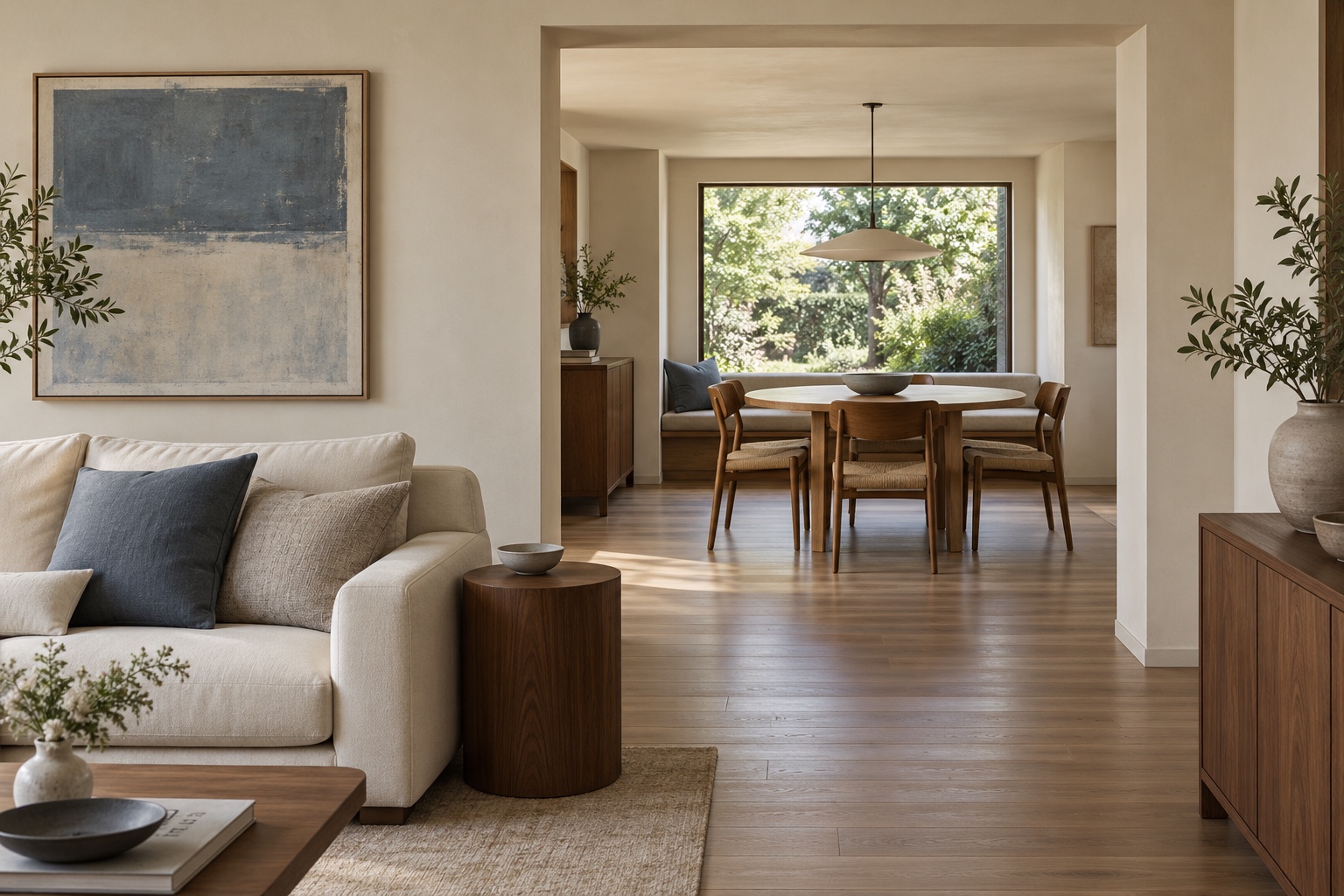 Let neighboring rooms feel connected, without making them identical.
A dark study and a light living room can belong in the same home. A shared wood tone, a repeated accent color, or related artwork can give them continuity while allowing each room its own character.
At Studio Did It, Space Identity™ helps establish that shared direction. It connects your taste, routines, and the experience you want from your home so that individual choices make sense together.
Give symbols a personal role
Feng shui is often presented through symbolic objects associated with prosperity, protection, or relationships.
You can appreciate those meanings without treating an object as a guarantee of a particular outcome.
A small bell might mark the pleasure of arriving home. A rounded ceramic vessel might be something you enjoy seeing every morning. A photograph might remind you of a relationship you want to make more time for.
A Korean moon jar, for example, can introduce a quiet, rounded form into a room. You can choose it for its craftsmanship and presence without assigning it a promised effect on your luck.
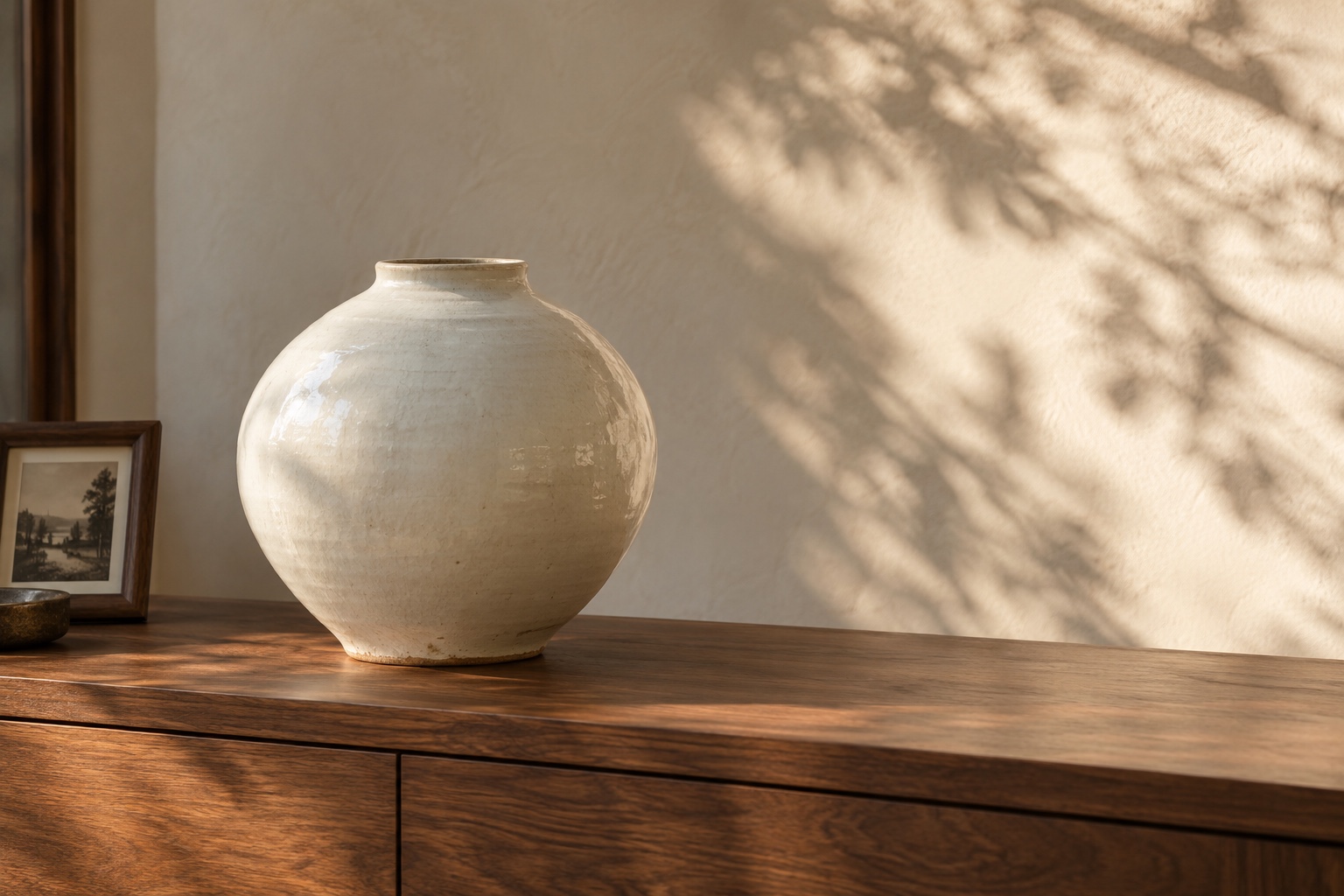 Give meaningful objects room to be appreciated.
The important question is whether you want to live with the object.
Give meaningful pieces enough space to be noticed. Avoid adding something simply because you feel your home is incomplete without a prescribed symbol.
Try a wider view of your home
Before buying anything, choose one place where you spend time and examine its context.
| Look at | Notice | Try |
|---|---|---|
| The window | Light, views, privacy, and nearby activity | Adjust a chair's angle or the window covering |
| The entrance | Door clearance, places to put things, and the first view inside | Remove one obstacle or create a useful landing place |
| Your seat | What is behind you and how people move nearby | Test another position without blocking circulation |
| The doorway | What you see in the next room | Reposition a distracting item or repeat a connecting color |
| A favorite object | Whether it is easy to appreciate | Give it more space instead of adding another accessory |
Live with one change before making the next.
You may discover that the chair was right but its position was wrong. That the room needed privacy rather than decoration. Or that a cherished object was already there, waiting for a better place.
A Korean perspective on feng shui encourages us to consider more than the contents of a room. It invites attention to the place itself and to the relationships within it.
About this article: Pungsu and feng shui include diverse traditional beliefs and practices. This article offers cultural context and SDI's design interpretation, rather than a formal assessment or a promise of changes in fortune.
Further reading: UNESCO: Royal Tombs of the Joseon Dynasty · International Feng Shui Guild: Perspectives and Schools
Explore your space with Studio Did It
Before asking what your home needs next, look at how what is already there works together.
Jihyun Lee is the founder of STUDIO DID IT and has spent more than 25 years designing residential and public interiors, from private homes to the National Library of Korea in Sejong.
The Noticer
For thoughtful people who notice spaces.
What did you notice?
Did something in this story make you see your own space differently?
See what your home already has going for it
Upload a photo of your room and Archie, Studio Did It's AI design assistant, shows where light, views, and the rooms around it can work together.
Look at my room with ArchieAdvertisement. Archie is made by STUDIO DID IT, the studio that publishes Spatia.