The Gifts I Haven’t Unwrapped Yet
Since starting Studio Did It, I have been learning to look beyond what I have and pay attention to who I am being. Along the way, I am discovering how much of life is already here, waiting to be enjoyed.
Short answer A life includes what we accomplish. It also includes the moments we allow ourselves to receive.
For much of my life, I have understood myself through what I have.
Experience. Accomplishments. The work I have completed. The things I have built and collected along the way.
Those things matter. They hold years of effort, responsibility, and care.
But since starting Studio Did It in 2025, I have been asking myself another question:
Beyond what I have, who am I being?
Am I present in my own life? Am I noticing the people and places around me? Can I enjoy a moment without first making it useful?
Recently, I realized something that feels both simple and surprisingly generous.
I still have so many gifts I haven’t unwrapped.
My body. What my eyes can see. What my ears are hearing right now. The textures my hands can feel.
Leaves changing color. Morning sunlight. The sky.
The sudden lift of the heart at a rainbow, a feeling William Wordsworth captured in My Heart Leaps Up. Even as we grow older, an ordinary sky can still surprise us.
A small wildflower that holds our attention longer than we expected. William Blake imagined heaven in a wildflower in Auguries of Innocence. I want to leave room for that kind of attention, too.
A bird drinking dew from a blade of grass, a moment Emily Dickinson noticed in A Bird came down the Walk. While I am hurrying toward the next thing, these small lives are quietly unfolding around me.
Even a single day holds so much for me to feel, enjoy, and marvel at.
Perhaps I have been looking so intently toward the next thing I need to acquire that I have left some of the gifts already here unopened.
I would like to unwrap them a little more slowly. With my eyes, my ears, my fingertips, and my attention.
Learning to receive what is already here
It is easy to keep our attention on what is missing.
The next milestone. The unfinished room. The answer we are waiting for. The version of ourselves we think we should have become by now.
I know that way of looking.
But I want to make room for another one.
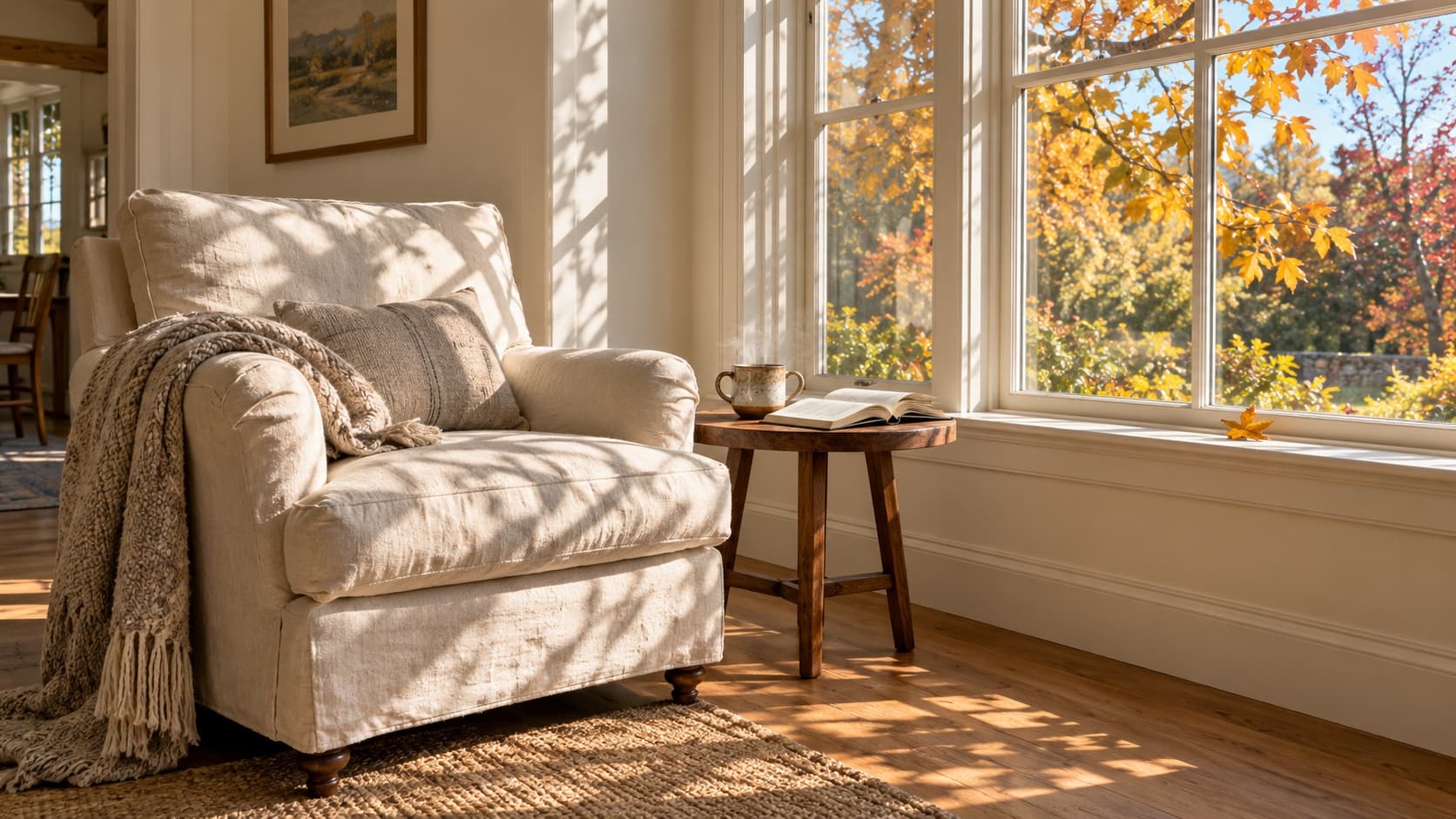
The changing colors of a leaf do not ask me to accomplish anything before I notice them. The warmth of a cup is available while my work is unfinished. Morning light arrives without checking whether I have earned a quiet moment.
There is something deeply comforting about that.
I can still have difficult questions to answer and appreciate the sky. I can care about the future and feel the texture of the chair beneath my hand.
The difficulties remain. So does the beauty.
I want to become more available to both.
What my home can help me notice
After about 25 years as an interior architect, I still care about proportion, materials, and light.
But I am increasingly interested in what happens after a room is finished.
Do we sit in the chair we chose so carefully? Do we notice how the afternoon changes the color of a wall? Do we enjoy the softness of a throw, or mostly see the things that need to be put away?
A home offers sensory experiences throughout the day.
The cool surface of a table. The grain of wood beneath our fingers. The sound of rain near an open window. The warmth of sunlight reaching the floor.
I want to spend more time experiencing my home.
For me, that begins with a small question:
What is here that I have stopped noticing?
I do not need to buy something to answer it. I may only need to sit down long enough to find out.
Making room between pressure and response
My interest in the brain has helped me think about why slowing down can feel difficult.
The amygdala helps process emotionally significant information, including potential threats. The prefrontal cortex supports functions such as attention, planning, and regulating responses. Stress can affect how these connected systems work, making flexible, considered responses harder.
I do not think of them as a bad brain and a good brain. And the movement from “having” to “being” is my personal philosophy, not a scientific division of the brain.
Still, this understanding gives me a useful question:
Can I create a little space between feeling pressure and deciding what to do next?
Sometimes I want that space to begin with something physical.
Feeling my feet on the floor. Looking away from a screen. Noticing a sound without immediately needing to respond to it.
My home cannot make those choices for me. But it can offer a place to practice them.
Moving in a body I want to appreciate
I want exercise to be part of this shift.
I am interested in steady aerobic movement, including Zone 2 exercise, because I want a sustainable way to move without turning every outing into another performance review.
Depending on a person’s fitness and effort, walking, easy jogging, or cycling may provide this kind of exercise. The activity alone does not determine the zone. Intensity matters, and zone definitions vary.
For a useful introduction, Cleveland Clinic’s guide to Zone 2 cardio explains the approach, possible activities, and how to think about effort.
What draws me to it personally is the possibility of moving at a pace that leaves some attention for the world around me.
The leaves overhead. The air on my skin. The sound of my own steps.
I want to appreciate my body while caring for it, without waiting for it to look different or perform better.
At home, supporting that intention might be as simple as keeping my walking shoes somewhere easy to reach.
A small invitation to begin.
A comfortable breath and a little morning light
I also want to make room for meditation and a few moments of gentle breathing.
One rhythm I would like to try is 4-2-4: breathing in gently for four counts, pausing for two, and breathing out for four.
For me, it is a cue to pause. I am not presenting this exact ratio as a proven treatment or a way to activate a particular brain region. The breath should remain comfortable and unforced. If the pause feels unpleasant, I can leave it out; if I feel dizzy or short of breath, I stop and return to normal breathing.
Meditation, too, can be a modest practice: sitting, noticing, and returning when my attention wanders. Research suggests possible benefits for some stress-related symptoms, but results vary and some people find the practice uncomfortable. NCCIH’s guide explains both the evidence and its limitations.
Then there is morning light.
Light helps coordinate the body’s sleep-wake rhythm, as described in NHLBI’s explanation of the sleep/wake cycle.
Once daylight arrives, I would like to spend a little time outside. On dark October mornings, that can happen later.
I also want to enjoy what the light reveals: the color of a leaf, the shape of a cloud, the way an ordinary room looks different for a few minutes.
These are moments I want to be present for.
A place to unwrap an ordinary day
I do not need a new room for this.
I want one comfortable place in my existing home where I can enjoy what is already available.
A seat near daylight. Somewhere to put a warm cup. A little distance from my phone.
If you would like to try something similar, choose a place you already have and spend a few unhurried moments there.
You might notice:
- Something you can see: a shadow, a color, the movement of a branch.
- Something you can hear: rain, a familiar voice, the quiet sounds of home.
- Something you can feel: the fabric beneath your hand, the warmth of a cup, your feet resting on the floor.
You can adapt this to the senses available and comfortable to you. There is no need to complete a checklist.
Simply notice what reaches you.
Perhaps the room does not need anything added at that moment. Perhaps there is already something in it you would like to enjoy.
Who I am being, today
I still want to build a meaningful company. I still care about good work, beautiful spaces, and the future of Studio Did It.
Alongside those ambitions, I want to pay attention to the person I am while pursuing them.
That is part of what I want Studio Did It to stand for: helping people connect the choices they make for their homes with the lives they want to experience inside them.
A life includes what we accomplish. It also includes the moments we allow ourselves to receive.
I am learning to make room for those moments.
To move. To breathe. To listen. To feel the morning air. To notice that the leaves have changed.
What I have tells part of my story.
Who I am being shapes how I experience it.
What is one ordinary gift you would like to notice today?
And there are still so many gifts I haven’t unwrapped.
The Noticer
For thoughtful people who notice spaces.
What did you notice?
Did something in this story make you see your own space differently?
Want to try this in your own space?
Upload a photo of your room and let Archie, our AI design assistant, show you personalized recommendations.
Try Archie FreeAdvertisement. Archie is made by STUDIO DID IT, the studio that publishes Spatia.